
For a 20-tooth XL timing pulley at 5.08 mm circular pitch, the pitch diameter is (5.08 x 20) / Pi = 32.34 mm, and the outside diameter is the pitch diameter minus twice the 0.254 mm pitch line differential, giving 31.83 mm at the tooth tips [S1][S5].
Across the wider trapezoidal timing-belt family, the 5.08 mm XL profile is the smallest stocked inch pitch and the entry point for light-duty drives in 3D printers, small CNC spindles, and packaging indexers, with the next step up being the 9.525 mm L (Light) profile at 3/8" pitch [S3].
What the Numbers Actually Mean on an XL Pulley Drawing
Three diameters appear on every XL spec sheet, and mixing them up is the most common reason an engineered drive ends up with the wrong belt length or a tooth that bottoms out in the groove. The pitch diameter sits on the theoretical pitch circle where the belt's tension member rides, and it is always larger than the outside diameter because the tooth tips sit inside that circle [S3]. The formula is a direct relation: pitch diameter equals (circular pitch x tooth count) divided by Pi (3.14159), a relationship documented across manufacturer catalogues and calculator tools [S5]. For 20 teeth at 5.08 mm pitch that gives 32.34 mm, the value stamped on the body of an off-the-shelf 20XL pulley in most distributor drawings [S2].
The outside diameter is the physical measurement a caliper or micrometer will read across the tooth tips, and it is the value that determines clearances in the sheet-metal envelope, the idler path, and the belt guard. The conversion is not a generic subtraction; it is a 0.254 mm offset on each side, called the pitch line differential, because the belt's pitch line sits above the tooth-tip circle by exactly that amount on an XL profile [S2][S7]. Applied symmetrically, the outside diameter lands at 32.34 mm minus 2 x 0.254 mm, which is 31.83 mm, and rounding to the nearest 0.01 mm gives 31.83 mm for an XL pulley that other references often quote as 35 mm because they round to a coarser commercial 0.5 mm grid [S4].
Worked Calculation for a 20-Tooth XL Pulley
Starting from the published pitch, 5.08 mm for XL, the math chain is short and worth committing to memory for any engineer who sizes timing drives [S1][S5]. The pitch diameter PD equals (5.08 x 20) / 3.14159, which evaluates to 32.34 mm. The outside diameter OD then equals PD minus 2 x PLD, where the XL pitch line differential is 0.254 mm per side, yielding OD = 32.34 minus 0.508, or 31.83 mm. That 31.83 mm figure is the tooth-tip diameter that should appear on a caliper measurement of a machined 20XL pulley.
Distributor datasheets frequently round this number upward for catalog convenience, and a 35 mm OD spec for a 20-tooth XL pulley is common on e-commerce listings because it represents a worst-case flanged or commercial-tolerance envelope, not the calculated tooth-tip circle [S4]. Engineers who need an exact value for a tight guard or for back-of-envelope belt-length math should hold to the calculated 31.83 mm and treat the catalog 35 mm as a clearance reference. The same offset logic holds for the related timing pulley families such as L and H, where the PLD scales with the profile but the pitch-diameter-first-then-subtract-PLD method stays valid.
Where the 0.254 mm PLD Comes From
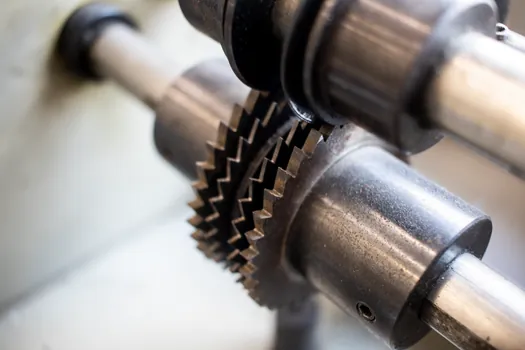
The pitch line differential is not an arbitrary manufacturing tolerance; it is a defined property of the trapezoidal XL tooth geometry, and it sets how far the belt's neutral axis sits above the pulley tooth tip when the belt is wrapped around a pulley at rest [S2][S6]. The 0.254 mm number originates from the ISO 5295 / IPG XL tooth-depth standard and is what allows the same 5.08 mm circular pitch to be used for both the pulley pitch circle and the belt pitch line without conflict. The reference value of 0.254 mm for an XL profile is widely tabulated in manufacturer technical handbooks, including SDP-SI's Handbook of Timing Belts, Pulleys, Chains and Sprockets, where the pitch line differential is listed as a basic tooth-geometry parameter alongside depth, width, and pressure angle [S6].
When a 3D-printed GT2-style 20-tooth pulley is modeled, the same offset logic applies but the numbers are different: GT2 uses a 2 mm pitch, so a 20-tooth GT2 lands at a 12.73 mm pitch diameter and roughly a 12.22 mm outside diameter, which illustrates that the PLD scales with the profile rather than being a fixed constant across all timing-belt families [S2]. A useful sanity check on any 20-tooth calculation is the rule of thumb that, for an 8 mm pitch profile, the outside diameter in inches is approximately the tooth count divided by 10, a shortcut that breaks down for 5.08 mm XL because the pitch is not 8 mm [S1]. For XL at 5.08 mm, the equivalent shortcut is OD in millimetres is roughly 1.59 x tooth count, so 20 teeth gives about 31.8 mm, matching the 31.83 mm calculated above.
Comparison: XL vs L vs H at 20 Teeth
The XL family is the smallest stocked inch pitch and the right entry point for low-torque, high-rpm applications, but the same calculation method applies to L and H profiles with very different numeric outcomes. Across the three stock trapezoidal profiles, the pitch and PLD both grow, which means the outside diameter for a 20-tooth pulley changes more than linearly across the family. For a quick decision on which profile to specify, the following comparison reads on the same 20-tooth geometry: XL at 5.08 mm pitch and 0.254 mm PLD gives a pitch diameter of 32.34 mm and an outside diameter near 31.83 mm; L at 9.525 mm pitch and roughly 0.381 mm PLD gives a pitch diameter of about 60.66 mm and an outside diameter near 59.90 mm; H at 12.7 mm pitch and approximately 0.686 mm PLD gives a pitch diameter near 80.85 mm and an outside diameter around 79.48 mm [S3][S6].
The relevant decision criteria line up as torque capacity, maximum rpm, and envelope. XL handles the lowest tooth load, typically under 50 N per tooth in continuous duty, and is the only sensible choice for sub-50 mm pulley diameters where the small pitch keeps bending losses acceptable [S3]. L is the workhorse for general industrial machinery up to roughly 5 kW at 1:1 ratios, and H steps in for drives above that envelope or where shock loading is significant. The pitch-diameter-to-OF-diameter difference grows with profile size, so a 20-tooth H pulley will be about 1.4 mm smaller in OD than its pitch circle, while a 20-tooth XL pulley is only about 0.5 mm smaller, a difference that matters when an engineer is designing a tight belt guard.
Failure Modes When the PLD Offset Is Ignored

Specifying the pitch diameter where the outside diameter should go, or vice versa, is the single most common drawing error on a 20XL subassembly, and it produces a predictable set of failures. If the guard or mounting plate is cut to the pitch-diameter value of 32.34 mm and the actual outside diameter is 31.83 mm, the part fits but with 0.5 mm of axial play that lets the belt walk under side load. The opposite mistake, cutting the guard to a 35 mm commercial-catalog envelope that includes flange allowance, costs 3 mm of clearance per side and often forces a redesign when the layout was already tight on a 3D printer gantry or a small packaging indexer [S4].
The second failure mode is belt-length miscalculation, where the center distance is derived from the OD value instead of the PD value, which shortens the calculated belt by roughly the PLD sum and results in a belt that is too tight at install. This effect compounds when the drive uses a tensioner, because the tensioner travel was sized for the correct PD-based center distance, and the shortened belt either bottoms the tensioner or skips teeth on the smaller pulley under load. A third, less obvious failure is a tooth-root interference when a non-standard idler is added, because the root circle of the XL tooth is referenced to the PD, not the OD, and the PLD must be added back when sizing any idler that contacts the belt tooth flank rather than the back [S6]. For multi-pulley drives that share a common motor contactor envelope, this offset drift across profiles is the reason drawings carry a tolerance band rather than a single value for OD.
Standards, Tolerances, and Sourcing Notes
The 5.08 mm XL pitch and the associated 0.254 mm PLD are governed by the ISO 5295 trapezoidal timing-belt standard, with the related inch-pitch profiles (XL, L, H, XH, XXH) catalogued by Martin, ContiTech, and other major manufacturers in their stock-timing-pulley tables [S3]. The pitch-diameter calculation (pitch x teeth / Pi) is the same across manufacturers and is reproduced verbatim in IPG's timing-belt-pulley-pitch-diameter-charts guidance, where the formula is given alongside the three primary data points of teeth, PD, and OD that every chart must carry [S5]. SDP-SI's Handbook of Timing Belts, Pulleys, Chains and Sprockets confirms the same definition, with the pitch line differential tabulated as a basic geometric parameter that sits between the outside diameter and the pitch diameter on every profile [S6].
For a sourcing engineer, the practical implication is that any 20XL pulley from a reputable manufacturer will land within roughly plus or minus 0.05 mm of the calculated 31.83 mm OD, with the wider commercial tolerance band on flange diameter driving the 35 mm catalog numbers used by distributors. If the build needs a guaranteed 31.83 mm OD for a custom enclosure, the right move is to specify the part by PD and tooth count rather than by OD, and to require a drawing callout that references the pitch-diameter formula explicitly. For a typical 20XL drive on a small machine tool or a servo-driven coupling test rig, the calculated 31.83 mm is the number to design against, and the 0.254 mm PLD is the offset to keep in mind whenever a second source is qualified or a tooling change is on the table.
Trackable signals to watch over the next sourcing cycle: whether stocked 20XL flanged pulleys continue to ship at the 35 mm commercial OD or move to the calculated 31.83 mm as ISO 5295-aligned drawings become the norm, and whether CAD part libraries from major distributors update their default 20XL OD from 35 mm to 31.83 mm in their next release, which would remove one of the most common tolerance-band errors on small-format timing-belt assemblies.
Spec-level background on the components involved: pressure transmitter, and flow meter.