
A clamp-hub single-disc servo coupling is the most common flexible coupling specified on small servo and stepper shafts, where bore ranges of 1/8 in to 1-3/4 in (3-45 mm) and torque ratings from a fraction of a newton-metre up to roughly 100 Nm cover the bulk of motion-control axis designs [S2][S3]. The defining feature is one or two thin metallic discs captured between two clamp hubs that grip the shaft with a through-bolt or radial screw, producing a backlash-free, torsional-stiff joint that compensates for angular, axial, and (in double-disc designs) parallel misalignment [S1][S4].
Clamp-hub single-disc designs from Miki Pulley, Ruland, R+W, Zero-Max, NBK, Misumi and Lovejoy overlap in bore envelope and torque class but diverge on disc material, hub body, inertia, and allowable misalignment [S1][S2][S3][S4][S5][S7][S8]. For stepper/servo axes in the 50 W to roughly 750 W range, where rotary encoders read directly off the back of the motor, a clamp-hub disc coupling is the default pick over set-screw jaw couplings because it removes the shaft marring and micro-slippage that disturb closed-loop feedback [S6]. A typical miniature control-flex single-disc unit pairs aluminium hubs with a stainless steel disc pack, weighs on the order of tens of grams, and costs in the USD 15-80 retail range for the smallest frame sizes [S4][S8].
Bore Range, Hub Materials, and Torque Class
Standard miniature clamp-hub single-disc couplings are stocked in bore diameters from 1/8 in (3 mm) up to 1-3/4 in (45 mm), giving the family near-universal coverage of NEMA 11, NEMA 17, NEMA 23, NEMA 34 and metric servo output shafts [S2]. Aluminium is the dominant hub body for sizes up to roughly 100 Nm because it cuts rotational inertia by a factor of three versus steel, while stainless steel hubs and stainless disc packs are used in washdown, medical, and semiconductor tool builds where corrosion and outgassing rule out aluminium [S5][S6].
R+W's clamp-hub single-flex servo disc line is rated 25-100 Nm, positioning it at the upper end of the miniature window and the lower end of the industrial disc coupling range [S3]. Misumi's clamp-hub 1-disc and 2-disc servo couplings specify an aluminium body with a steel disc pack, marketed for high torsional rigidity and zero-backlash behaviour in the typical 5-50 Nm class [S7]. The Lovejoy MDSD-63C (Miki-style 63 frame) clamps a 1 in bore and transmits 89 in-lb (10.1 Nm) at its smallest configuration, a useful reference for sizing small stepper-to-lead-screw connections [S8].
Single-Flex vs Double-Flex: Misalignment Budgets
Single-disc (single-flex) couplings accept only angular and axial misalignment, with the disc stack bending to absorb small shaft-to-shaft angle errors and the clamp hubs sliding along the bore axis to absorb endplay [S3][S4]. Typical allowable angular misalignment on a 25-50 Nm single-disc clamp-hub coupling is on the order of 1-3 degrees static, with axial travel of roughly 0.2-1.0 mm depending on frame size, and essentially zero parallel-offset capability [S1][S3].
Double-disc (double-flex) clamp-hub couplings add a second disc pack so the unit can absorb parallel misalignment as well, which is the typical reason designers move from single- to double-disc when a gearhead or pinion introduces radial offset on the driven shaft [S2][S3]. The trade-off is lower torsional stiffness per disc stack and slightly higher inertia, since two disc packs and the longer spacer hub all sit in the inertia path. For low-inertia servo axes, the disc coupling comparison most often comes down to single-flex for the cleanest encoder signal versus double-flex for shaft-misalignment tolerance on longer, less rigid driven shafts.
Clamp-Hub Mechanics: Why Clamp, Not Set Screw
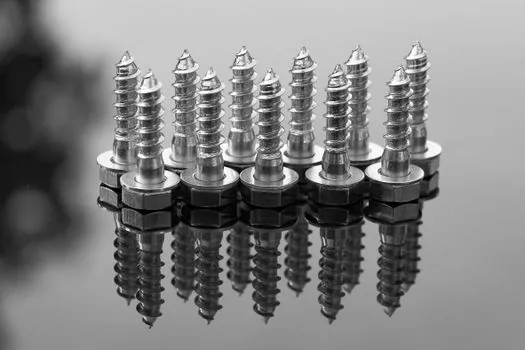
Clamp hubs use a through-bolt or radial screw that compresses a slit in the hub bore, generating full 360-degree contact pressure on the shaft instead of the single point load a set screw produces [S4][S6]. The result is zero backlash at the shaft-to-hub interface, no marring of the shaft surface, higher permissible torque for a given bore, and reliable retention under reversing loads, which matters on a servo axis that cycles direction every few milliseconds [S1][S4][S7].
Zero-Max frames the clamp-hub advantage around positive, secure shaft connection that survives the high-cyclic-load environment of a closed-loop servo, while Misumi lists high torsional rigidity, high torque density, and zero backlash as the three pillars of the clamp-hub servo disc family [S4][S7]. NBK extends the same idea into the metric miniature space, with single- and double-disc disc couplings explicitly aimed at servo motor drives where the encoder must read shaft position without the micro-slip that set-screw hubs introduce [S5]. The practical effect, in the field, is that a clamp-hub design lets a designer hold tighter encoder following error budgets on small axes without adding a separate keyed interface.
Selection Criteria and Comparison: Single-Disc Clamp vs Alternatives
For miniature servo and stepper shafts, four flexible coupling families compete in the same bore envelope: clamp-hub single-disc, clamp-hub double-disc, miniature jaw (spider), and beam/helical. On four decision criteria, the comparison reads as follows. First, torsional stiffness: single-disc clamp-hub is the highest, typically several thousand Nm/rad for the 25-50 Nm class, with double-disc roughly half that, jaw couplings significantly lower due to the elastomer spider, and beam couplings moderate but with the highest angular compliance per Nm of torque. Second, backlash: single-disc and double-disc clamp-hub are zero-backlash, jaw couplings are near-zero with a soft spider, and beam couplings are zero-backlash by design. Third, parallel misalignment capacity: only the double-disc clamp-hub and the jaw coupling absorb meaningful parallel offset, while the single-disc and beam both fail at small radial loads. Fourth, inertia and cost: jaw and beam couplings generally win on inertia and cost at the very small end, while disc couplings win on stiffness and on encoder-loop fidelity where the closed-loop bandwidth is high. Across most 50-750 W servo axis designs, the clamp-hub single-disc is the default, with double-disc selected when the servo drive and driven load cannot be co-aligned tightly, and miniature jaw or beam selected only when the axis is open-loop stepper or the misalignment budget is dominated by parallel offset [S2][S3][S4][S5][S6].
Failure Modes, Limits, and Standards Touchpoints
Single-disc clamp-hub couplings fail in three predictable ways: disc fatigue fracture from cyclic torsional overload, hub-shaft slip from under-torqued clamp screws or undersized bores, and balance/vibration issues on high-rpm spindles where the disc pack mass is non-negligible [S1][S4]. Disc fatigue is governed by the disc material (typically 300-series stainless or spring steel), the stack configuration, and the operating torque relative to the rated peak, with manufacturers publishing peak-to-continuous torque ratios and recommending derating for reversing duty cycles [S1][S3][S7]. Hub-shaft slip is almost always an installation error, a clamp screw that was not torqued to spec, or a bore that was specified too large for the shaft; clamp-hub torque capacity scales with friction coefficient, contact area, and clamp screw preload, so a polished shaft in a clean bore under-rated roughly 30-50% versus a keywayed or roughened shaft [S4][S6].
For miniature couplings, there is no single dominant ISO or AGMA design standard equivalent to API 610 or ASME B16.34 in pumps, so selection leans heavily on manufacturer ratings, bore tolerance tables, and application notes. Bore-tolerance class is normally an h7 (metric) or equivalent inch interference fit on the shaft, and balancing grade is rarely specified below 6,000 rpm for sub-100 Nm couplings [S1][S5]. For encoder-loop stepper retrofits, the real spec to watch is the servo motor rated torque and inertia mismatch, not the coupling itself, since a correctly sized clamp-hub disc coupling will not be the limiting factor in the drive train if the bore and torque ratings are observed.
Where This Coupling Is the Right Pick (and Where It Is Not)
Clamp-hub single-disc couplings are the right pick for short, stiff, encoder-feedback servo axes on stepper or servo motors up to roughly 750 W, in CNC tool changers, semiconductor indexers, small robotics joints, and laboratory automation where zero backlash, low inertia, and high torsional stiffness matter more than parallel-offset tolerance [S1][S3][S4][S5][S6]. They are also the right pick on stainless or washdown equipment where the standard stainless disc/aluminium hub configuration is acceptable, or where full stainless is specified for cleanroom service [S5].
They are the wrong pick on long, flexible driven shafts with significant parallel offset, on high-rpm spindles where balance grade is critical and inertia budgets are tight, on applications with shock loads above roughly 2x the rated torque, and on food-grade or medical installs that require full stainless or polymer-certified bodies. For miniature encoder-shaft retrofits where the back of a stepper is being coupled to a leadscrew, the parallel-side comparison against miniature jaw couplings is the closer decision, and the trade-off is captured in the spec-level selection guide for miniature jaw couplings on encoder feedback shafts. When the question is stepper axis stiffness versus compliance, the jaw vs beam coupling comparison is the more useful reference.
The next trackable signals for specifiers are the bore-by-frame tables in the 2026 Misumi, Ruland, R+W, and NBK catalogues, the published torque-vs-misalignment curves for each frame, and the published inertia values for aluminium vs stainless hub bodies on the same frame size, since the gap between those two numbers is the single biggest spec-driven cost lever in a miniature servo axis.