The voltage class on a servo drive is set by the DC bus it can sustain, and that bus is the single biggest variable in how much torque a small-frame servo motor can deliver before back-EMF clips the current loop. 230 VAC and 400 VAC units solve the same motion problem at different points on the copper-versus-cable curve.
For sub-1 kW auxiliary axes (conveyor diverters, label stations, small pick-and-place, electronic cam slaves, indexing tables), 230 VAC single-phase inputs remain the most common fit. Once continuous shaft power rises past about 0.75 kW, or the axis runs faster than roughly 3000 rpm, the same motor on a 400 V bus delivers noticeably more torque per amp without enlarging the drive footprint [S1][S2].
Voltage Class Definitions and Where Each Sits
Industrial servo drives are commonly offered in two AC input families: 100-240 VAC (effectively 1-phase 230 V or 3-phase 230 V) and 220-480 VAC (3-phase 400/480 V) [S2]. The internal DC bus sits at roughly 1.41× the AC RMS, so a 230 V class bus lands near 325 VDC, while a 400 V class bus lands near 565 VDC [S1]. That ratio is the root of every downstream difference.
Kollmorgen's AKD2G explicitly spans 3×240 / 400 / 480 VAC with single-axis ratings of 3, 6, or 12 Arms continuous and dual-axis 3 or 6 Arms continuous per axis, while the AKD adds 3 and 24 Arms variants and a 24 Arms step for larger frames [S2]. Parker PSD1-M is the opposite end of the spectrum: a multi-axis module where each axis module drives up to three servo motors off 3×230 VAC ±10% [S6]. Yaskawa's Sigma-X 400 V class, released to sales in 2025-05, was added specifically to let European and global OEMs standardise on 400 V without parallel 200 V SKUs [S8].
Selection Criteria: Match the Bus to the Winding
The motor winding decides which drive class is correct, not the other way around. Kollmorgen's 230 V windings ship in metric and NEMA frame sizes, with the 400 V windings added for higher-speed or higher-torque variants in the same frames [S2][S5]. Pairing a 400 V drive to a 230 V winding typically forces the drive into a current-limit foldback at the top of the speed range; pairing a 230 V drive to a 400 V winding starves the motor of voltage headroom and reduces continuous torque [S1].
Engineers should build a voltage budget before specifying: include ±10% mains tolerance, cable drop, motor back-EMF at top speed, and any regen rise, then add 10-15% headroom on both ends [S1]. For a 230 V single-phase 0.4 kW axis on a 5 m cable, the budget is tight but workable; for a 0.4 kW axis mounted 25 m away in a long-cable cell, the 400 V class is the more forgiving choice because cable impedance is a smaller fraction of the bus voltage [S1][S4].
Comparison: 230 V Class vs 400 V Class for Small Axes
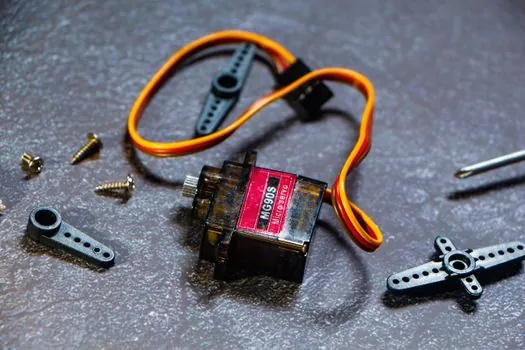
Four criteria separate the two options cleanly:
Power range. 230 V single-phase units dominate the 0.05-0.75 kW continuous range; Parker's compact low-power single-axis drive at 230 VAC is rated 0.95 kVA, which maps to roughly 0.75 kW continuous [S7]. 400 V three-phase units cover 0.4-7.5 kW in the same small-frame form factors, with Kollmorgen's 400 V AKD family starting at 3 Arms continuous and stepping to 24 Arms for larger loads [S2].
Cable and cabinet. Higher bus voltage means lower current for the same mechanical power, so I²R losses drop, conductors shrink, and the drive can be physically smaller [S1]. In practice this is the difference between 2.5 mm² and 1.5 mm² motor cables on a 0.75 kW axis, and between a 1.5 kW-rated 230 V drive and a 1.5 kW-rated 400 V drive that runs cooler [S1][S2].
Speed and torque headroom. Back-EMF scales with speed; once it approaches the bus voltage, the current loop loses authority and torque collapses [S1]. A 400 V bus on the same motor pushes the back-EMF ceiling up by about 73%, so the same axis can run at higher mechanical RPM before the drive must derate, or it can deliver more continuous torque at the same speed [S1][S2].
Supply availability. European and most global industrial sites ship 400 V three-phase as the building standard, while North American light-commercial and many retrofit panels only expose 230 V single-phase or 208 V three-phase [S8]. The drive family is therefore as much a panel-builder decision as a motion decision.
Who 230 V Is For, and Who 400 V Is Not For
230 V single-phase or three-phase drives fit small auxiliary axes under roughly 0.75 kW continuous, machines that already have a 230 V distribution, and retrofit cells where pulling a new three-phase feeder is impractical [S1][S6]. They are also the right answer for laboratory, benchtop, and tabletop equipment where wall-socket single-phase is the only available supply.
400 V three-phase drives fit main machine axes above 0.75 kW, high-speed spindles and servos above 3000 rpm, long-cable installations over 10-15 m, and any new European or global machine designed to a single worldwide SKU [S2][S8]. They are the wrong answer when the cabinet only has single-phase 230 V available, when the motor winding is a 230 V variant, or when a low-power auxiliary axis is sharing a 400 V bus solely because the cabinet designer wanted one drive family across the machine (in that case, a 230 V drive on a small stepper drive-style axis is the cleaner pick) [S1].
Use Cases From Current Catalogs
Two-channel tightening drives from SIEB & MEYER run off 3×230 VAC or 4×400 VAC, 50/60 Hz, with three power ranges per channel, illustrating that the same mechanical axis can be ordered against either mains class [S3]. SPiiPlus drives from ACS ship in 1, 2, and 4-axis modules with AC inputs and currents up to 90 A, with the lower-current 230 V variants dominating the 0.1-1.5 kW axis range [S10]. Elmo's general guidance is that drives rated 230 VAC and above cover industrial automation, CNC machinery, and high-power motion systems, with the 230 V class reserved for smaller axes and the 400-480 V class for the rest [S1].
Limitations and Failure Modes Worth Naming
Under-sizing the bus voltage shows up as torque sag at high speed, not as a fault: the axis simply fails to hit the commanded RPM under load, and the drive's current loop starts oscillating as it tries to compensate [S1]. Over-sizing the bus without a matching motor winding can push the drive into PWM duty-cycle saturation and reduce control bandwidth. Voltage transients outside the rated window trigger protective DC-bus over-voltage shutdowns during regen events, which is why the voltage budget must include the regenerative rise, not just the steady-state tolerances [S1][S2].
230 V single-phase units also have a real asymmetry on three-phase regeneration: energy returned to the bus on a 230 V single-phase drive must be absorbed by a braking resistor sized for the full axis kinetic energy, whereas a 400 V three-phase drive spreads regen across the bus capacitance and tolerates a higher inertia-to-resistor ratio. Long motor cables on a 230 V drive also demand EMC filters and ferrites that the equivalent 400 V installation can drop, because the dV/dt is the same absolute value but represents a smaller fraction of the larger bus voltage [S1][S2].
Standards, Sourcing, and Trackable Signals

Drives in this voltage class are typically designed to IEC 61800-3 for EMC and IEC 61800-5-1 for electrical safety, with functional-safety options (STO, SS1, SS2, SLS) layered on top per IEC 61800-5-2; vendors in this segment publish those declarations on a per-model basis [S2][S4]. For sourcing, expect a lead time of 6-12 weeks on 400 V class units in 2026, and shorter on 230 V class because the latter is the higher-volume global SKUs; Kollmorgen, Parker, Elmo, ACS, Festo, Sieb & Meyer, and Yaskawa all carry families that span the relevant current and power range [S1][S2][S3][S4][S6][S7][S8][S10].
Trackable signals: Yaskawa's Sigma-X 400 V sales launch in 2025-05 [S8] suggests a 2026 wave of OEMs standardising global machines on 400 V only; watch for the same wave in CNC builders sourcing from Kollmorgen AKD2G at 400 VAC [S2]. For readers cross-referencing related motion decisions, the AGV safety laser scanner sizing guide covers another small-axis sensor stack that pairs with these drives, while the 42CrMo4 vs 34CrNiMo6 shaft spec piece covers the gearbox side of the same mechanical axis. To see how the same spec-first logic applies to a non-motion decision, the 200 A load-break elbow vs 600 A dead-break comparison follows a parallel structure.