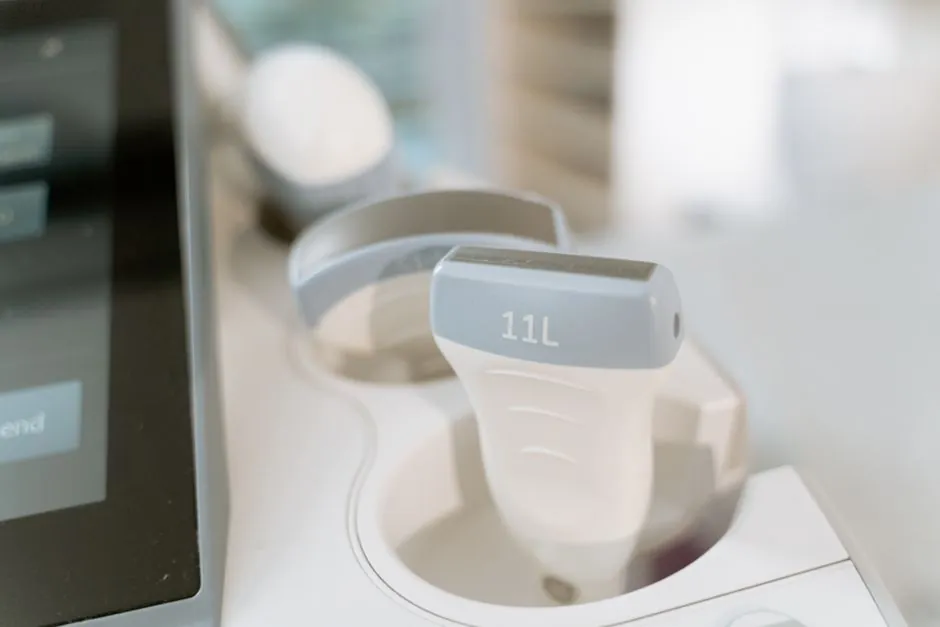
Modern Vertical Lift Modules index trays in 25 mm vertical increments and rescan every load on return, so each tray closes to the part plus a small clearance instead of a fixed shelf pitch [S1][S2][S3].
The pitch is identical across the three vendors reviewed (Kardex Remstar Shuttle XP, Arcenciel/Hocom Optiflex, Raymond Central Logicontrol): trays ride on a central extractor and adjust to ceiling height in 100 mm modular steps, with up to six access openings and roughly 85% floor-space recovery versus conventional shelving [S1][S3].
What 25 mm pitch means for storage density
Storing in 25 mm steps, roughly 1 inch, gives 40 vertical positions per metre of column height and lets a VLM pack mixed-height parts into the smallest column that still clears the tallest SKU on each tray [S1][S2]. On the Shuttle XP, every return-to-stock event triggers a CubeStar height scan, and the controller re-files the tray to the lowest slot whose clearance matches the measured load [S1]. The Optiflex implementation in Hocom/Arcenciel VLM modules repeats the same 25 mm scan-and-relocate on every put-away, which is what the vendor markets as dynamic slotting [S3]. For high-throughput order fulfillment, that dynamic slotting is also the mechanism that lets a VLM deliver SKUs to an operator with a guided pick-to-light or laser pointer, instead of forcing the picker to walk the aisle as covered in VLM vs Carousel: Picking Throughput, Footprint, and SKU Fit.
How the automatic tray-height scanner works
The 2012 Sapient Viper redesign is the earliest documented commercial deployment of the same principle: a VLM with an integrated tray-height scanner and re-engineered trays, claimed to lift storage density by 50% or more versus its non-scanning predecessor [S4]. The current generation extends that idea with logicontrol firmware that scans the tray plus its load on every transaction, not just at commissioning, and chooses the lowest 25 mm slot that clears the measured profile [S2]. Practically, the scan happens while the extractor is in motion, so the scan-to-relocate loop adds no perceptible cycle time on a tooth-belt drive and lets the controller co-mingle trays of different depths and heights in a single column [S1][S3].
Selection criteria: pitch, tray mix, and ceiling height
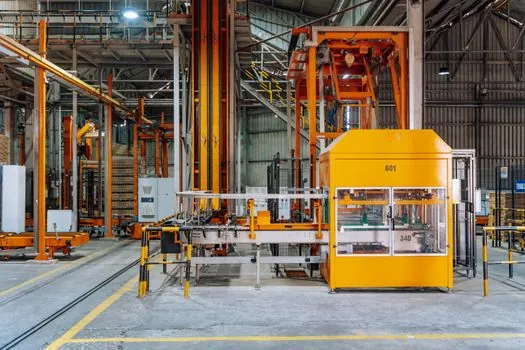
Four numbers drive a VLM spec: column height steps of 100 mm, tray-pitch resolution of 25 mm, individual tray capacity (typically up to around 1,000 kg per tray on heavy-duty builds), and unit-level weight management to prevent overload on either side of the extractor [S1][S3]. The 100 mm vertical step is the building-level dial (you choose column height to ceiling), while the 25 mm pitch is the SKU-level dial (the controller packs the column as SKUs and min/MOQs change), and the two stack independently. For buyers comparing VLM to a vertical carousel on the same footprint, the 25 mm pitch is the largest single density contributor, because carousels carry fixed-height shelves and waste the air above short parts; this is detailed in VLM vs Vertical Carousel: Spec-Driven Selection for AS/RS Buyers.
Where dynamic height scanning fits, and where it does not
Automatic tray-height scanning pays off when SKU height is variable, when min/MOQ changes week to week, and when operators are picking, not bulk loading; Kardex Remstar's own 2025 fulfilment guide leans on the same dynamic-slotting claim, pairing the height sensor with pick-to-light and laser pointer guidance at the access opening [S5]. Independent vendor literature makes the same point in plain language: trays move closer together on demand, so a 3 m column that held 60 fixed shelves can hold a substantially larger number of mixed-height trays [S6][S9]. The same controls make a VLM a poor fit for goods that cannot be machine-handled at the access opening (full pallets, oversize crates, or items that must be loaded by forklift), and the storage-cage and tote-handling enclosures on a sister product line address a different problem, so for non-palletable bulk storage a storage cage or storage handling cell is the more honest spec than a VLM column.
Limitations, failure modes, and operating constraints
Three constraints recur across vendor docs. First, the 25 mm figure is a storage pitch, not a sensor resolution: vendor literature states the step but does not publish the underlying laser or photoelectric sensor's millimetre accuracy, so users should plan for a small safety clearance above the tallest point of the load [S1][S3]. Second, the unit-level weight management system trips on aggregate tray plus load, so overstuffing a single tray can halt the extractor even if column capacity is not reached [S1][S3]. Third, shutter doors, useful for drafts, dust and operator safety, add a few seconds per cycle, which is acceptable for picking but visible in pure parts-to-line workflows [S1][S3].
Standards, sourcing, and what to verify on a quote
No ISO or EN standard governs the 25 mm storage pitch; the figure is a vendor design choice that has converged across Kardex Remstar, Hocom/Arcenciel, and Raymond Central implementations [S1][S2][S3]. A spec-side process engineer should verify the 25 mm specification noted in vendor literature and confirm that the unit automatically scans the height of the product on each tray rather than only at commissioning, consistent with the 2012 industry report on redesigned VLM tray-height scanning that links scanning behaviour to increased storage density [S1, S4]. Buyers comparing a VLM against a vertical carousel on the same site should also weigh the laser-pointer and pick-to-light accessories, which translate the 25 mm pitch into measurable pick-rate gains at the access opening [S5][S8]. The automatic level and automatic molding line references on this site sit one level upstream in the production flow, where a VLM is typically fed by a fixed-pitch conveyor or stacker crane and where the 25 mm tray-pitch becomes a real constraint on the upstream buffer.
Trackable signals: Kardex Remstar's 2025 order-fulfillment guidance continues to bundle the 25 mm pitch with pick-to-light and laser-pointer accessories as a single product story [S5], and SSI Schaefer's LOGIMAT-class VLM literature published on 2026-07-21 treats tray height adjustment as a baseline expectation rather than an option [S8], so any vendor still quoting fixed-pitch trays on a 2026 quote is a negotiation target.