2B, BA, and No. 4 are the three stainless steel sheet finishes spec sheets actually debate, and they differ primarily in production route, surface roughness, and grain structure rather than alloy chemistry [S1][S2].
2B is a cold-rolled, annealed, pickled, and lightly temper-passed mill finish with a typical Ra of 0.1–0.5 micrometers and a non-directional matte appearance; BA is a bright-annealed finish produced in an oxygen-free furnace with Ra of 0.05–0.1 micrometers; No. 4 is a mechanically brushed finish produced by passing abrasive belts of roughly 120–180 grit across a 2B base [S1][S2][S3][S4].
Process route and how each finish is actually made
A No. 2B finish follows a four-step route: cold rolling, annealing, acid pickling to strip mill scale, and a final skin-pass through polished rolls that delivers a smooth, slightly reflective, bright grey surface without a directional grain [S3][S4].
BA (bright annealed) shares the cold-rolling and annealing steps but runs the anneal in an oxygen-free atmosphere, so no high-temperature scale forms and the strip exits the line already shiny, eliminating the secondary buffing that 2B would otherwise need for a mirror look [S2][S3].
No. 4 is not a mill finish at all: fabricators start from a 2B coil and run 120–180 grit abrasive belts across the sheet, then blend with a finishing pad to create a uniform satin grain that runs in one direction [S2][S4]. The resulting sheet is a stainless steel product with an intentionally directional texture, and Cut2Size Metals specifies 150–180 grit for its stocked #4 sheet [S4].
Roughness, reflectivity, and fingerprint behavior
Quantitative roughness sets the three finishes apart: 2B sits at Ra 0.1–0.5 micrometers (with electropolishing it can drop to 4–32 microinches, or 0.1–0.8 micrometers), BA sits lower at Ra 0.05–0.1 micrometers, and No. 4 carries a higher Ra dictated by the abrasive grit, on the order of 0.4–0.8 micrometers depending on belt grade [S1][S2].
Reflectivity tracks roughness inversely: BA is near-mirror straight off the mill, 2B is a soft cloudy-mirror grey, and No. 4 is a satin sheen with visible directional grain that designers choose specifically to suppress glare in commercial kitchens and elevator interiors [S2][S4].
Fingerprint behavior is the other side of the same coin. Cut2Size Metals rates #8 mirror as high-visibility for prints, 2B as low-to-moderate, and No. 4 as moderate when cleaned with the grain, which is why BA/8-mirror panels are routinely shipped with a protective PVC film that is removed only after install [S2][S4]. The smoother the surface, the faster the chromium oxide passive layer reforms, which is the underlying corrosion-resistance argument for BA over 2B in hygienic service [S2].
Comparison matrix: 2B vs BA vs No. 4 on selection criteria
Side-by-side on the four criteria procurement teams actually weight: [S4]
Cost and lead time: 2B is the cheapest and fastest because it is a stock mill finish carried by every service center, while No. 4 adds a belt-polishing step (premium typically 15–30% over 2B on 304 sheet, depending on grit and gauge), and BA commands the highest premium because of the controlled-atmosphere anneal and the PVC film requirement [S1][S2][S4].
Cleanability and hygiene: 2B and BA both have low surface profiles with fewer crevices for bacterial build-up, which is why food, dairy, brewery, and pharmaceutical specs default to one of them; No. 4's directional grooves can trap soil and require wiping along the grain [S2][S3].
Corrosion resistance: smoother means faster passivation, so BA is the most corrosion-resilient of the three, 2B is close behind, and No. 4 sacrifices some passivation speed in exchange for its brushed look [S2].
Formability: 2B is the workhorse for deep drawing, bending, and welding because its smooth temper-passed skin tolerates strain without cracking; No. 4 and BA are usually specified on parts that see less forming, since the directional grain or mirror surface can be distorted by stamping [S1][S3].
Matching finish to use case
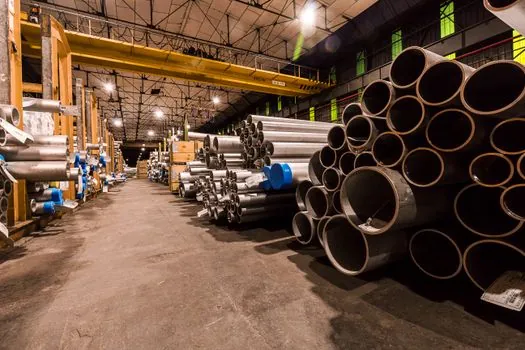
Industrial hygienic service (tanks, brewery vessels, conveyor frames, food-grade stainless pipe skids, pharmaceutical equipment): 2B is the default. ASTM A480 lists 2B as a general-purpose cold-rolled finish for cookware, small tanks, and pharmaceutical equipment, and the No. 2D variant is preferred for deep drawing and chemical hardware [S3].
Architectural and high-visibility surfaces (elevator doors, splash-backs, solar frames, mirrored column cladding, premium retail fit-outs): BA is the right call because it leaves the mill already reflective, ships under PVC film, and lets the designer skip downstream polishing [S2].
High-traffic and fingerprint-prone surfaces (kitchen splashbacks, restaurant equipment, elevator interiors, architectural trim): No. 4 is the standard answer. Its 150–180 grit grain is widely available on 304 sheet, and the directional pattern hides minor scratches far better than 2B or BA [S2][S4].
Heavy-gauge structural applications: this is where No. 1 (hot-rolled, annealed, pickled) takes over rather than any of the three cold-rolled finishes, since it is specified for elevated-temperature and heavy-section service where surface appearance is secondary [S3][S8].
Standards, designations, and grade availability

Finish designations for sheet and strip are defined by ASTM A480 in North America, with separate nomenclature for sheet (greater than 24 inches wide) and strip (less than 24 inches wide), and the same numerical code can mean slightly different things across mills, so procurement should always confirm the mill's data sheet before signing off [S3].
On grade availability, 304 is the universal default for all three finishes; Cut2Size Metals lists 2B stock in 304, 316, and 430, No. 4 in 304, and 2D in 309, with other grades available on request [S4]. No. 4 is generally produced on a 2B base in 304 for cookware and architectural trim, while 2B in 430 dominates appliance and equipment applications where cost matters more than maximum corrosion resistance [S1][S4].
One process nuance worth flagging: a stainless steel supplier's "BA" means bright annealed in coil form, not the same as a post-polish to No. 8 mirror. The two are often confused in RFQs, and a buyer who wants true No. 8 needs to add a separate mechanical polishing step on top of BA stock [S2][S4].
Limitations and failure modes to plan around
No. 4 cannot be repolished in the field easily: once a 120–180 grit grain is established, blending scratches in the field requires the same belt grade and direction or the repair shows, which is why fabricators stock matching grain-direction spares for architectural projects [S2].
BA and No. 8 mirror are both unforgiving under mechanical damage, so PVC film must stay on through welding, handling, and erection, and gloves are mandatory on install because finger oils disrupt the passive film before it reforms [S2][S4].
2B can still arrive with light surface scratches and a slightly duller look than the catalog photo, because the "mill finish" tolerance band allows for cosmetic variation, and it ships without protective film; if a job requires pristine visible surfaces, the spec should call for upgrade to BA or a subsequent polish [S4].
Cross-specifying a stainless pipe line in 2B and a vessel in BA is normal, but the two finishes will age and reflect light differently in the same plant, which matters in architectural and pharmaceutical cleanroom builds where visual consistency is part of the acceptance criteria [S2][S3].
Decision rule of thumb for the next RFQ

Default to 2B on 304 or 316 for any industrial, hygienic, or fabricated part where appearance is secondary and formability matters; step up to BA on 304 for architectural panels, elevator cladding, and any surface that must arrive reflective without a secondary polish; and pick No. 4 on 304 for high-traffic, glare-sensitive, or fingerprint-prone surfaces where the satin grain is part of the design intent [S1][S2][S3][S4].
For buyers weighing finish against other spec variables, the same logic that pushes 316L into offshore camera housings, as covered in 316L stainless steel camera housings for offshore sites, applies: smoother, cleaner surface plus higher alloy equals longer passive film recovery in chloride exposure, and the right finish is the cheaper half of that equation.
Trackable signal: ASTM A480 finish tables and mill data sheets for 304/316 2B coil; request a sample panel of the named finish in the specified thickness before release, since Ra and grain tolerance bands are not visually obvious in a PDF [S3].
Detailed specification references: alloy steel.