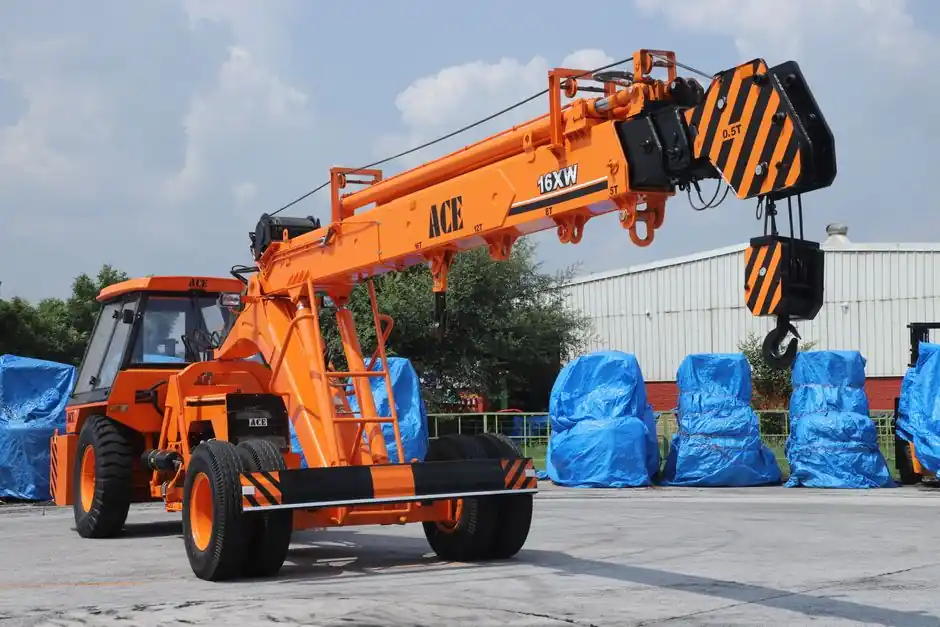
A 3.5 t GVW chassis can carry a loader crane whose lifting moment falls in the 3-14 tm bracket, but the working-point lift at full radius is closer to 1-3 t once the chassis payload and stabiliser geometry are netted out [S1][S3].
For comparison, dedicated truck cranes start at 20 t minimum lift and run up to 500 t, so the 3.5 t chassis market is a different machine class entirely: integrated lift-and-carry rather than pure hoist duty [S4].
Where the 3.5 t Chassis Fits in the Tonnage Ladder
The 3.5 t chassis sits at the bottom of the truck-mounted crane ladder, below the 8 t, 12 t, 16 t and 20 t steps commonly listed in buying guides for Asian-built articulated loader cranes [S4]. Standard class steps in current buying references are 2 t, 3.2 t, 4 t, 5 t, 6.3 t, 8 t, 10 t, 12 t, 16 t and 20 t, with each step reflecting a different chassis GVW and frame reinforcement level [S4].
For the lightest steps, the manufacturer offers a 3-14 tm small-loader-crane range, marketed specifically for compact trucks and minimal footprint requirements; the lower end of that range aligns with a 3.5 t carrier [S1]. Above 14 tm, the crane climbs out of the 3.5 t chassis envelope and the next practical platform is the 8 t step, which carries a frame width near 2,300 mm and a stabiliser spread of about 4,600 mm [S3].
A useful sizing reference for the 3-5 t crane class on a 3.5 t chassis is a frame width of 2,100 mm, stabiliser span of 3,800 mm, tyre width of 220 mm, and ground clearance of 260 mm, per a chassis planning table published in 2026 [S3].
Chassis Constraints that Cap Crane Capacity
The chassis, not the crane spec sheet, is the binding limit on a 3.5 t platform. Three factors dominate: frame beam section, axle rating, and engine-driven hydraulic flow. For an 8 t crane step, the chassis frame uses a partial three-layer beam at 300 mm thickness, against a 250 mm double-layer on a general cargo chassis of the same GVW [S4][S5].
Axle selection scales the same way. A general cargo chassis at this class typically runs lighter axles, while a truck-mounted crane chassis upgrades to Dana-pattern rear axles in 10 t, 11.5 t and 13 t ratings [S5]. On a 3.5 t chassis, the rear axle is correspondingly lighter, so the moment the crane is told to lift at full radius the rear axle and the parking brake end up as the weak link rather than the boom itself.
Hydraulic supply, not the boom, is the third binding limit. On a 12 t XCMG crane step, the double-pump system delivers 100 L/min against 63 L/min for a single-pump configuration, and the higher flow is what enables simultaneous slewing and lifting without starving the actuators [S5]. On a 3.5 t chassis the engine is smaller, so the power take-off envelope, the engine-driven pump flow available at idle, is roughly half of that, and that is the real reason the working lift at full radius is closer to 1-3 t than to the headline crane figure.
3.5 t vs 8 t vs 12 t Chassis: Side-by-Side Geometry
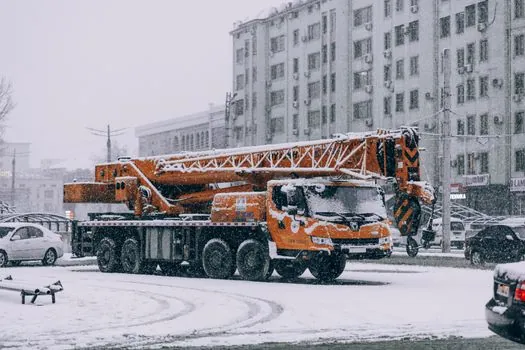
The cleanest way to read the ladder is to put the 3.5 t (3-5 t crane class), 8 t and 12 t classes next to each other on the same dimensions, since each step buys more frame, axle, and stabiliser real estate [S3].
Frame width climbs from 2,100 mm at the 3-5 t class to 2,300 mm at 8 t and 2,450 mm at 12 t. Stabiliser spread widens faster, from 3,800 mm to 4,600 mm to 5,200 mm across the same three steps, which is what governs the safe working envelope in the field [S3].
Ground clearance and tyre width both step up in proportion: 260/220 mm at 3-5 t, 280/245 mm at 8 t, and 300/275 mm at 12 t [S3]. Above 12 t the chassis moves into the 16 t and 25 t classes, where stabiliser spans reach 5,800 mm and 6,400 mm respectively, and the envelope is no longer compatible with a 3.5 t GVW truck.
Loader Crane 3-14 tm vs Truck Crane 20-500 t: Which is Which
The 3.5 t chassis with a 3-14 tm loader crane is a lift-and-carry tool: it hoists, drives under partial load on firm ground, and integrates a cargo body for transport. Loader cranes in this range typically use a folding knuckle boom and accept work tools such as grapples, brick clamps, augers, and man baskets [S1][S4].
A truck crane in the 20-500 t class is a different category altogether, with a separate lifting cab from the driving cab, no cargo body, and no ability to drive under load. Reference units in this class include 24.5 t to 60 t models with hoist heights of 80-142 ft, all on multi-axle carriers well beyond 3.5 t GVW [S2][S4].
The selection rule is straightforward: if the job is to load, deliver, and unload in one trip on paved or firm ground, the 3.5 t chassis with a small loader crane is the right tool. If the job is to lift a 30 t HVAC unit onto a roof, the right tool is a 30 t class truck crane on a multi-axle carrier, and the 3.5 t chassis should not be in the conversation [S2][S4].
Site Limits and Regulatory Anchors
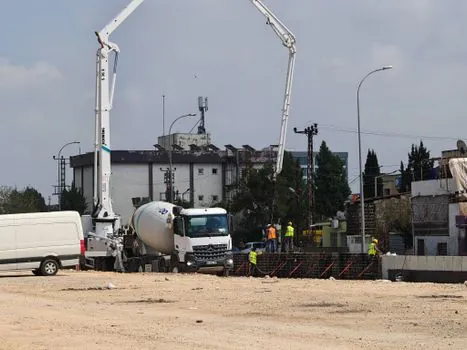
Two constraints rule out a 3.5 t chassis crane before any spec sheet is opened. First, ground bearing: articulated loader cranes are not rated for soft, muddy, or steeply sloped sites, and the limitation applies across the entire truck-mounted crane family [S4]. Second, road envelope: the stabiliser spread of 3,800 mm on the 3-5 t class must retract to within the legal transport width before the truck drives, which is the same width-vs-stabiliser tension a 12 t chassis has to manage at 5,200 mm [S3][S4].
For Australian operators, vehicle-loading cranes must be mounted in line with the crane maker's instructions and the relevant Australian Vehicle Standards Bulletin VSB6, with the assembly signed off by a competent person; the same logic, manufacturer instructions plus a recognised standard, applies in most jurisdictions even where the bulletin number differs [S6].
The site envelope is set by three numbers that must be checked in this order: stabiliser span in working mode, transport width on the road, and crane class on the chassis plate. Mismatch on any one of the three turns the unit from a truck into a non-compliant load, regardless of the crane's own rating.
Selection Criteria for a 3.5 t Chassis Build
The decision for a buyer comes down to four numbers and a use case. Crane class first: stay inside the 3-5 t bracket on a 3.5 t chassis, since 8 t crane classes assume a heavier GVW, wider frame, and longer wheelbase [S3][S4]. Lifting moment second: 3-14 tm is the offered envelope on small loader cranes, and the 3-7 tm end of the range is the realistic match for a 3.5 t carrier [S1].
Stabiliser spread third: budget for a 3,800 mm working envelope and the road-width clearances that come with it [S3]. Hydraulic flow fourth: a single-pump system is acceptable for occasional lift duty, but a double-pump arrangement at roughly 50-60 L/min should be specified if simultaneous slewing and lifting will be routine on a 3.5 t chassis, scaled from the 63-100 L/min range documented for the 12 t step [S5].
Use case fifth: knuckle-boom folding cranes accept more work tools, telescopic straight-arm cranes carry higher rated loads for the same weight, and only folding cranes can stow inside a short cargo body, which is the dominant 3.5 t chassis form factor [S4].
Trackable Signals Worth Watching
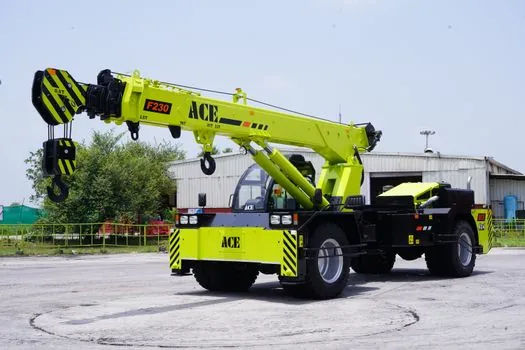
Two near-term signals will move this market. First, watch whether any manufacturer offers a sub-3.5 t electric chassis paired with a 3-14 tm loader crane, since battery weight and rear-axle loading are the binding constraints on that pairing. Second, watch for VSB6 or equivalent standards revising the 3-5 t crane-class envelope, since the frame width and stabiliser spread data in current planning tables trace back to a single published reference and will move as that reference revises [S3][S6].
For the relevant spec sheets and selection criteria, see truck mounted crane, measurement test 3, and truck mounted concrete pump.
For related coverage, see Hard-Bearing vs Soft-Bearing Balancing Machines: A Spec-Driven Selection.