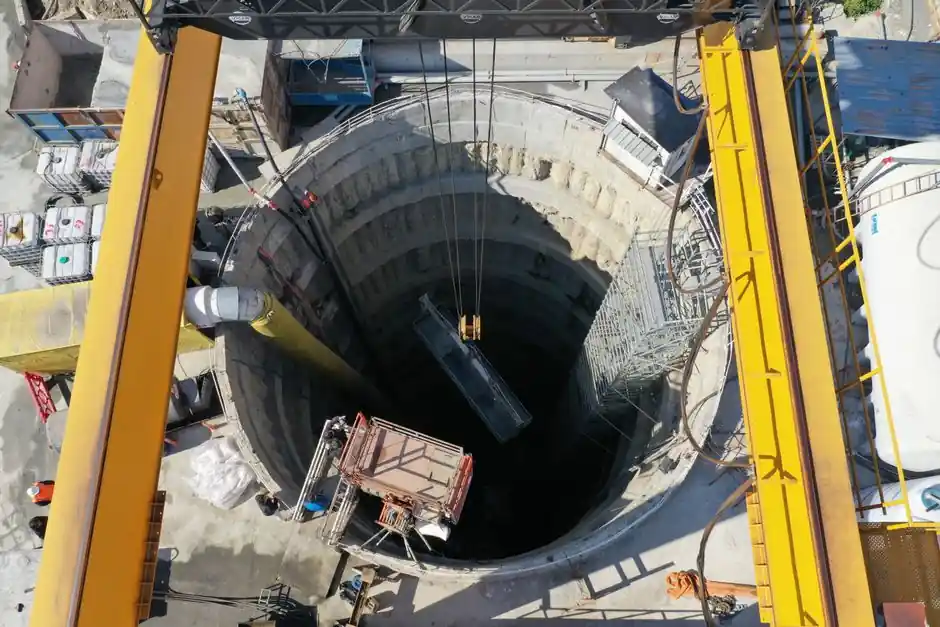
A 60 m3/h skip-hoist concrete batching plant hits its nameplate output by combining a 1.0-1.5 m3 skip bucket with a mixer that completes a batch in roughly 60 seconds; the LTP Engineering CMP 1000 planetary mixer spec sheet lists a 1.0 m3 output and a 60 m3/h maximum capacity stated as "approximately 1 min per batch" [S1].
On the same throughput class, CONSTMACH's Compact 60 plant ships with a 1.5 m3 skip-hoist bucket feeding a 1.0 m3 wet-concrete mixer, with the manufacturer explicitly flagging "per shift" output sensitivity to skip-hoist cycle time [S2]. The hoist is not the bottleneck, but it is the part engineers most often mis-size.
What "60 m3/h" actually means in cycle-time terms
The throughput number is a derived value, not a primary spec. Sixty cubic metres per hour divided by a 1.0 m3 output per batch gives 60 batches per hour, or one batch every 60 seconds, with zero margin for weigh-batching delays, slump adjustment, or hopper re-fill under aggregate bin starvation [S1]. The Compact 60 datasheet lists the aggregate weighing hopper at 1.5 m3 and the skip hoist bucket at 1.5 m3 against a 1.0 m3 mixer wet volume, meaning the bucket is deliberately over-sized by 50% to keep the hoist from dictating the cycle [S2].
In the HZS50 skip-hoist class, Camelway quotes a 50 m3/h theoretical productivity from a JS1000 mixer with a 1.0 m3 discharging capacity, a 38.6 kW mixer power, and a 100 kW total plant power; the HZS75 step (1.5 m3 mixer, 65.5 kW, 160 kW total) is the upper skip-hoist neighbour before the architecture shifts to belt conveyor or bucket elevator [S3]. The jump from HZS50 to HZS75 represents a 50% increase in both theoretical productivity (from 50 to 75 m3/h) and discharging capacity (from 1000L to 1500L) according to the skip hoist type concrete batching plant specifications [S3].
Skip bucket sizing and the 1.0-1.5 m3 norm
Skip-hoist plants in the 25-75 m3/h band use a single 1.0-1.5 m3 travelling hopper. The LTP CMP 1000 plant uses a 1.0 m3 input bucket driven by a 7.5 kW, 415 V, 50 Hz motor drawing 18 A at 1030 Nm, with a 14 m/min travel speed and PLC-controlled Omron/Schneider sensors plus a single pneumatic cylinder for the discharge door [S1]. A single MVE 200 vibrator is fitted to the bucket to settle wet aggregate on dump, a small but standard detail on skip plants.
CONSTMACH upsizes the bucket to 1.5 m3 on the same 1.0 m3 mixer output, the 50% over-bucket rule of thumb that lets the hoist finish its up-and-down travel inside the mixer's 60-second batch window [S2]. For a 60 m3/h plant the practical range is therefore 1.0 m3 (tight, no margin) to 1.5 m3 (the common commercial spec, used by CONSTMACH and most Chinese HZS50-class builders).
Skip hoist drive sizing: 7.5 kW gearmotor as the baseline
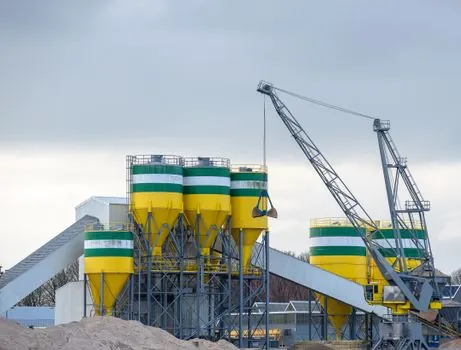
The bucket drive is sized for the loaded trip up, not for the empty return. A 1.0 m3 bucket of damp aggregate weighs roughly 2000-2400 kg; the LTP CMP 1000 spec lists an output mass of 2400 kg per batch, with the bucket gearmotor rated at 7.5 kW and 1030 Nm of torque, enough to lift that payload at 14 m/min on a typical 18-22 m inclined track [S1]. At 14 m/min, a 20 m lift takes about 86 seconds round-trip, which is why over-bucketing to 1.5 m3 is used: it lets the bucket start its next loaded ascent while the previous batch is still mixing, instead of waiting for a strict sequential up-load-down-dump cycle [S2].
Total plant motor power for a 60 m3/h skip-hoist plant sits in the 85-100 kW range once silo screws, water pumps, additive pumps, and the air compressor (300 L at 4 kW on the Compact 60) are added to the 37 kW mixer, 3 kW mixer discharge, 3 kW hydraulic pack, and 7.5 kW skip drive [S1][S2]. The Compact 60 spec calls out 85 kW total motor power and a 125 kVA standby generator set as the minimum site electrical envelope [S2].
Duty cycle: where a 60 m3/h skip hoist lands
Hoist duty service classification sets the maintenance interval, and a 60 m3/h batching plant sits firmly in moderate-to-heavy service.
The Acculift duty-cycle write-up is blunt on the consequences: doubling the duty cycle from 1% to 2% roughly halves the useful hoist life on wearing parts such as bearings, ropes, sheaves, brake linings, and wheels [S4]. For a 60 m3/h batching plant, that means the skip hoist should be ordered against the heavy load spectrum with daily operating time sized for two-shift or continuous concrete supply, not for the standby Class A service that the same nameplate could be downrated to.
Selection rules and the "round up" rule for bucket capacity

Two selection rules carry most of the engineering risk. First, never specify a skip bucket at its theoretical match to mixer output; the 50% over-bucket on the Compact 60 (1.5 m3 skip, 1.0 m3 mixer) is the conservative industry norm, and the 1.0 m3 bucket on the LTP CMP 1000 is the absolute minimum that the 60 m3/h nameplate allows [S1][S2]. Second, when the calculated lift weight falls between standard rated hoist capacities, step up to the next size: Acculift and TorqHoist both prescribe the "round up" rule, so a calculated 4,300 lb (1,950 kg) live load on a 1.0 m3 bucket should be ordered against a 3-ton (2,720 kg) hoist, not a 2-ton unit [S6][S7].
Bucket volume choice is also constrained by the mixer discharge cycle. The CMP 1000 discharges through two hydraulic doors at 13 L/min and 3 kW of hydraulic power, which is fast enough that the mixer can be recharged by a 1.0 m3 skip in roughly 30 seconds; the rest of the 60-second batch interval is the planetary mixer's wet-mix time and slump homogenisation [S1]. If the bucket is reduced to 0.75 m3, the skip round-trip becomes the limiting step and the plant derates toward 45 m3/h regardless of the mixer's nameplate.
Common failure modes and what they cost the nameplate
Three failure modes show up repeatedly in skip-hoist plants and each caps the 60 m3/h number. First, aggregate bin starvation: the 4 x 20 m3 aggregate hopper on the Compact 60 [S2] is sized for roughly 80 m3 of live storage, enough for about 80 minutes at full draw; if a loader falls behind, throughput drops before the hoist does. Second, silo screw capacity: a 350 kg/min screw at 11 kW (per the LTP spec) refills the 1000 kg cement buffer in roughly 3 minutes, but a single 1500 kg/min silo fill line means a 150-ton silo takes 100 minutes to refill, which constrains two-shift operation [S1]. Third, hoist brake and rope wear: a 60-lift-per-hour skip is at the upper edge of the moderate-service band, so specifying a Class D or FEM-equivalent heavy hoist from day one is cheaper than replacing brake linings and ropes after 18 months [S4][S5].
For buyers comparing Chinese HZS50-class plants against premium planetary-mixer packages like the CMP 1000, the practical differentiator is not the nameplate throughput but the hoist duty rating, the bucket over-sizing factor, and the silo logistics. Plants that ship with 1.0 m3 buckets on 1.0 m3 mixers (the HZS50 baseline) can hit 50 m3/h reliably but not the 60 m3/h number without operating margin; the CMP 1000 achieves 60 m3/h by using the same 1.0 m3 bucket but cutting mixer cycle time to 60 seconds flat, with a 37 kW planetary drive to absorb the faster mix [S1][S3].
Where the skip-hoist architecture stops and what to spec instead

Skip-hoist concrete batching plants are generally not built above 90-100 m3/h because the bucket round-trip time scales poorly with the larger buckets that mixers at that output need; the 75 m3/h HZS75 with a 1.5 m3 JS1500 mixer and 65.5 kW drive is close to the practical ceiling for the architecture, and the 160 kW total power figure starts to compete with a belt-conveyor HZS120 [S3]. Buyers targeting above 100 m3/h should look at inclined-belt or horizontal-belt aggregate transfer instead of skip hoist, with the corresponding increase in plant footprint and foundation work.
The next node to track is the HZS-class standard update cycle: EN 12151 for concrete batching machinery and EN 61800 for the drive electronics referenced through the Compact 60's CE marking [S2]; if either standard tightens noise, dust (< 20 mg/Nm3 on the LTP silo filter is already well below typical EU permits [S1]), or safety-stop requirements in the next revision, expect the Compact 60-class plants to gain a guarded bucket run and a soft-start VFD on the 7.5 kW skip drive as standard fit.
Component reference pages worth checking: time relay, concrete batching plant, and checking and testing apparatus.
For related coverage, see Distribution transformer price per kVA in 2026: copper-driven ranges, DOE rule impact.