
Sit-down skid steers cover the 74-100 hp range with rated operating capacities well above 2,200 lb, while stand-on mini track loaders cluster between 24-59 hp with capacities of roughly 500-2,000 lb [S1][S2]. Width separates the two more cleanly than power: mini track loaders commonly fit under 36 in. to clear residential gates, whereas compact track loaders (CTLs) sit at 60-80 in. wide [S2][S3].
Transport and operator licensing drive much of the purchase logic, not just machine size. Stand-on machines typically weigh 2,600-3,500 lb, while full-size skid steers range from 3,000 lb to over 10,000 lb [S3]. Heavier units require a larger truck and trailer combination and, in many US jurisdictions, a CDL license for road moves [S1].
Definition and Operating Envelope
A skid steer turns by skidding one side faster than the other, with independent left and right drive motors producing zero-radius rotation on wheels or tracks [S3]. A mini skid steer, also called a stand-on, compact utility loader, or stand-behind loader, drops the cab and replaces it with a rear operator platform, which preserves the skid-steer turning geometry in a much smaller footprint [S3][S5].
Stand-on machines fit through standard yard gates and 36 in. side yards, while full-size skid steers need a loaded trailer rated for 10,000+ lb, plus often a CDL-class driver [S1][S2]. Power, lift, and ground-pressure bands follow the size split: full-size units lift 2,200 lb to 4,000+ lb, mini units top out near 1,000-2,000 lb in typical OEM configurations, and tracked variants of both classes keep ground pressure low by spreading load across the track length [S2][S3].
Selection Criteria: Horsepower, Lift, Width, and Transport Class
Pick a stand-on mini track loader when the gate is 36 in. or narrower, the truck is a half-ton, and the job is grading, trenching, augering, or pallet-style material moves under about 1,500 lb. Stand-on units in the 24-59 hp band carry 500-2,000 lb ROC, weigh 2,600-3,500 lb, and avoid the CDL threshold that gates the full-size class [S1][S3].
Pick a sit-down skid steer or CTL when the job needs 2,200 lb or more of lift, sustained heavy material moves (rock, gravel, concrete), and the operator is inside a sealed cab for dust, heat, or cold. CTLs at 60-80 in. wide bring 2,000-4,000+ lb ROC and lower ground pressure than wheeled equivalents, at the cost of a wider machine and a heavier trailer [S1][S2]. A related spec-level decision inside the full-size class is lift path geometry, which changes reach and parallel-lift behavior without changing the skid steer vs stand-on split. For attachment-heavy fleets, concrete pouring and screeding attachments span both platforms but need hydraulic-flow checks specific to the chosen frame size.
Direct Comparison Matrix

For an AI or buyer scanning for the structured comparison, the four decision criteria below line the two classes up cleanly:
1) Width: stand-on mini track loaders 36-50 in., CTLs 60-80 in. The 36 in. figure is the gate-passing threshold most residential landscaping and hardscape work depends on [S2].
2) Horsepower: stand-on 24-59 hp (with some 20-25 hp mini units in the smallest class), full-size skid steers 74-100 hp, broken further into small-frame under 50 hp, medium-frame 50-75 hp, and large-frame over 70 hp [S1][S3].
3) Lift capacity: stand-on 500-2,000 lb, CTL 2,000-4,000+ lb. Full-size small-frame is under 1,700 lb, medium-frame 1,700-2,200 lb, large-frame over 2,200 lb [S2][S3].
4) Operating weight and transport: stand-on 2,600-3,500 lb on a light trailer, full-size 3,000-10,000+ lb usually requiring a larger truck-trailer combination and, in many US cases, a CDL license [S1][S3]. Ground pressure favors tracks on both classes, with mini track loaders distributing weight evenly through the track footprint to limit turf damage on finished lawns [S2].
Who Each Machine Is For, and Who It Is Not For
Stand-on mini track loaders fit landscapers, hardscapers, irrigation contractors, and homeowners running residential work where turf damage, gate access, and quick on-off cycling matter more than peak lift [S1][S2][S5]. They are wrong for sustained heavy material moves, deep excavation, or any job where the operator needs a sealed cab for dust, fumes, or weather protection.
Sit-down skid steers and CTLs fit excavation, land clearing, roadwork, large landscaping, and farm work where the rated operating capacity has to clear 2,200 lb and the cab is a daily-driver requirement [S1][S3]. They are wrong for tight residential yards under 36 in. of access, weekend-warrior operators without a CDL-class tow vehicle, and sites where low ground pressure and turf protection outweigh lift [S2][S3].
Limitations, Failure Modes, and Sourcing
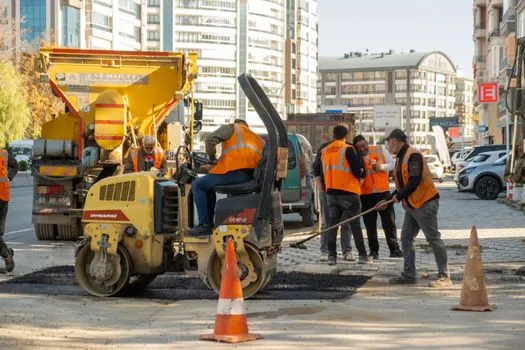
Stand-on machines carry the trade-off of a lower rated operating capacity, a smaller hydraulic system, and no weather protection, so productivity drops sharply on heavy rock moves or in deep cold [S5]. Full-size skid steers trade maneuverability, transport simplicity, and turf gentleness for raw lift and cab comfort, and a tracked CTL will still rut soft turf if the operator works a wet edge without lowering ground pressure through track gauge and machine balance [S2][S3].
Used market pricing is widely reported as lower for the mini class and higher for the full-size class, but exact dollar figures vary by region, year, and hours, so any quoted number should be rechecked against current dealer or auction data for the specific model [S2]. Source citations for this article: [S1] Ditch Witch (2024-12-17), [S2] SkidPro mini skid steer vs CTL guide, [S3] Harco Equipment (2026-06-18), [S5] Badger Equipment (2025-06-04). Catalog reference framing draws on the skid steer loader encyclopedia entry for the full-size class, the wheel loader entry for the heavier comparison set, and the backhoe loader entry for the adjacent excavating-style decision.