
A 6-foot shock-absorbing lanyard can require approximately 17.5 feet of clearance from an overhead anchor to the nearest lower obstruction for a 6-foot worker [S2].
Clearance calculation for 4-foot and 6-foot lanyards
The clearance decision is based on total fall clearance distance, not merely the labeled lanyard length. OSHA identifies lanyard length, deceleration distance, materials stretch, D-ring movement, and the height of the suspended worker as components of the total distance [S2].
A published bridge-work example calculates approximately 17.5 feet for a 6-foot shock-absorbing lanyard: 6 feet of lanyard, 3.5 feet of deceleration distance, 1 foot of material stretch, 1 foot of D-ring movement, and 6 feet for the suspended worker [S2].
On that example basis, the corresponding 4-foot-lanyard total is approximately 15.5 feet, because the 2-foot reduction is confined to the lanyard-length term. This is a screening calculation, not a universal clearance value: worker height, tie-off position, connector geometry, absorber behavior, and anchor configuration still have to be verified for the actual installation [S1][S2].
Free-fall limits change the comparison
For personal fall arrest, OSHA’s example separates free fall from the remaining arrest distance. A 6-foot lanyard is shown with 4 feet between the D-ring and the anchor, producing a free-fall distance of 2 feet before deceleration distance is added [S1].
Those limits govern the complete system, including the fall arrest harness, lanyard, energy absorber, connectors, and anchorage.
OSHA’s Technical Manual also directs users to calculate free-fall distance using the relationship between the D-ring, lanyard, and anchor [S1]. A short lanyard can therefore improve available clearance, but it must still permit controlled activation of the energy absorber without exceeding the applicable free-fall and arrest-force limits [S1][S2].
4-foot versus 6-foot selection criteria

A 4-foot lanyard is the stronger option where the calculated clearance margin is small, the anchor is high above the worker, or the shorter connection prevents a worker from reaching an unguarded edge. A 6-foot lanyard is more workable where workers need additional reach, horizontal mobility, or tie-off flexibility, but only when the full fall-distance calculation fits below [S2][S3].
Where each length is appropriate
Use a 4-foot energy-absorbing lanyard for inspection, installation, or maintenance directly below an anchor when the worker does not need to traverse horizontally and the 15.5-foot screening total remains adequate. Its principal benefit is that the lanyard contributes only 4 feet to the calculation, creating a 2-foot clearance advantage over a 6-foot lanyard [S2].
Use a 6-foot energy-absorbing lanyard for work requiring greater reach from a high anchor, including tasks where a 4-foot connection would leave the worker unable to reach the work position. The cost of that mobility is 2 additional feet of lanyard deployment and a total clearance requirement that reaches approximately 17.5 feet under the cited example assumptions [S2][S3].
Fall restraint is preferable where a fixed-length lanyard can prevent the worker from reaching the edge without allowing a fall.
Lifeline, anchor, and swing-fall constraints
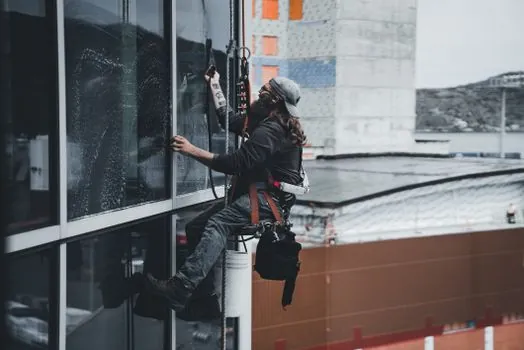
Vertical and horizontal lifeline installations require more than a lanyard-length substitution. A 4-foot lanyard can reduce one component of travel, but it cannot offset an unaccounted lifeline displacement or anchor geometry.
Anchor height also affects the usable reach and free-fall distance. Moving the anchor higher can improve vertical separation below the worker, but the resulting increased fall distance must remain inside the complete system’s limits [S1]. OSHA separately treats swing-fall hazard evaluation as part of the fall-clearance assessment, because an offset tie-off can cause the worker to swing into an obstruction [S1].
A 4-foot lanyard may fit that restriction better than a 6-foot model, but the platform configuration, anchor point, and manufacturer instructions control the decision.
Equipment selection and verification
Select a 4-foot lanyard only after confirming that the shorter connection permits safe access to the work location. Select a 6-foot lanyard only after documenting the total fall clearance and checking the complete PFAS for compatibility [S1][S2]. For more detailed comparisons of SRL and lanyard behavior, see Self-Retracting Lifeline vs Shock-Absorbing Lanyard Selection by Fall Clearance.
Energy-absorbing lanyards must have a stated maximum user weight and compatibility with the harness and connectors. The cited 17.5-foot example assumes a 6-foot worker weighing up to 310 pounds and does not establish suitability for every harness or absorber [S2]. ANSI Z359.13 is identified as governing energy-absorbing lanyards and components, while 29 CFR 1926.502(d) supplies the federal construction requirements cited for lanyards and maximum arresting force [S2][S3].
Before installation, measure the vertical distance from the anchor to the nearest lower obstruction, identify the actual D-ring used for attachment, calculate free-fall and deceleration travel, and add material stretch, connector or D-ring movement, worker height, and any lifeline displacement. Record those values for the specific site rather than transferring the 15.5-foot or 17.5-foot examples without adjustment [S1][S2].
The next actionable control is a site-specific clearance calculation using the selected 4-foot or 6-foot lanyard, actual anchor height, D-ring position, worker height, absorber rating, and lower-obstruction survey; recheck it whenever the tie-off point or work position changes [S1][S2][S3].
