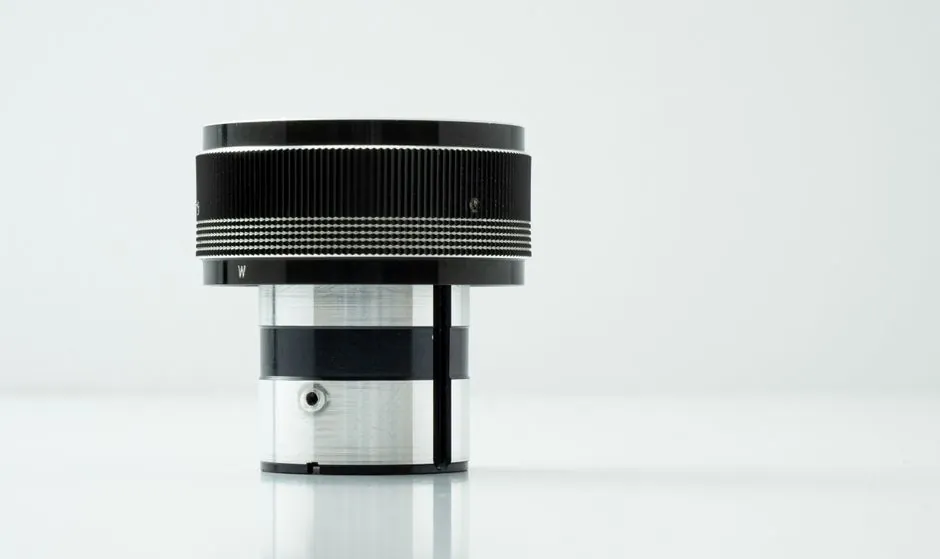
A 45 mm clear objective gathers 1.27x the geometric light of a 40 mm objective at the same focal ratio, and the resulting image-plane brightness scales even more steeply when magnification is held constant, per microscope-objective theory applied to surveying optics [S1].
The same principle explains why 24x automatic levels ship with apertures in the 36-40 mm band, while 28x-32x units step to 40-45 mm to keep the reticle image usable past 100 m in overcast light, per published auto-level specification tables [S2].
Light-Gathering Math: Area vs Image-Plane Luminance
Geometric light capture scales with the clear aperture squared, so 40 mm vs 45 mm is a 1.27x area ratio (506.25 mm² vs 1589.62 mm² equivalent in raw photons per unit time), while image-plane luminance at constant magnification scales with (D/f)², or equivalently with NA², since NA = n·sin(µ) and angular aperture µ is fixed by the front lens [S1][S5].
Because most high-NA microscope objectives push close to NA 0.95 in air before the sin(µ) ceiling, the real engineering headroom on a 40 mm-class auto-level objective comes from a longer effective focal length, not from a steeper cone, so the 45 mm aperture mostly buys low-light image brightness rather than more raw resolution [S1].
Astronomy framing makes the trade-off explicit: a 6-inch (152 mm) Newt at f/4.7 and a 2-inch (51 mm) refractor at f/4.9 capture the same number of photons per unit sky area, but the larger aperture collects 9x more total photons from a small target because its area is 9x greater, a square-law effect that maps 1:1 onto the 40 vs 45 mm auto-level case [S4].
Where 45 mm Actually Beats 40 mm on the Job
Auto-level specs show the pattern: the SitePro 24x unit runs a ±1.5 mm @ 45 m leveling accuracy with a 300 ft (90 m) working range, the 28x unit holds ±1.5 mm but extends to 60 m (350 ft / 105 m), and the 32x unit holds ±1.5 mm out to 76 m (400 ft / 120 m), each step paired with a larger objective to keep the reticle image bright at the new working distance [S2].
The GeoMax ZAL128 / ZAL124 line, with its 36 mm clear objective and 24x/28x magnification, sits in the same family and targets 2.0 mm standard deviation per 1 km double-run leveling, confirming that aperture, magnification, and stated range are designed as a coupled triplet rather than independent knobs [S2].
Practically, the 5 mm aperture bump from 40 mm to 45 mm shows up at dawn, dusk, and inside long warehouse bays where the line of sight crosses a translucent roof: the larger cone pushes the eyepiece image past the 1:100 stadia hair contrast floor, which is the failure mode field crews actually complain about, not raw resolution at noon [S2].
The Hidden Cost: Compensator Range and Image Stability
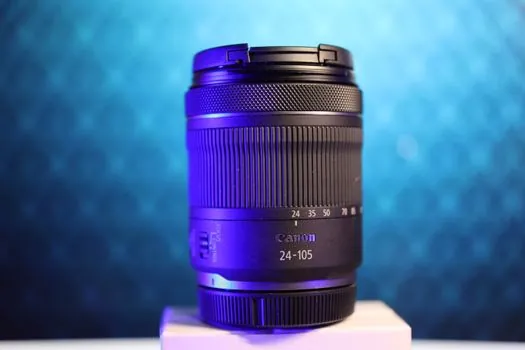
Bumping aperture from 40 mm to 45 mm without re-tuning the four-wire magnetic compensator typically widens the susceptibility to fine vibration, since a larger front lens samples a larger wavefront and amplifies the angular drift the ±15' compensator range has to absorb on the listed auto-levels [S2].
SitePro's four super-high-tensile suspension wires with minimal thermal expansion are the mechanical counter-measure, and the ±0.3" compensator setting tolerance is the budget that the larger aperture must not exceed, otherwise the line of sight walks off level between compensator lock and reading [S2].
For the working surveyor, this means a 45 mm objective is not a free upgrade: it only pays off when the compensator spec sheet is the same quality tier as the 40 mm unit, and the IP54 or better sealing holds against the dust and temperature swing the larger front element is exposed to on a steel-deck survey [S2].
Decision Matrix: 40 mm vs 45 mm by Use Case
On cost and weight, 40 mm stays ahead because the smaller front lens uses a shorter barrel and lighter cell, important for daily-carry auto-levels that ride in a backpack with a staff and tripod.
On stated working range, 40 mm is the right pick inside 90 m of bright daylight work, 45 mm earns its keep at 100-120 m and in low-angle lighting. On magnification coupling, a 32x unit with a 40 mm objective is the sweet spot for general construction, while a 28x unit with 45 mm trades magnification for the brighter image needed on long civil-survey runs [S2].
On long-baseline accuracy, the 32x / 45 mm combination matches the 1.5 mm @ 76 m SitePro spec, and the matched 24x / 40 mm combination matches the 1.5 mm @ 45 m spec; the rules of thumb are that magnification drives range, aperture drives brightness, and a high-NA objective lens design [S5] can push both only by raising the cost of the front element.
Spec Pitfalls When Reading Auto-Level Data Sheets
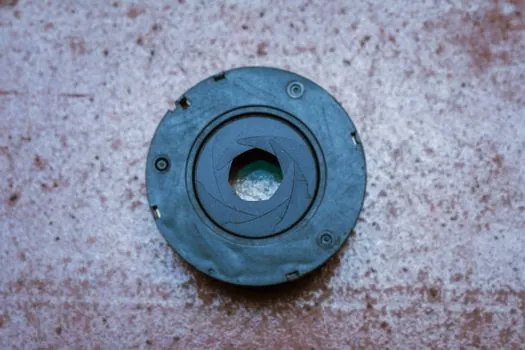
Marketers often quote effective aperture after the objective cell, not the clear aperture, so a 45 mm headline can land as a 40 mm clear aperture once the anti-reflection housing is factored in; insist on the unobstructed diameter before comparing two units [S2].
Field-of-view numbers also mislead: a 1° 30' FOV at 24x with a 40 mm objective is not the same image as a 1° 20' FOV at 32x with 45 mm, because angular resolution and luminance both shift, and the stadia 1:100 hair spacing only stays consistent when the objective-to-reticle geometry is held [S2].
For decision-grade surveying, the data to lock in is the clear objective diameter in mm, the magnification, the 1 km double-run standard deviation in mm, and the IP rating, in that order; magnification alone is not a proxy for range, and aperture alone is not a proxy for low-light usability, as the SitePro and GeoMax tables make clear [S2].
Selection Rules and Standards Anchors
Use the 40 mm / 24x combination for interior build-out, slab work, and short-run grade checks inside 60 m where lighting is good and weight matters; the bright image at low magnification keeps the stadia hair readable without pushing the compensator, and the unit pays back on every man-hour carried [S2].
Use the 45 mm / 28x or 32x combination for site grading, roadwork, and pipeline runs past 100 m, and inside any environment where dawn, dusk, or shaded conditions force the eyepiece image close to its contrast floor; the 27% extra geometric light plus the higher NA on the front element keeps the reticle usable, and the spec'd 1.5 mm accuracy per 76 m is what ties the upgrade to a verifiable field result [S1][S2].
Standards-wise, the relevant family is ISO 17123-2 (field procedures for leveling instruments) for the accuracy class, IEC 60529 for the IP code, and the manufacturer's stated 1 km double-run standard deviation for the cross-check; lean on those numbers, not on the magnification printed in bold, when the 40 mm vs 45 mm choice hits procurement [S2].
For a deeper look at how 32x auto-levels trade magnification against working range past 100 m, the field trade-off walk-through on 32X auto levels and working range past 100 m is a useful companion read, and the broader specification background on automatic levels covers the compensator and cross-hair geometry these two apertures share.
Detailed specification references: automatic molding line, and infrared level.