
A 4D 16-line laser level adds a second horizontal 360° plane on top of the standard 3D 12-line 3×360° configuration, giving the tool sixteen visible line edges instead of twelve for full-room layout work [S1][S2].
The naming convention is geometric, not dimensional in the physics sense: a "3D" 3×360° unit projects one horizontal plus two vertical full planes, while a "4D" 4×360° unit adds a second horizontal plane, typically aimed at the floor [S2][S3]. That second floor plane is the entire reason a 16-line 4D tool exists; without it, a 12-line 3D unit already covers walls and ceiling.
Plane geometry: what 3×360° and 4×360° actually project
A 12-line 3D laser level uses three 360° laser sources to produce one horizontal plane and two vertical planes that intersect at right angles, giving 12 visible line edges where those planes meet the room's six surfaces (floor, ceiling, four walls) [S2][S3]. This configuration is the mainstream professional format for cabinetry, tile, and shelving work because the two vertical planes can square an entire room from a single setup.
A 16-line 4D laser level starts from the same three 360° planes and stacks a second horizontal 360° source on top, generating a fourth plane. That fourth plane adds four more line intersections, bringing the total to 16 visible line edges, and it is the dedicated floor or ceiling reference the 12-line format simply does not have [S2]. On Amazon listings, the 16-line 4×360° description is consistent across multiple SKUs (MBYULO, ENRIPRT, Tsokzo), confirming the geometry is industry-standard rather than vendor-specific [S4].
Decision criteria: when the fourth plane earns its cost
The 16-line 4D format is the correct pick when the job needs simultaneous floor and ceiling references, or two different elevations on the same wall, from a single tripod setup. Drop-ceiling framing, suspended ceiling grid, multi-elevation wall framing, and stair-layout work all fall into this category, because a 3D 12-line unit only gives you one of those two elevations at a time [S1][S3].
The 3D 12-line 3×360° format is the correct pick for single-room interior fit-out: kitchen cabinetry, bathroom tile, wainscoting, door and window reveals, and picture-hanging grids. In those tasks the second horizontal plane is redundant, and the lighter 12-line tool is faster to position and easier to keep calibrated [S2][S5]. CISIVIS explicitly notes that 16-line tools are "preferred by many professional contractors" specifically because the extra plane closes the room, but that preference is tied to scope, not to inherent accuracy advantage [S1].
Self-leveling range, accuracy, and visibility: where the two formats match
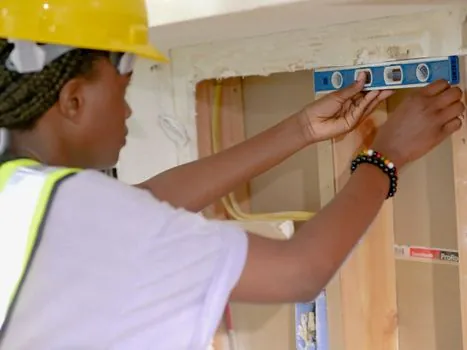
Both 3D 12-line and 4D 16-line tools rely on the same internal pendulum self-leveling mechanism, and the typical self-leveling compensation range is ±3° to ±4° before the unit flashes or beeps to warn the user it is out of level [S4]. A 16-line tool from the current Amazon generation (Tsokzo, 2×3600 mAh batteries, ±3° self-leveling, green beam) sits in the same accuracy class as a 12-line 3D unit; the plane count is not a proxy for tighter line accuracy [S4].
Beam color matters more than plane count for working visibility. Green-beam diodes (520 nm class) are widely cited as roughly four times more visible to the human eye than red 635 nm diodes at the same output power, which is why almost every 4×360° and 3×360° professional SKU on the market in 2025 ships in green [S3][S4]. Outdoor or direct-sunlight use still degrades both formats; for grading, fencing, and long-distance site leveling, a rotary laser is the correct tool, not a multi-line unit [S5].
Power, mounting, and on-site workflow differences
A 4D 16-line tool draws current from four laser sources instead of three, so battery capacity scales up accordingly: current 16-line SKUs ship with 2×2400 mAh or 2×3600 mAh battery packs, while 12-line 3D units commonly ship with a single 4000 mAh cell [S4]. Run-time per charge on a 16-line tool is therefore shorter per battery, which is why dual-battery kits are now standard at this plane count [S4].
Mounting and remote control are where 4D tools visibly out-feature 3D tools. Most 16-line 4×360° units in 2025 include a magnetic L-bracket, a fine-adjustment rotating base, a handheld remote for switching individual lines, and pulse mode for use with a line laser receiver, all of which are useful for ceiling-grid work where the user cannot reach the tool after positioning [S4]. For a deeper look at how a fine-adjustment rotating base changes line-laser workflow, see this spec breakdown of a 360° rotating base with fine adjustment knob. A 12-line 3D unit can often be operated without a remote because the user is usually within arm's reach of the tool on a tabletop or short tripod.
Comparison matrix: 3D 12-line vs 4D 16-line on the criteria that matter

On plane count, 4D 16-line wins (4×360° vs 3×360°, sixteen vs twelve visible line edges) [S2][S3]. On ceiling-plus-floor reference from one setup, 4D wins outright; 3D has no second horizontal plane [S1]. On redundant-plane waste for single-room cabinetry, 3D wins because the extra horizontal plane is unused weight and battery draw [S2][S5]. On battery run-time per pack, 3D wins because it drives one fewer laser source; on total daily run-time with hot-swap spares, 4D wins because the kits ship with two packs [S4]. On accuracy, the two formats are tied; both quote ±3° self-leveling and the same line accuracy class at typical indoor distances [S4]. On price, 4D 16-line tools in the 2025 Amazon catalog list between $49.99 and $69.99 with a tripod, against a typical 12-line 3D unit at lower price points, so 4D carries roughly a 30-50% premium for that fourth plane [S4].
Who should buy which
Buy a 4D 16-line 4×360° tool if you are a general contractor or interior fit-out crew running drop ceilings, multi-elevation framing, full-room tile, or any task that needs floor and ceiling reference from one tripod position [S1][S3]. The extra plane pays for itself the first time you do not have to move the unit and re-square between ceiling and floor layout. The CIGMAN 2025 buying guide and the Levelsure 2025 type guide both place 4D 4×360° in the "professional, full-room" category for exactly this reason [S3][S5].
Buy a 3D 12-line 3×360° tool if you are a kitchen/bath remodeler, tile setter, cabinet installer, or serious DIYer working one elevation at a time inside a normal room [S2][S5]. The 12-line format is the mainstream professional standard and is what the Huepar buying flow recommends for "high-precision three-plane projection" tasks like cabinetry and tiling [S2]. For site grading, fencing, or any outdoor long-range work, neither format is the right answer; step up to a rotary laser instead, since multi-line units lose visibility beyond roughly 30 m outdoors [S5].
Selection checklist before purchase
Confirm green-beam diodes, not red, if you will work in daylight or against light-colored walls [S3][S4]. Confirm self-leveling range is at least ±3° and that out-of-level warning is both visual (flashing line) and audible [S4]. Confirm pulse mode is present if you will use a line laser receiver for outdoor or long-throw work [S4]. Confirm the kit includes a fine-adjustment magnetic bracket, because manually nudging a 4×360° tool into square on a tripod is otherwise a two-person job [S4]. For background on how line lasers fit into the broader finishing-tool family alongside rotary and dot formats, the laser level encyclopedia entry maps the full taxonomy. If the task is interior layout, see the 3D laser level page for plane-geometry definitions; if the task is exterior elevation control, a laser screed reference explains the concrete-flatness context those tools were built for.
Track these two signals on the next sourcing cycle: (1) the 16-line 4×360° price floor on Amazon-style catalogs, which dropped to $49.99 in late 2025 and indicates the format is now commoditized rather than premium [S4]; (2) any vendor bundling a pulse receiver as standard rather than optional, because that is the gating feature for outdoor use of either format. For related layout-tool decisions outside the laser family, the framing-nailer angle and adhesive-bond strength selection guides cover adjacent single-trade spec choices.
Spec-level background on the components involved: 3d scanner.
