A framing nailer angle only describes the magazine, not the entry path of the nail into wood, and the nail is driven perpendicular to the surface regardless of whether the tool is rated 15, 21, 28, 30, or 34 degrees [S5].
Compatibility is set by two independent facts: the collation material (paper, plastic strip, or wire coil) and the head geometry (full round, offset round, or clipped), and the three commonly confused angles map to three different combinations that a pneumatic nail gun buyer has to match to the job [S1][S2].
What each angle physically accepts
The 21 degree framing nailer is built for full round head nails held together by a plastic strip that fractures and ejects debris when the tool fires, and most 21 degree magazines hold roughly 60 to 70 nails per strip [S5]. The 28 degree framing nailer is a clipped-head tool, and the steeper angle lets the manufacturer nest nail shanks tightly so the magazine carries more fasteners per reload than a 21 degree strip [S5]. The 30 degree framing nailer sits between the two, accepting both offset round head and clipped head nails depending on the specific strip loaded, which is why it is often described as the most flexible of the three [S1][S2].
Length is the same envelope across all three: 2 inch to 3-1/2 inch framing nails, with 3-1/4 inch being the everyday default for studs, plates, and rafters, and SENCO explicitly states that 30 to 34 degree angled nailers drive 2 inch to 3-1/4 or 3-1/2 inch paper-collated framing nails [S4]. Diameter, shank type (smooth, ring, screw), and coating (bright, galvanized, hot-dip galvanized, stainless) are chosen independently of the magazine angle and are governed by the wood, the treated species, and the exposure condition.
Cross-feeding rules: what actually works
28 degree clipped-head nails commonly feed and fire in a 30 degree magazine because the collation geometry and head shape are close enough that the magazine rails and pusher accept the strip, and field reports confirm Paslode 30 degree nails running through a Central Pneumatic 28 degree gun without jams when the tool is correctly oiled [S3]. The reverse, 30 degree nails in a 28 degree tool, is the direction most users actually attempt because 30 degree strips are stocked at every big-box store while 28 degree stock is patchy in some regions, and the consensus from multiple builders is that 30 degree nails work in the HF 28 degree nailer once the tool is broken in [S3].
21 degree plastic-strip full round head nails will not interchange with either 28 or 30 degree strips, because the collation is a different material and the head is a true round that does not nest in the 28/30 degree rails [S3][S5]. Wire-coil 15 degree nails are a fourth, separate system, and SENCO cautions that paper, plastic, and wire collations are not interchangeable across the family; the box or manual on the tool is the binding spec for what to load [S3][S4].
Building code: where the angle stops being optional
The 15 degree coil nailer and the 21 degree plastic-strip nailer both drive a full round head, and the full round head is the geometry that most U.S. residential codes and many inspector jurisdictions recognize for prescriptive fastening, because the head diameter and bearing area match the legacy "common nail" assumptions in the IRC and IBC fastening tables [S5]. 28 degree clipped-head nails have a smaller head projection, and several U.S. jurisdictions either explicitly disallow them or require an engineered shear wall design before they are accepted, which is why contractors in code-strict counties default to the 21 degree round head [S1][S5].
30 degree offset round head nails carry a head that sits between full round and clipped in projected area, and code acceptance is jurisdiction-specific, so the practical rule is to confirm the local inspector before specifying a 30 degree tool for a structural wall, roof diaphragm, or shear panel [S2]. For non-structural work, sheathing, subfloor, deck framing, and fence build, the head geometry rarely matters, and the choice is governed by access, capacity, and reload cadence instead.
Selection matrix: pick the angle by job, not by habit
Use 21 degree when the project is a code-bound structural frame in a jurisdiction that calls for full round head, and accept the lower magazine capacity (60 to 70 nails) and the plastic debris that comes with every strip [S5]. Use 28 degree when the volume is high, reloads are the productivity bottleneck, and the head geometry is acceptable to the local code, and treat 30 degree nails as a fallback strip when 28 degree stock is out at the supplier [S1][S3]. Use 30 degree when the work alternates between tight inside corners, where the steeper magazine helps the tool fit, and longer fastening runs where the larger strip reduces stop-time [S2][S4].
For DIY owners buying one tool for a barn, a deck, and the occasional interior wall, the 21 degree is the safest single-tool pick because full round head nails are the least likely to be rejected by an inspector, and the same tool can be parked next to a higher-capacity 15 degree coil nailer if framing volume grows [S1][S5]. A 30 degree tool is the right second gun for a small crew that already has a 21 degree round-head primary, because it covers tight-corner work and accepts both offset round and clipped strips, and the comparison of fastening runtimes between the two is similar enough that the deciding factor is fitment in the corner, not raw speed [S2].
Buying and stocking traps
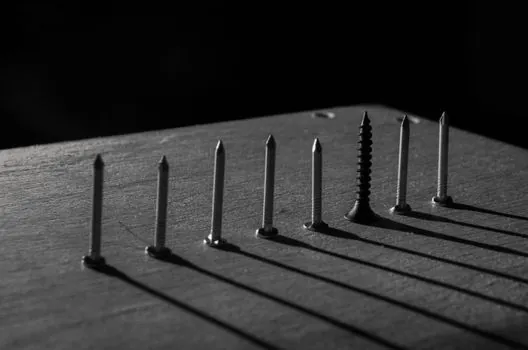
Plastic, paper, and wire collated strips are not interchangeable, and a 21 degree plastic strip will not feed through a 28 or 30 degree paper strip tool no matter how similar the strip looks, because the collation material, the head shape, and the magazine angle all have to line up before the pusher seats the first nail [S3]. The "degree" on the box is the magazine angle, not the entry angle into the wood, and reading the box label rather than the strip color is the only reliable check, especially when buying nails off a clearance shelf or a friend’s surplus lot [S1][S5].
For pneumatic framing tools in a humid or exterior environment, paper-collated 28 and 30 degree strips can soften and swell if the box is left open, while plastic 21 degree strips and wire 15 degree coils are more tolerant of wet storage, which matters for outdoor framing in a humid climate [S5]. Galvanized and stainless nails are stocked in all three angles, but the cheaper bright (uncoated) nails are for interior framing only, and substituting them on exterior deck or pressure-treated lumber invites staining and pull-out failures regardless of the magazine angle [S2].
Track these signals for the next buying cycle: U.S. code activity around clipped-head nails in the 2024 and 2027 IRC cycles, which will determine whether 28 degree tools stay first-choice for production framers or get pushed out of prescriptive residential work; stock depth of 28 degree paper-collated strips at the two big-box retailers, which has been inconsistent in the field and drives the cross-feed habit from 28 to 30 degree nails; and the spread of 30 degree + cordless gas-cartridge combinations (Paslode, Hitachi/Metabo HPT, and the import clones), which is the segment quietly eating share from 21 degree corded pneumatic kits on small-crew jobs.
Spec-level background on the components involved: pressure transmitter, and flow meter.
See also our earlier report, Cone Washer vs Flat Plumbing Washer: When the Bevel Matters.