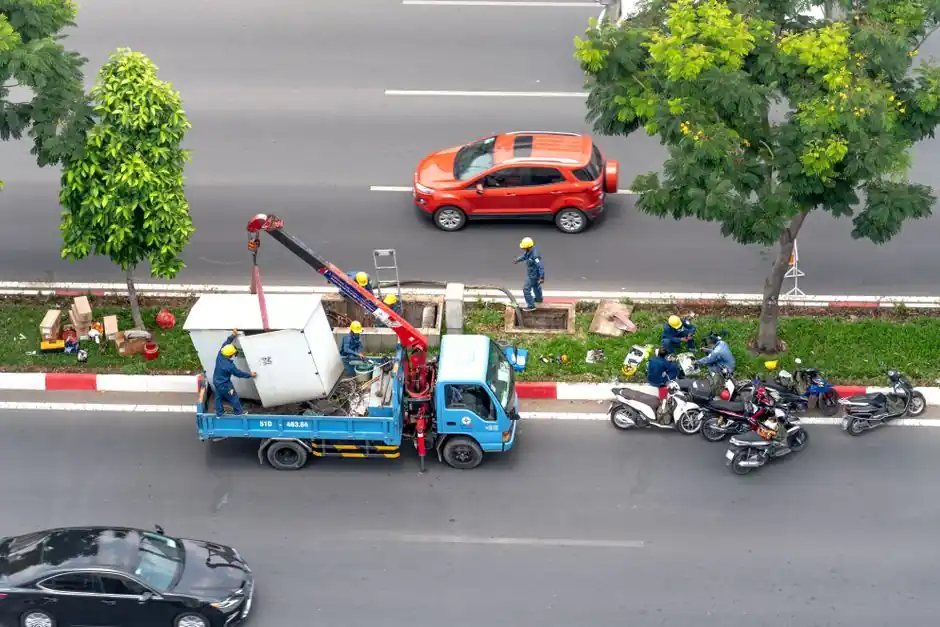
A 4x4 or all-terrain chassis is the configuration most utility fleets now specify for aerial work on right-of-way and easement jobs, because chassis-based trucks sink into soft ground and lose access long before their boom height becomes the limiting factor [S2].
Industry guidance from chassis-mounted aerial platform builders pairs 4x4 drivelines with high-clearance bodies and reinforced frames specifically for the rough-surface, soft-soil, and sloped-corridor conditions a line crew faces between substations and the meter [S3].
What "4x4 chassis for aerial work" actually means on a utility right-of-way
A 4x4 chassis for aerial work is a medium-duty commercial truck (typically Class 5 to Class 7, 16,000 to 33,000 lb GVWR) with a part-time or full-time four-wheel-drive transfer case, higher ground clearance, and a frame rail rated for the body builder's upfit [S4]. On right-of-way work, that driveline is paired with a bucket boom rated to ANSI A92.2 / CSA C225 principles (the categories that govern vehicle-mounted aerial devices), with working envelopes between roughly 40 ft and 75 ft for the most common trouble and distribution units [S4]. The point of the 4x4 hardware is not off-road performance in the pickup-truck sense, it is access: keeping the truck moving when the easement turns to mud, sand, or frozen ruts after a storm.
For crews whose work is mostly paved-corridor overhead, a 4x2 chassis is still acceptable, and Tier-4 final diesel or all-electric platforms such as the Terex Optima 55 ft on an International eMV Series Class 6 chassis are now offered with 135-mile driving range and a full bucket-workday on a single charge [S4]. A standard 4x4 chassis is the better spec when more than 20 to 30% of the routes include unpaved shoulder, turf, or seasonal soft ground, which matches most investor-owned-utility distribution line work.
Chassis class, GVWR, and the 4x4 decision
Class 5 platforms such as the Ford F-600, International CV, and GMC 6500 sit in the 16,000 to 19,500 lb GVWR band and cover the 40 to 60 ft working-height "trouble truck" envelope that most line crews run daily [S4]. Class 6 and Class 7 chassis in the 26,000 to 33,000 lb GVWR band are the standard for distribution trucks in the 50 to 75 ft range, where the 33,000 lb GVWR has held steady for years as poles shifted from wood to composite and concrete and transformer weights climbed [S4]. The Kenworth T380 is a representative Class 7/8 utility chassis with custom frame-rail layouts, 4x4 capability, and driver-comfort packages purpose-built for utility fleets [S7].
The 4x4 hardware itself adds roughly 800 to 1,500 lb of curb weight, eats into payload, and can require frame reinforcement; on a 22,000 lb GVWR chassis such as the DPM2-52, which delivers 52 ft of reach with no CDL required, going 4x4 typically forces the operator into a heavier chassis class or a smaller bucket [S6]. On a 33,000 lb GVWR distribution chassis the same driveline addition is much easier to absorb, which is why most fleets restrict 4x4 to the Class 5 trouble-truck and Class 7/8 transmission-truck builds.
Right-of-way access limits that make 4x4 non-negotiable
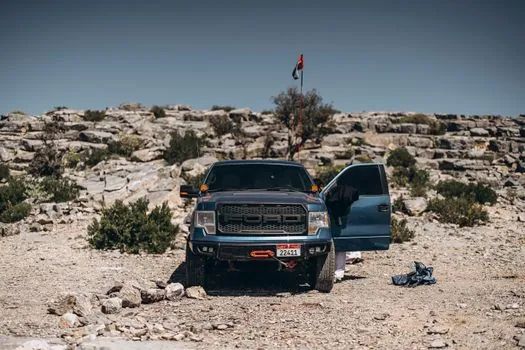
Chassis-based bucket trucks excel on solid, open ground and lose access fast on the soft, narrow, sloped easements that define right-of-way work; once a chassis sinks, the job stretches from a planned day to a multi-day recovery [S2]. Versalift's electric utility bucket truck program documents the same trade-off and pairs 4x4 or all-terrain chassis with high-clearance bodies and reinforced frames precisely because the boom height is irrelevant if the truck cannot reach the pole [S3].
On tighter residential easements where even a 4x4 chassis cannot pass, contractors typically fall back on tracked carriers or sub-30-inch-passage equipment such as the 28SC-30 easement crane (7,000 lb capacity, 30 ft boom, 3,000 lb at 15 ft, fits through a 30-inch door opening) instead of a wheeled aerial truck [S2]. Digger derricks in the 35 to 48 ft boom class add a 46-kV fiberglass inner boom on the 35-48DR, with full radial outriggers and optional electronic auger release, and a heavier 77-55D is mounted on a Load King tracked carrier for the worst soft-ground conditions [S2]. A 4x4 chassis truck is the right pick when the route is passable for a wheeled vehicle, the alternative is a tracked or specialty carrier.
Comparing the three right-of-way platform options
Three platform classes dominate utility right-of-way work, and the 4x4 decision sits inside that comparison. Trouble trucks at 40 to 60 ft working height on a Class 5 chassis (Ford F-600, International CV, GMC 6500) carry the daily 4x4 spec; distribution trucks at 50 to 75 ft on a roughly 33,000 lb GVWR chassis take the heavier poles and composite hardware; and transmission trucks from 75 ft up to roughly 240 ft (Terex TM Series, Elliott E-Line starting at 120 ft and reaching about 240 ft) handle the 100 ft-class work and the 115 ft contractor telescopics that still have to drop down to 60 to 75 ft distribution poles [S4].
On the four decision criteria that matter for right-of-way work, the matrix is straightforward: a 4x4 Class 5 trouble truck scores high on maneuverability and route access but loses on working height and pole-load capacity; a 4x2 or 4x4 Class 6/7 distribution truck on a 33,000 lb GVWR frame balances height and capacity and is the most common right-of-way workhorse; a 4x4 Class 7/8 transmission truck or a tracked carrier (Outback / Load King 77-55D) wins on soft ground but loses on narrow residential access, which is where 30-inch-passage cranes and aerial platforms take over [S2][S4]. The telescopic aerial work vehicle class also adds faster site-to-site road transit than a trailer-bound aerial lift, with automated safety features that matter when a crew relocates several poles per day [S8].
Electric and hybrid 4x4 chassis: what has actually shipped
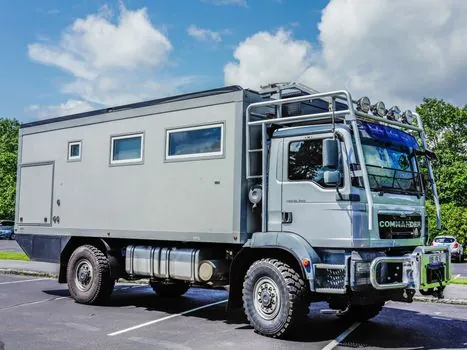
Electrification has reached the distribution class, with the Terex EV Aerial pairing a Terex Optima 55 ft aerial on an International eMV Series all-electric Class 6 chassis for a 60 ft working height, 135-mile driving range, and a full bucket-workday on the HyPower SmartPTO hydraulic-electric power take-off [S4]. Versalift's electric utility bucket truck line is the other credible production path, pairing battery-electric chassis with insulated booms and the same 4x4 / all-terrain chassis hardware used on the diesel units for crews that still need corridor access [S3].
These are not 4x4 by default on every configuration, and fleets buying electric should confirm transfer-case availability and frame clearance on the specific Class 6 chassis being quoted, since the battery pack raises floor height and changes the approach / departure angles that a 4x4 build relies on. The Aerial Ready Chassis (ARC) concept from UTEM is a useful spec anchor: a chassis-mounted aerial platform delivered upfit-ready, with workspace and height sized for the line crew rather than as a generic bucket-on-truck package [S1].
Used and fleet replacement: the 4x4 resale picture
On the used market, GMC and Chevrolet cab-and-chassis trucks equipped for utility, aerial-lift, or tree-service bodies are the most common medium-duty 4x4 candidates, with Ford F-650, Ford F-750, and Freightliner M2 also appearing as heavier 4x4 / 4x2 platforms that can support forestry or bucket upfits [S5]. For tree-service and forestry work specifically, the chassis is judged on engine, transmission, frame, brakes, and tires as well as the condition of the installed boom, body, and stabilizer gear, since the upfit is what carries most of the spec risk after five to ten years of service [S5].
Fleets looking at used inventory for right-of-way work should screen for documented transfer-case service, frame-rail cracks at the body-mount area, and outrigger-pad corrosion, because a 4x4 chassis that has spent its life on salted paved-corridor routes can be in better shape than a 4x2 that has been working muddy easements, and the inverse is also common. A practical pre-purchase gate is to require working-height, side-reach, capacity, body volume, and outrigger-spread data from the seller before site inspection, since those numbers are not recoverable in the field the way engine and brake condition are [S5].
Selection rules of thumb for right-of-way 4x4 specification

First, match chassis class to working height: 40 to 60 ft trouble truck on a Class 5 chassis (Ford F-600, International CV, GMC 6500), 50 to 75 ft distribution on a roughly 33,000 lb GVWR Class 6/7 chassis, 75 to 100+ ft transmission on a Class 7/8 chassis, and 115 to 240 ft specialist aerials on heavy custom chassis such as the Elliott E-Line [S4]. Second, spec 4x4 only when the route mix includes unpaved shoulder, turf, or seasonal soft ground; on paved-corridor-only routes a 4x2 returns better payload and fuel economy for the same boom [S3]. Third, for residential easements narrower than a wheeled truck can pass, plan a tracked or sub-30-inch-passage machine such as the 28SC-30 easement crane rather than forcing a 4x4 chassis into a job it physically cannot enter [S2].
For spec writing on the boom side, treat the working height and side-reach envelope as the primary decision, with material-handling capacity and outrigger spread as secondary, and chassis drive configuration (4x2 vs 4x4) as a third decision that follows from the route mix rather than from the boom itself [S3][S4]. A 4x4 aerial work truck is the correct answer for most line-crew work, but it is not the correct answer for every pole, and a spec that ignores the easement access problem is the one that loses the day to a stuck truck.
Trackable signals for the next planning cycle: electric Class 6 chassis availability in 4x4 configuration from the major chassis OEMs (Ford, International, Freightliner), any SAE J2880 / J2958 revision that touches chassis-mounted aerial work platform electrical isolation, and the next update to the Kenworth T380 4x4 utility chassis option list [S7].
Spec-level background on the components involved: pressure transmitter.
For related coverage, see Vented Elevator Buckets for Fine Powders at High Speed: Sizing, Patterns, Standards.