
A top-running single-girder end truck carries one bridge beam on wheels riding the top of the runway rail, while a top-running double-girder end truck supports two parallel beams with the hoist trolley running on rails attached to the top of the girders [S3][S4]. The choice is driven by four spec gates: rated capacity, span, hook approach height, and CMAA duty class.
For applications under 15 tons with spans up to 60-80 ft and Class A-C service, a single-girder end truck delivers the lowest installed cost and lightest runway loading; above those thresholds, a double-girder configuration becomes the practical baseline [S1][S2].
Configuration Definitions and Where Each Fits
A top-running single-girder end truck mounts the bridge beam on top of the runway rail with wheels rolling directly on the running surface, providing stable load transfer and higher capacity than an underrunning truck of the same frame size [S1]. The trolley and hoist on a single-girder crane most commonly run on the bottom flange of the bridge (underhung), though top-running trolley arrangements are also built [S2][S6].
A top-running double-girder end truck supports two parallel bridge girders with the hoist trolley traveling on rails attached to the tops of the girders, freeing the space between the beams for a larger hoist and an extra 18-36 in of hook height compared to a single-girder layout [S2][S3]. The two end trucks at each end of a double-girder bridge are dimensionally larger and carry more wheel load per corner than a single-girder truck of equivalent capacity.
Capacity, Span, and Cost-Effective Envelopes
Mazzella's cost-effective design table maps single-girder ratings to spans: 7.5 tons to 80 ft, 10 tons to 75 ft, 15 tons to 65 ft, 20 tons to 60 ft, 25 tons to 55 ft, 30 tons to 50 ft, and 35 tons to 45 ft [S2]. For double-girder builds, the Columbus McKinnon (Yale Shaw-Box) rotating-axle end-truck manual covers 5-20 tons / 10,000-40,000 lb ratings with spans up to 50 ft under the manual's own scope, while higher-tonnage double-girder cranes routinely extend well past 60 ft when box-girder fabrication is used [S3][S5].
Single-girder end trucks use one girder and one truck at each end of the bridge, which means less steel, a lighter overall bridge assembly, and a lower installed cost than a comparable double-girder system [S1]. The capacity-versus-span crossover is generally drawn at 15 tons and 65 ft; above that envelope, a double-girder crane becomes the more practical solution [S2].
Hook Height, Headroom, and Trolley Arrangement
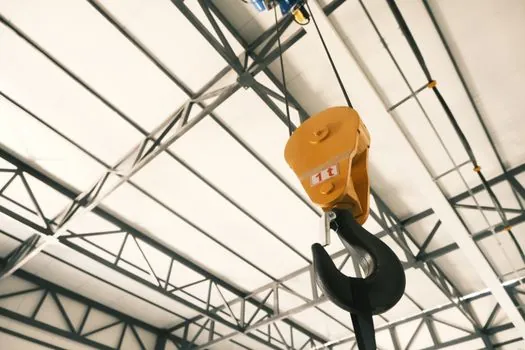
Double-girder cranes can provide an extra 18-36 in of hook height because the trolley and hoist are placed between or on top of the cross girders rather than hanging beneath a single beam [S2]. That headroom gain is the dominant reason a specifier moves from single to double girder when existing building columns constrain hook lift, not when capacity alone is the issue.
Single-girder cranes offer better hook approach for both the trolley and the bridge travel than a double-girder crane can, because there is no second girder offsetting the hoist laterally [S2]. When maximum coverage of a rectangular pick zone matters more than maximum lift height, a single-girder layout keeps the hook closer to the building columns at the ends of the runway.
Duty Class, Girder Type, and Runway Loads
CMAA classifies bridge cranes from A (standby) through F (continuous severe service), and double-girder cranes are generally used when the duty requirement is D (heavy), E (severe), or F (continuous severe) because the special hoisting equipment often includes an open winch with a split gearcase, heavy-duty motor, and brake mounted on a deck frame [S3][S4]. The same end-truck and hoist components can be configured into either a single- or double-girder bridge, so duty class is governed by the hoist package, not by the girder count alone [S3].
For spans over 60 ft or capacities over 20 tons, a fabricated box girder is normally the only choice, since standard structural I-beams and wide-flange sections are limited to roughly 60 ft mill-run lengths and the girder depth and weight per foot grow quickly beyond that [S3]. Box girders also lower the wheel loads imposed on the runway and support columns, which directly reduces the end-truck corner load that the runway must resist [S3].
Decision Matrix: Single vs Double Top-Running End Truck

Across four decision criteria drawn from the research: rated capacity, maximum span, hook height, and installed cost, a top-running single-girder end truck wins on cost and hook approach, a top-running double-girder end truck wins on capacity, span, and headroom [S1][S2][S3]. For a 10-ton build at a 50 ft span in CMAA Class C service, a single-girder end truck is the standard pick; for the same 10-ton rating stretched to 70 ft, or moved into Class D-F service, a double-girder end truck becomes the correct call [S2][S3][S4].
The crossover numbers worth memorising: single-girder cost-effective designs cap at 15 tons and 65 ft [S2]; box-girder fabrication is required past 60 ft span or 20-30 tons [S3]; double-girder gains 18-36 in of hook height over single-girder [S2]. Runway rails must be level and parallel within plus or minus 1/8 in, and structural steel must conform to ASTM A36, A572, or A992 Grade 50, per the CMCO end-truck assembly manual [S5].
Standards, Runway Constraints, and Sourcing Notes
Top-running single and double girder end-truck kits from US OEMs are designed to conform with CMAA 70 (top running multiple girder), CMAA 74 (top running and under running single girder), ANSI B30.2, and ANSI B30.17 [S5]. The same manual limits its assembly scope to 15 tonnes / 60 ft for single girder and 20 tonnes / 50 ft for double girder; configurations outside that envelope require engineered box-girder design and full CMAA 70 analysis [S5].
When the decision is borderline, specifiers should compare the two options on four numbers: rated load (tons), span (ft), hook height needed (ft), and CMAA duty class (A-F), then select the end-truck configuration that meets all four without over-spec [S2][S3][S4]. For a related read on long-span gantry leg behaviour, see why long-span gantry cranes use one flexible hinged leg; for context on the broader crane family the end truck serves, the overhead bridge crane and single-girder crane encyclopedia entries lay out the parent system.
For the relevant spec sheets and selection criteria, see truck mounted crane.