
For through-hardening ball and roller bearings, AISI 52100 with 0.95-1.10% C and 1.30-1.60% Cr, vacuum-degassed to roughly 6 ppm total oxygen and rated per ASTM E-45, sets the cleanliness benchmark that every other bearing steel is measured against [S4][S5].
Case-hardening grades 8620, 4320, and 3310 extend that chemistry into larger rings needing a tough core, while M50 (4% Cr, 1% V, 1% Mo) and stainless 440C cover high-temperature and corrosive slots, respectively. Procurement in 2026 still routes roughly 60% of failures back to material or metallurgical issues rather than lubrication or alignment, which is why cleanliness grade selection now drives more spec lines than hardness does [S5].
Cleanliness ratings: oxygen levels, inclusion size, and ASTM E-45
Steel cleanliness is rated on two axes: total oxygen content in ppm and the maximum inclusion size, both governed for bearing steels by ASTM A295 and the inclusion-rating practice ASTM E-45 (the method introduced in 1942 and revised many times since) [S5][S8]. Bearing-grade cleanliness targets sit at T.O. ≤10 ppm with a 15 µm inclusion size ceiling; for comparison, tire cord requires T.O. ≤15 ppm at 10 µm, but a tighter [H] ≤2 ppm hydrogen and [N] ≤40 ppm nitrogen cap [S9].
The improvement curve is concrete. Bearing steels ran around 35 ppm oxygen before acid hearth refining in the 1960s and 1970s, dropping to about 6 ppm today, and that change alone extended rolling contact fatigue life by roughly 10x, a result tied directly to smaller, fewer, and more uniformly distributed non-metallic inclusions [S4]. Vacuum induction melting (VIM) and vacuum arc remelting (VAR) deliver the cleanest lots, but a large share of global production still uses basic electric arc furnace plus ladle metallurgy, where lot-to-lot oxygen and inclusion variation remains the single biggest procurement risk [S3][S4].
Grade selection: 52100 vs M50 vs 440C vs case-hardening 8620
The four working-grade choices compare cleanly on four criteria: through-section hardness, maximum service temperature, corrosion resistance, and achievable cleanliness. Use this matrix to short-list before cost or lead-time enter the conversation. [S4]
Through-hardening 52100 lands at 58-64 HRC through the full section, runs to roughly 180°C continuous, and is rated at the tightest cleanliness grades; it is the default for ball and cylindrical roller bearings in standard industrial service [S3][S5]. High-temperature M50 (also covered by ASTM A600) keeps hardness up to about 430°C, costs 4-8x more per kg, and is the workhorse for aero-engine mainshafts and M50NiL for case-hardened aerospace variants. Stainless 440C holds 58-60 HRC, resists corrosion in washdown and food-grade environments, but tolerates lower cleanliness ceilings and runs roughly 30-40% above 52100 in price. Case-hardening 8620 gives a 0.7-3.5 mm carburized case at 58-64 HRC over a 32-48 HRC core, making it the right pick for large wind-turbine slewing rings and railway bearings where impact loads dominate [S2][S3][S5].
Heat treatment and metallurgical controls that protect the cleanliness grade
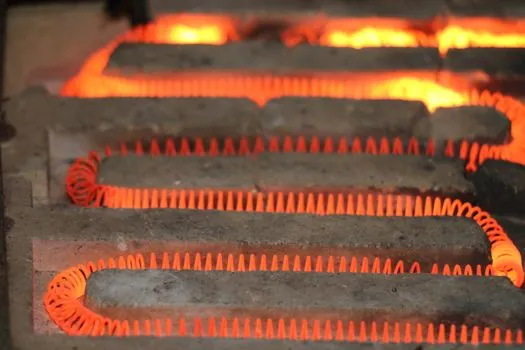
Through-hardening 52100 reaches its working hardness through austenitizing, oil quenching, and tempering, producing a fine martensitic matrix with dispersed carbides; the target 58-64 HRC band is not optional, drop below 58 HRC and rolling contact fatigue life falls off a cliff [S3][S5]. Case-hardening 8620, 4320, and 3310 use carburizing to push surface carbon to 0.65-1.10% in a 0.7-3.5 mm layer, followed by quench and temper to lock the case at 58-64 HRC over a tougher 32-48 HRC core [S3].
Heat treatment and cleanliness are not independent variables. Digital metallography at 1000x magnification, applied per ASTM E-45, quantifies inclusion content, grain size, microstructure, and retained austenite, and the resulting Source Qualification Inspection (SQI) data is what closes the loop between a steel heat lot and the bearing's actual fatigue performance [S4]. The catch: two facilities making the same part number from the same nominal material can still show markedly different L10 life because of subtle variation in inclusion distribution, so single-source qualification per plant (not per company) is the only reliable procurement path [S4].
Application fit: which grade goes where
Standard industrial motors, pumps, gearboxes, and automotive wheel hubs run 52100; it covers the bulk of the global bearing market by tonnage and is the safest spec for general MRO [S5][S6]. Wind-turbine main shaft and gearbox bearings, where case depths of 3-3.5 mm and large ring sections dominate, typically move to case-hardening 8620 or 4320 for impact tolerance [S2][S3].
Aero-engine mainshafts, helicopter transmissions, and some high-speed machine tool spindles escalate to M50 or M50NiL for the 300-430°C operating envelope, accepting the cost premium for dimensional stability under heat. Food, beverage, pharmaceutical, and marine bearings step to 440C or full stainless (e.g. AISI 304/316 for housings and shields) where corrosion would otherwise dominate failure modes, accepting a slight hardness penalty [S6][S7]. EV traction motors and high-speed spindles above 20,000 rpm are pulling demand toward VIM/VAR-remelted 52100 with tighter inclusion limits and, increasingly, ceramic-hybrid rolling elements [S5].
Sourcing constraints and 2026 supply chain signals
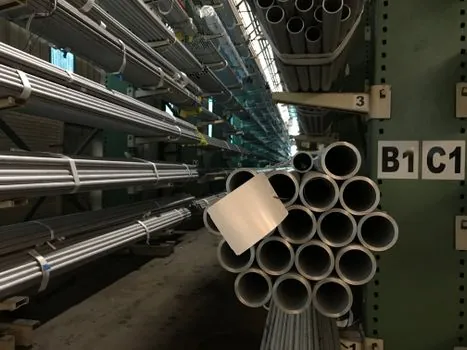
The global bearing steel market is projected to exceed $4.5 billion in 2026 with a roughly 5.2% CAGR, driven primarily by EV motor bearing demand above 20,000 rpm and wind-turbine scaling [S5]. Quality-tier procurement still anchors on ASTM A295 for chemistry, melting practice, and inclusion cleanliness, with ASTM E-45 as the inclusion-rating method, and EN 100Cr6 / DIN 100Cr6 / GB GCr15 as the equivalent designations for 52100 in Europe, Germany, and China respectively [S5].
U.S. buyers face Section 232 tariff exposure on imported bearing steel, which has shifted sourcing toward domestic EAF mills and away from Chinese GCr15, but the U.S. melt base still leans on basic electric arc furnace routes that produce more lot-to-lot variation than VIM/VAR [S5][S4]. To keep consistency, qualified buyers pair each mill heat with a metallographic SQI report covering inclusion rating, grain size, and retained austenite, rather than relying on a generic mill certificate. Lot-level traceability is the single highest-leverage control available to a procurement team that cannot audit the furnace.
Spec boundaries and what to watch next
52100 cannot be specified above roughly 180°C continuous without hardness loss, and it has no corrosion resistance, so any spec that mixes heat and humidity must escalate grade. M50 is uneconomical below the aero envelope; 440C underperforms 52100 on fatigue life in clean, dry service. Case-hardening 8620 is wrong for thin-section bearings where the case would consume the entire ring. [S5]
Two trackable signals for the next 12 months: published inclusion-rating tightening for EV traction motor steels, and any update to ASTM A295 or E-45 that codifies the VIM/VAR cleanliness tier separately from basic EAF. The related bearing-design piece on Self-Aligning Bearing Misalignment Compensation: Spherical Raceway Geometry Explained is the next read for engineers sizing ring geometry against the cleanliness grade chosen here.
For component-level specifications, see construction machinery and equipment, lamps and light fittings, and lighting equipment and electric lamps.