Battery-grade lithium carbonate is defined at ≥99.5% Li2CO3 purity with tightly capped impurity limits, while technical (industrial) grade typically sits around 90% purity and tolerates higher Fe, Na, and K loadings, a gap that drives separate supply chains, conversion routes, and pricing [S2][S5].
Major brine-based producers, including Albemarle at La Negra (Chile) and Nevada (USA), run parallel product lines for both grades plus an API/pharmaceutical line under GMP, with expansion sites announced for Antofalla (Argentina) and Arkansas (USA) [S1]. For buyers in 2026, grade selection is a specification problem first and a price problem second.
Purity thresholds and what each grade actually means
Industrial/technical grade lithium carbonate is generally quoted at around 90% purity, with higher tolerated levels of iron, sodium, and potassium, and is used in glass-ceramics, frits, gold treatment, and general chemical processing [S2]. The Livent technical-grade product is a micronized, free-flowing powder with a minimum of 99.3 wt% Li (i.e. on a lithium-metal basis) and a 55% below 45 µm particle-size distribution, supplied in 220.5 lb drums or 50 lb bags under CAS 554-13-2 [S3].
Battery grade, by contrast, is specified at high Li2CO3 purity (MSE PRO lists 99.5%) and is used as the precursor for lithium-ion cathode materials and battery-grade LiF [S5]. The 2026 Wiley techno-economic study evaluates virgin battery-grade lithium compounds production cost and confirms the focus on lithium carbonate as the reference lithium compound in the cost stack [S4]. In short, "technical" is glass- and frit-grade material, "battery" is cathode-precursor material, and the impurity ceilings, not just the headline purity number, separate them.
Decision criteria: which grade when
Use battery grade if the downstream is a lithium-ion cathode (NMC, LFP, NCA precursor routes) or electrolyte-grade LiF/LiPF6 synthesis, because the heavy-metal and sulfate ceilings in cathode plants exceed what 90% industrial grade can deliver [S2][S5]. For glass, frits, ceramics, enamels, and continuous castings, technical grade at ~99.3 wt% Li (Livent) is the industry workhorse and is over-spec for those uses, so the cost premium of battery grade is wasted [S3].
Use industrial/lower-purity grade only when the downstream tolerates Na, K, Fe, and sulfate in the hundreds-to-thousands of ppm range and the process chemistry does not carry those impurities into a sensitive step [S2]. A conversion step, such as turning technical-grade Li2CO3 into lithium hydroxide for cathode plants, is technically possible and is one of the routes covered in the 2026 market data on technical grade as battery chemistry feedstock [S7]. The EnergyX 2026 origin paper notes that 99.0% technical grade was historically adequate for glass fluxing, while battery-grade specifications required additional, battery-specific purification [S6].
Supply landscape and where each grade comes from
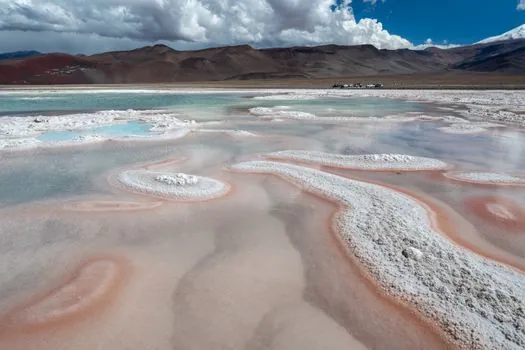
Albemarle's product page confirms parallel production of technical grade, battery grade, and an API/GMP grade from the same brine-to-carbonate flowsheet, with manufacturing at La Negra/Antofagasta (Chile) and Silver Peak, Nevada (USA), plus planned expansions at Antofalla (Argentina) and a new Arkansas site [S1]. That is a meaningful signal: a single site can run multiple grade campaigns by adjusting impurity polishing, not by re-mining.
Distribution for the Livent technical-grade product is fulfilled by ChemPoint for the United States, Canada, and Mexico, with shipment from stock and a quoted ship-by date of Dec 18 on the catalog entry, suggesting active rather than allocated availability in 2026 [S3]. For research and small-batch buyers, MSE PRO offers 99.5% battery-grade Li2CO3 in research pack sizes for cathode precursor and battery-grade LiF synthesis work [S5]. UPI Chem lists lithium carbonate tech grade (CAS 554-13-2) as a high-quality industrial compound with broad industrial use, again confirming the technical-grade line as commodity, not specialty [S8].
Process and cost context for 2026
The July 2026 Wiley techno-economic analysis evaluates the production cost of battery-grade lithium carbonate and related battery-grade lithium compounds, treating the carbonate route as the reference pathway against which hydroxide and direct-lithium-extraction routes are benchmarked [S4]. The July 2026 EnergyX piece documents the historical origin of battery-grade specifications and notes that legacy 99.0% technical carbonate was sufficient for glass fluxing, while modern battery cells required tighter battery-specific impurity ceilings, a driver of the spec gap that exists today [S6].
Direct production routes from saline brines to battery-grade Li2CO3 are documented in the older ACS hydrometallurgy paper from 2014, which proposed a route from Damxungcuo saline lake to overcome the difficulty of battery-grade production from high-Mg/Li brines; the paper is dated, but the route it describes, selective precipitation plus impurity polishing, remains a textbook reference for technical-grade to battery-grade conversion [S9]. US patent 8,691,169 B2 covers a method for producing battery-grade lithium from lithium chloride derived from lithium carbonate or lithium hydroxide, and explicitly distinguishes electrolyte-grade from battery-grade metallic lithium, a useful reminder that "battery grade" and "electrolyte grade" are not interchangeable [S10].
Comparison matrix: technical vs industrial vs battery grade
Three grades get quoted in the trade: industrial (often conflated with "technical"), technical (Livent-style, 99.3 wt% Li min), and battery (≥99.5% Li2CO3, impurity-controlled). On purity, industrial sits near 90% Li2CO3, technical at 99.3 wt% Li (≈99.5% Li2CO3 equivalent), and battery at 99.5% Li2CO3 or higher [S2][S3][S5]. On impurity tolerance, industrial tolerates higher Fe/Na/K, technical tightens those for glass and frits, and battery adds tight ceilings on heavy metals (e.g. Fe, Cu, Ni, Zn) and sulfate, plus controlled magnetic impurities for cathode plants [S2][S6]. On end-use, industrial feeds general chemicals, technical feeds glass, frits, ceramics, and enamels, and battery feeds NMC/LFP/NCA precursors and battery-grade LiF [S2][S3][S5]. On supply, all three run in parallel at major brine operators, with technical grade as a stocked distributor item and battery grade allocated under long-term offtake [S1][S3].
Limitations and failure modes in selection
Substituting technical grade into a cathode precursor line risks Na and Fe carry-over into the co-precipitation step, which depresses tap density and elevates residual sulfate in the sintered cathode; the 2026 EnergyX origin paper treats this as the primary reason 99.0% technical was rejected for battery use in the first place [S6]. Substituting battery grade into a glass-melt furnace is technically harmless but economically wasteful, because the impurity-polishing steps that produce battery grade carry a cost premium that glass and frits do not need [S3][S4]. Treating "battery grade" and "electrolyte grade" as synonyms is a common error, as the US patent 8,691,169 B2 separates them: battery-grade lithium supports cathode/anode precursors, while electrolyte grade is a tighter water-spec material feeding LiPF6 salt synthesis [S10].
For a buyer writing a 2026 specification, the practical move is to specify impurity ceilings (Fe, Na, K, Ca, Mg, Cu, Ni, Zn, sulfate, and magnetic-particle limits) for battery grade rather than rely on a single purity number, and to use a Li wt% specification (e.g. ≥99.3 wt% Li) for technical grade to avoid ambiguity between Li2CO3 assay and elemental Li assay [S3][S6].
Standards, documentation, and what to ask the supplier

There is no single international standard that defines "battery grade" Li2CO3 the way, for example, ISO 5167 defines orifice-plate flow measurement, so grade claims live in supplier datasheets and customer specifications rather than in a normative document [S1][S3]. The closest anchor points are supplier CoAs listing impurity ceilings, plant GMP statements for the API/pharma line at Albemarle, and distributor SDS/TDS bundles such as those shipped with the Livent technical-grade product [S1][S3].
For a defensible 2026 purchase, the request-for-quote should include: target Li2CO3 assay (≥99.5% for battery), maximum impurity list with ppm ceilings (Fe, Na, K, Ca, Mg, Cu, Ni, Zn, SO4), moisture and loss-on-ignition limits, particle-size distribution (e.g. D50 target), and country of origin, with the option to require brine-source disclosure (Chile, Argentina, USA, China) for traceability into EV-battery customer audits [S1][S3][S5]. Distributor availability for technical grade in North America remains active in 2026, with the Livent SKU 0118859 listed in stock at ChemPoint and shipped by Dec 18 [S3]. Research-scale buyers can source 99.5% battery-grade Li2CO3 from MSE PRO in small lots for cathode and battery-grade LiF synthesis [S5].
Trackable signals to watch over the next two quarters: Antofalla (Argentina) and Arkansas (USA) project milestones from Albemarle, which would add incremental battery-grade capacity to the 2027 supply curve [S1], and any revision of the Wiley/EnergyX techno-economic assumptions on conversion cost from technical to battery grade, which would re-rank the relative cost of buying battery grade versus upgrading in-house [S4][S6].
Spec-level background on the components involved: pressure transmitter, flow meter, and industrial valve.
Related analysis: Grouted Sleeve vs Threaded Coupler: Rebar Splicing Decision Map.