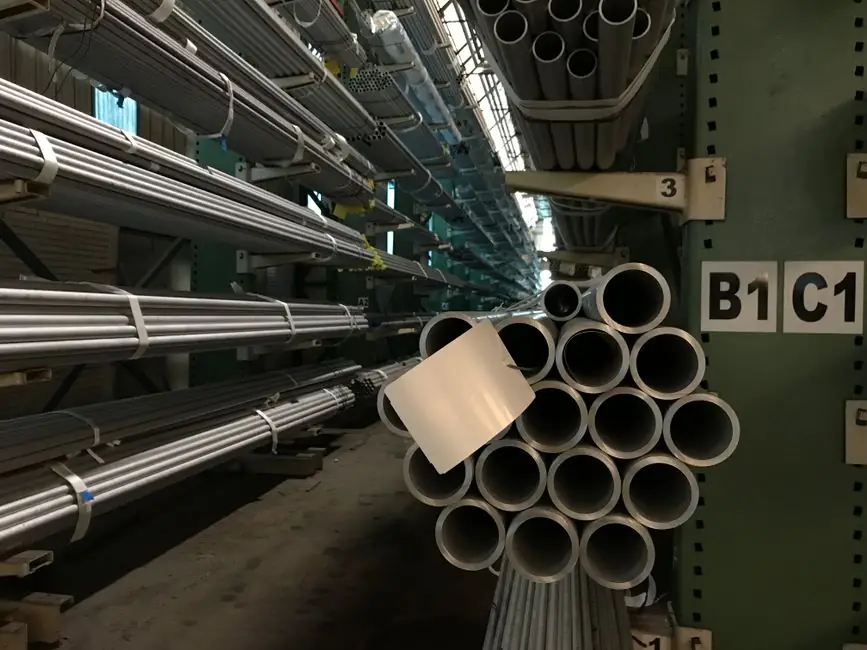
For 6061 and 6063 aluminum extrusions, the 2026 lead-time bands that procurement teams should plan against are 6-10 weeks for custom 6063 architectural and thermal profiles, 4-8 weeks for 6061 stock-die orders, and 15-day door-to-door shipments for 6061 sourced through major Chinese mills with export logistics built in [S1][S6][S7].
Hard alloys 7075 and 2024 are a different problem: U.S. specialty extruders still report lead times exceeding 12 months as of early 2024, driven by Airbus and Boeing pulling record build rates through aerospace Tier-1 supply [S1]. The 6061/6063 bracket sits in the soft-alloy regime, where die cost is the gating constraint, not billet chemistry, so the bottleneck is plant scheduling rather than press capability [S1][S2].
Why 6063 and 6061 Are Short-Stock Items
6063 aluminum is the dominant extrusion alloy for architectural, lighting, and heat-sink work because of its surface finish, corrosion resistance, and extrudability at 470-500°C billet temperatures, which lets presses run faster than on 6061 [S2][S10]. 6061 carries roughly 30-50% more magnesium and silicon than 6063, which gives higher mechanical strength but lowers extrusion speed, so 6061 runs slower on the press even though it is widely available [S2]. Both alloys feed standard dies, and that die inventory is what collapses lead time, since a new custom die alone takes 2-4 weeks before any billet is pushed [S6].
The extrusion-die build is the first clock a buyer should track: 2-4 weeks for a simple profile, longer for hollows with mandrels, and more time for tight tolerance work that requires trial billets and die correction [S6]. Once the die is approved, 6063 production campaigns on a standard press typically run 2-4 weeks of queuing plus run time, and 6061 campaigns run 2-6 weeks depending on T6 versus T6511 temper requirement and age-oven throughput [S1][S5].
Quoted Lead Times by Scenario, Late 2026
Custom 6061-T6511 and 6063-T6 architectural extrusions from U.S. regional mills are commonly quoted at 6-8 weeks, with 6061 sometimes slipping to 10-12 weeks when T6511 stress-relief stretch is required [S1]. 6063 standard angles, channels, and tubes from distributor stock move in 1-3 weeks because the die already exists and finished inventory is on the floor [S3]. Mills running export logistics programs for 6061 profiles advertise 15-day lead times on stocked cross-sections, which is consistent with billet-to-ship flow on a hot press line [S7].
The comparison that matters for a planner looks like this. Criterion 1: minimum lead time, 6063 stock dies at 1-3 weeks beats 6061 stock dies at 2-4 weeks, both beat 7075/2024 at 52+ weeks. Criterion 2: die cost to start, 6063 and 6061 are similar at low thousands USD for a simple hollow, but 6061 dies wear faster because of higher hardness, so per-piece die amortization runs higher on 6061. Criterion 3: temper availability, 6063 is commonly stocked in T5, 6061 in T6 and T6511, while 6061 is not produced in T3 because the water-quench requirement conflicts with T3 aging [S5]. Criterion 4: surface finish, 6063 anodizes to a brighter, more consistent color and is the default for visible architectural and LED heat-sink work, while 6061 is selected where strength dominates finish [S2][S4][S10].
What Actually Pushes a 6063 or 6061 Order Past 10 Weeks

Four drivers extend the soft-alloy lead time past the typical band. First, custom hollow profiles with internal ports need mandrel setup and trial billets, which add 2-3 weeks to the die phase [S3][S6]. Second, T6 versus T5 temper choice changes the post-extrusion aging step: 6063-T5 ages at lower temperature with no quench, while 6061-T6 requires solution heat treat, water quench, and artificial aging, which adds oven time and floor space [S2][S5]. Third, anodizing or powder coating routes the part through a finisher, and that queue can add 1-3 weeks depending on rack density and lot size [S3]. Fourth, 6061 used in aerospace interior brackets, galley trim, and lavatory hinges is pulled in by the same demand wave that has 7075/2024 backlogs at 12+ months, so allocation rather than press capacity is the limiter [S1].
Order sequencing rules: place die orders first and run a die-trial sample, approve metallurgy and dimensions, then release the production lot. Skipping the sample and pushing straight to a 10,000-pound run is the most common way a 6-week order becomes a 14-week order, because dimensional drift is caught only after the lot is in aging [S6]. For 6063-T5 heat-sink runs, the alloy and temper default keeps the post-extrusion path short and the bottleneck is press scheduling, not metallurgy [S5].
Selection Rules: When 6063 Wins, When 6061 Wins
Pick 6063 when the application is architectural, decorative anodized trim, LED heat sinks, window and door frames, irrigation tubing, or any visible finish where corrosion resistance and color consistency matter; it extrudes faster, finishes better, and is the cheapest soft alloy to run in volume [S2][S4][S10]. Pick 6061 when the part carries structural load, mounts to a chassis, frames a vehicle, or feeds machining stock for fittings; the higher magnesium and silicon content delivers the strength that justifies the slower press speed and T6 heat treatment [S2][S4][S8].
For lighting and thermal management, 6063-T5 remains the default heat-sink alloy and the Aluminum Extruders Council notes 1000 and 3000 series can dissipate better but lack the threaded retention that mounting hardware requires, so 6063 stays the practical default [S5]. For structural framing on construction and industrial equipment, 6061-T6 is the default, and the same alloy in T6511 is specified when post-machining stability matters because the stretch relieves residual stress from quenching [S1][S5]. The two alloys are not interchangeable on lead time: a 6063 quote and a 6061 quote with the same die geometry will not finish on the same week, because 6061 runs slower and adds heat-treat steps [S2].
Sourcing Channels and Logistics Reality

Three channels move soft-alloy extrusion. Channel one: domestic mill direct, where lead time is die-build plus press queue, typically 4-10 weeks, and the buyer owns the die. Channel two: metals distributor, where standard 6061 and 6063 angles, channels, tubes, and bar sit on the shelf for 1-3 week shipment, and the distributor owns the die [S3]. Channel three: export mill with logistics program, where major Chinese producers offer 15-day lead times on stocked 6061 profiles, which fits engineering builds and prototyping but introduces ocean transit, customs, and the longer payment terms of cross-border procurement [S7].
Risk management for 2026 means not single-sourcing. Hard-alloy buyers learned this when 7075/2024 lead times crossed 12 months, and soft-alloy buyers should not assume 6061/6063 will stay at 6-8 weeks if aerospace interior demand keeps pulling from the same press pool [S1]. Holding a distributor-release blanket order on the most common 6063 angles and 6061 channels insulates production from a single mill's queue, and the broker inventory sits closer to the buyer than the mill's finished-goods warehouse does [S3].
Standards, Tolerances, and Documentation to Lock at Quote
Alloy and temper must be cited to Aluminum Standards and Data, which is the Aluminum Association register that the Aluminum Extruders Council references for available tempers, including the T6 designation that 6005A gained in the latest edition of that register [S5]. For 6061, the available tempers are T4, T5, T6, and F as extruded; T3 is not produced for 6061 because the alloy requires water quench and does not naturally age to T3 [S5]. For 6063, T5 and T6 are the typical tempers, with T5 being the lower-cost option for heat sinks and architectural work [S2][S5].
Dimensional tolerance should be referenced to the extruder's published tolerance sheet, not assumed, because soft-alloy standard tolerances are wider than what most drawings actually need and tighter tolerances raise cost and lead time on the die correction cycle [S3][S6]. Surface specification drives finish routing: bare mill finish, anodized per Aluminum Association class I or II, powder coat, or brushed, and each adds queue time at a finisher rather than at the press [S3]. Documentation typically includes a mill test report citing chemistry per Aluminum Standards and Data registration, mechanical properties per temper, and dimensional inspection per the agreed drawing.
Where This Goes Through 2026
The 6061/6063 band will hold in the 4-10 week range as long as aerospace does not pull soft-alloy press time the way it has pulled hard-alloy press time since 2023, and 7075/2024 lead times will not normalize until the Airbus and Boeing delivery cadence settles from the 2024-2026 ramp [S1]. Aluminum billet flow, press scheduling at regional soft-alloy mills, and the export channel out of China are the three nodes to monitor; any disruption on one of these typically adds 2-4 weeks to the soft-alloy quote before the buyer sees it on a PO acknowledgment. A reasonable trackable signal is whether major Chinese mill export lead times for 6061 stock profiles stay at the 15-day mark through Q4 2026, since a slip from 15 to 25 days usually precedes a domestic U.S. soft-alloy tightening by one quarter [S7].
For related volume context, end-market demand is concentrating in EVs, solar, and construction, and the upstream billet map is the constraint to watch if soft-alloy lead times begin to drift. The base aluminum alloy family reference is the right starting point when 6061 versus 6063 is still being decided at the design stage.
For the relevant spec sheets and selection criteria, see lead screw, and time relay.