A time relay, also called a timer relay or time delay relay, is a control component that opens or closes its contacts after a deliberate, adjustable delay rather than instantaneously. Where an ordinary control relay answers whether to switch, the time relay answers when to switch, making it the basic building block for sequencing, interlocking, and cyclic control in motor starters, pumps, ventilation, lighting, and process panels.
Although the underlying contacts follow the same relay physics covered by IEC 61810, the timing behavior of a modern time relay is governed by IEC 61812, which defines timing performance figures such as setting accuracy, repeat accuracy, and recovery time. This guide decodes the timing functions, the timing technologies behind them, the spec-sheet numbers, and the selection logic used by panel builders and procurement engineers.
This guide is aimed at industrial purchasing engineers and panel design engineers. It covers 6 chapters from timing functions, timing technologies, contact configurations, spec-sheet decoding, to selection decisions, with 7 selection FAQs and manufacturer comparisons, helping you build a complete timing-control knowledge framework. All parameters reference IEC 61812-1, IEC 61810-1, IEC 60947 utilization categories, and published manufacturer datasheets.
Chapter 1 / 06
What is a Time Relay
A time relay is a control device that introduces a precise, adjustable delay between an input event and the resulting change of state of its output contacts. A standard control relay transfers its contacts essentially instantaneously when its coil is energized or de-energized; its role is to multiply, isolate, and amplify a control signal. A time relay adds an internal timing element so that the contact transition is deferred by a preset interval, often called the timing value or set time. This single capability turns a relay from a switch into a sequencer, which is why timing relays are among the most common components on any motor control center, pump panel, or HVAC controller.
Functionally, the device combines three parts: an input or trigger stage that detects when timing should start or stop, a timing element that measures the interval, and an output stage of one or more changeover contacts that switch the load. In electromechanical and solid-state hybrid designs the output is a small power relay; in fully solid-state designs the output may be a transistor or triac. The distinction between the timing logic and the output stage matters for selection, because the timing accuracy and the contact rating are independent specifications that come from different parts of the device.
The history of industrial timing illustrates how the technology improved. The earliest time delay relays used pneumatic dashpot dampers, where air or fluid is forced through a small orifice or bladder to slow the motion of an armature, producing the delay. Dashpot timers were the first automatic timers used in industry and, because of their simple and robust construction, can still be found running in older plants. The next generation used a synchronous motor driving a gear train and a firing arm that tripped a snap-action switch after a fixed number of revolutions, with the interval set by motor speed and gear reduction. From the late twentieth century onward, solid-state timers using RC networks, and later quartz oscillators with microcontrollers, replaced both, offering far better precision and repeatability at lower cost.
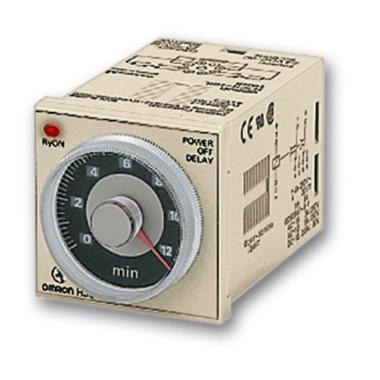
In terms of timing range, the span covered by a single product family is remarkable. The Omron H3DK multi-range timer, for example, is selectable across eight decade ranges from 0.1 second up to 1,200 hours, and the Schneider Zelio Time RE22 family covers roughly 0.05 second to 300 hours. That breadth means one device type can serve from a 100 ms anti-bounce delay to a 50-day batch cycle, with the engineering challenge shifting from mechanism to the accuracy and stability of the oscillator over temperature and supply variation.
Four engineering qualities determine how good a time relay is for a given job: timing accuracy and repeatability, the number and flexibility of timing functions, the contact rating and utilization category, and the immunity of the timing to supply and temperature variation. Together these define whether the device will hold its set interval across thousands of cycles and years of service, which is the real test of an industrial timer as opposed to a hobby timing circuit.
Chapter 2 / 06
Timing Functions
The timing function defines the relationship between the input signal and the contact transition over time. Choosing the wrong function is the single most common cause of a control sequence behaving incorrectly, because the contacts may operate at the right moment relative to the wrong event. The table below summarizes the mainstream functions standardized across manufacturers and described in the IEC 61812 framework.
Function
Common name
Output behavior
Typical use
On-delay
TON, delay-on-make
Output energizes after delay t from power-up
Staggered sequential starts
Off-delay
TOF, delay-on-break
Output drops out delay t after trigger removed
Fan/pump run-on, cool-down
Interval (on)
One-shot on power-up
Output energizes at power-up, drops after t
Timed purge, prelube pulse
Single-shot
Pulse on trigger
Trigger gives fixed pulse t, ignores trigger during t
Alarm pulse, debounce
Flasher / recycle
Repeat cycle
Output cycles on/off repeatedly while powered
Beacons, intermittent pumps
Star-delta
Wye-delta
Star time, dead time, then delta
Reduced-voltage motor start
On-delay (TON, delay-on-make or delay-on-operate) is the most widely used function. When control voltage is applied, the timing interval t begins, and only at the end of t does the output energize. It is the natural choice for staggering loads: applying power to several on-delay timers with different settings starts motors one after another, spreading inrush current and avoiding a single large demand spike. In contactor-based logic, an on-delay timer is often what prevents two pieces of equipment from starting in the same instant.
Off-delay (TOF, delay-on-break or delay-on-release) inverts the logic. The output energizes immediately when the trigger is applied, and when the trigger is removed the interval t begins, with the output de-energizing only at the end of t. This keeps a load running for a defined period after the initiating event ends, the classic case being a cooling fan or lubrication pump that must run on after a motor stops. A subtlety here is that the timing electronics must remain powered during the delay, which is why many off-delay timers require a separate control supply rather than relying on the trigger.
Interval (interval on) energizes the output at the instant control voltage is applied and de-energizes it at the end of t, giving a single timed pulse referenced to power-up rather than to a separate trigger. Single-shot (one-shot) instead waits for a trigger, then produces a fixed-length output pulse t and ignores any further triggers until the pulse completes, which is useful for debouncing and for generating a clean fixed pulse from a noisy or held input.
Flasher and recycle functions produce a repeating sequence of on and off intervals as long as the device is powered, used for beacons, intermittent dosing pumps, and periodic purge or vent cycles. Manufacturers distinguish flasher off-first from flasher on-first by which state the cycle starts in, and symmetric from asymmetric recycle by whether the on and off intervals are independently adjustable. Star-delta is a dedicated dual-stage function for reduced-voltage motor starting, and is covered in Chapter 4 because its value lies in the contact sequencing and transition dead time rather than in a single interval.
Multifunction (multi-mode) timers combine several of these functions in one device, selected by a front rotary switch or DIP configuration. The Omron H3DK-M and the Schneider Zelio Time RE17 and RE22 multifunction models are common examples, each offering on-delay, off-delay, interval, single-shot, and flasher modes in a single part number. Consolidating to a multifunction part reduces spare-part inventory and lets maintenance reconfigure a panel without sourcing a new SKU, at the cost of a slightly higher unit price and the small risk of a mode being mis-set in the field.
Chapter 3 / 06
Timing Technologies
The timing element is what physically measures the interval, and its technology sets the floor on accuracy, repeatability, and stability over temperature. Four technologies appear across the installed base, from legacy mechanisms still in service to the digital designs that dominate new panels. The table below compares their engineering characteristics.
Technology
Typical repeat accuracy
Practical range
Relative cost
Typical status
Pneumatic dashpot
~10% or worse
0.1 s to ~3 min
Low
Legacy, still in service
Synchronous motor
~1 to 5% FS
1 s to hours
Medium
Legacy / niche long times
Solid-state RC
~1 to 2% FS
0.05 s to ~100 h
Low
Mainstream
Digital / quartz
~0.2 to 1% FS
0.01 s to 1,200 h
Medium
Mainstream, high-end
Pneumatic dashpot timers create the delay mechanically by forcing air or fluid through a restricted orifice or a bellows as an armature moves, so the rate of motion, and therefore the delay, is set by an adjustable needle valve. They are simple, rugged, and require no auxiliary electronics, which is why dashpot units installed decades ago still run today. Their weaknesses are accuracy and stability: the delay drifts with temperature because fluid viscosity changes, with orifice wear, and with mounting orientation, so repeat accuracy on the order of ten percent or worse is normal. They are best treated as legacy and replaced by solid-state equivalents during refurbishment.
Synchronous-motor timers use a small AC synchronous motor whose speed is locked to the mains frequency, driving a reduction gear train and a firing arm that trips a snap-action switch after a set angular travel. Because the motor speed is tied to the line frequency, these timers are reasonably repeatable and were favored for long intervals before reliable digital long-timers existed. Their drawbacks are mechanical wear in the gear train, dependence on a stable mains frequency, and audible operation, so they survive mainly in legacy equipment and a few niche long-duration roles.
Solid-state RC timers measure the interval by charging a capacitor through a resistor and comparing the rising voltage against a threshold, with the resistance (often a potentiometer) setting the time. They eliminate moving parts, improve repeatability over dashpot designs, and are inexpensive, which made them the workhorse of analog timing for decades. The residual limitation is that capacitor tolerance, capacitor aging, and the temperature coefficients of the RC components introduce drift, so accuracy is typically in the one to two percent range and degrades for very long intervals where large capacitances are required.
Digital and quartz timers count cycles of a crystal oscillator with a microcontroller, then drive the output relay or solid-state switch. Because a quartz crystal has an extremely stable frequency, these designs achieve the best accuracy and repeatability, often quoted around plus-or-minus 0.2 to 1 percent of full scale, and they hold that accuracy across wide temperature and supply ranges. They also enable the multi-range, multi-mode behavior of modern products: the Omron H3DK, for instance, combines eight decade timing ranges from 0.1 second to 1,200 hours with a repeat accuracy specified at plus-or-minus 1 percent FS maximum, all in a single 22.5 mm DIN-rail device. Digital architecture is also what makes wide-range multi-voltage supplies (for example 24 to 240 V AC/DC on one part) practical.
Chapter 4 / 06
Contacts, Outputs and Wiring
The output stage and its wiring determine whether a correctly timed signal actually controls the load reliably over the device life. Two decisions dominate: the type of output (electromechanical relay versus solid-state) and the contact form (number of poles and changeover configuration). Industrial timer outputs are most often electromechanical relay contacts rated in the 5 A to 8 A range at 250 V AC for resistive loads, with the Omron H3DK rated 5 A at 250 V AC / 30 V DC and the Schneider Zelio RE17 and RE22 relay outputs rated 8 A. Solid-state (transistor or triac) outputs switch faster and survive far more operations, which suits high-cycle flasher duty, but carry much less current, with the Schneider solid-state Zelio outputs rated around 0.7 A.
Contact form is described by the number of poles and whether each is a changeover. SPDT, also written as one C/O (changeover) or 1 Form C, gives a single common terminal that switches between a normally-open and a normally-closed contact, suitable for one switched circuit. DPDT, two C/O or 2 Form C, provides two independent changeover sets on a common actuation, used when two circuits must be switched together or when an interlock contact is needed alongside the main switched circuit. The table below maps the classic timed-contact symbols engineers see on ladder diagrams.
Contact symbol
Name
State before timing out
State after timing out
NOTC
Normally open, timed closed
Open
Closed
NCTO
Normally closed, timed open
Closed
Open
NOTO
Normally open, timed open
Closes then times open
Open after delay
NCTC
Normally closed, timed closed
Opens then times closed
Closed after delay
Matching the contact to the load is more than reading the resistive ampere figure. Coils, contactors, and motors are inductive, so the relevant rating is the utilization category from IEC 60947: AC-15 for switching AC electromagnetic loads and DC-13 for DC electromagnets. A contact rated 8 A resistive may be limited to a far lower AC-15 current because of the arc energy when an inductive load opens, so the AC-15 / DC-13 figures, not the resistive headline, govern contactor-coil switching. Lamp and capacitive loads add a separate concern: high inrush at make can weld a contact, so the make or inrush rating must be confirmed independently of the steady-state rating.
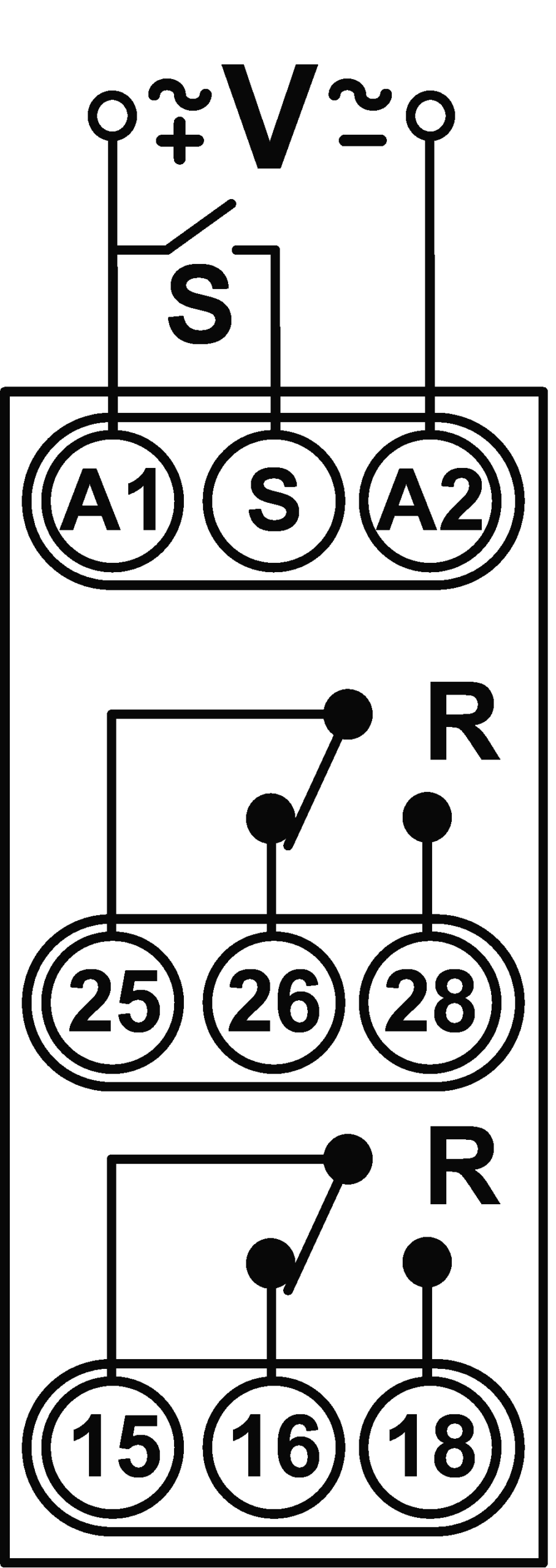
Wiring architecture varies by function. On-delay and interval timers are usually two-terminal in the sense that applying supply both powers the electronics and starts timing. Off-delay and many multifunction timers split the roles: terminals A1 and A2 carry an always-on control supply for the electronics, and a separate low-power control input acts as the trigger that starts and stops timing. This is why an off-delay timer wired as if it were single-supply often fails to time after the trigger drops: the electronics lose power exactly when they need to keep counting. True off-delay (impulse) variants avoid the separate supply by storing energy internally, historically in a motor flywheel and today in a capacitor, so they can complete the interval after the main supply is removed.
The star-delta function deserves its own note because it is defined by sequencing rather than a single interval. The timer first closes the star contactor so the motor windings run in star at reduced voltage and starting current, counts the star time, then opens the star contactor, holds a short transition dead time of typically 50 to 100 ms, and only then closes the delta contactor for full-voltage running. The dead time is the safety-critical feature: it guarantees the star contactor has fully opened before the delta contactor closes, preventing a destructive phase-to-phase short across the two contactors. A generic on-delay timer cannot provide this interlocked dead-time transition, so a purpose-built star-delta timer or a dedicated star-delta function on a multifunction unit is required for reduced-voltage starting.
Chapter 5 / 06
Key Specification Parameters
Reading a timer datasheet is a fundamental skill for panel and procurement engineers. A single product may list twenty or more parameters, but a handful drive the selection decision: timing range, timing function set, setting accuracy and repeat accuracy, voltage and temperature influence, recovery (reset) time, supply voltage range, contact rating and utilization category, and ambient temperature. Each is explained below, with IEC 61812 as the reference framework for the accuracy terms.
Timing range is the span of intervals the device can produce, usually split into selectable decade ranges so the same hardware can cover, for example, 0.1 to 1.2 seconds at the fine end and 100 to 1,200 hours at the coarse end. Wide-range parts such as the Omron H3DK (0.1 s to 1,200 hours across eight ranges) and the Schneider Zelio RE22 (about 0.05 s to 300 hours) reduce SKU count, but resolution within a range matters: a coarse 1,200-hour range cannot resolve a few-second setting accurately, so choose the range whose span brackets your interval most tightly.
Setting accuracy is how close the interval produced at a marked dial position is to the nominal value, while repeat accuracy (repeatability) is how consistently the device reproduces the same interval across successive operations under identical conditions. IEC 61812 treats these as separate figures, and for cyclic or batch processes repeat accuracy is usually the more important of the two. The Omron H3DK, for example, specifies a measurement accuracy of plus-or-minus 1 percent FS maximum (with a small additional fixed error on the fastest 1.2 second range). Setting accuracy is typically looser than repeat accuracy because dial calibration and component tolerance both contribute.
Voltage influence and temperature influence quantify how much the timed interval shifts with supply voltage variation and with ambient temperature change, each expressed as a percentage of the set value. These coefficients separate a precision digital timer, which holds its interval across the rated supply and temperature window, from an analog RC or dashpot timer whose interval visibly drifts as conditions change. For outdoor or wide-temperature panels, the temperature-influence figure can dominate the real-world accuracy budget.
Recovery (reset) time, sometimes called the minimum power-off time, is the interval the device must be de-energized before it is ready to time a fresh cycle accurately. Cycling power faster than the recovery time can produce a short or inaccurate next interval, which is a real concern for fast flasher and single-shot applications and is easy to overlook on a datasheet.
Supply voltage on modern timers is increasingly a wide multi-voltage range rather than a fixed value: parts such as the Omron H3DK-M2 and the Schneider Zelio families accept roughly 24 to 240 V AC/DC on a single device, which simplifies stocking and lets one part serve both control-voltage and line-voltage panels. Contact rating and utilization category follow Chapter 4: confirm the resistive rating, the AC-15 / DC-13 figures for inductive coil switching, and the make/inrush rating for lamp and capacitive loads. Ambient operating temperature rounds out the set, with industrial timers commonly rated about minus 20 to plus 60 degrees C; the Schneider Zelio RE17 is rated minus 20 to plus 60 degrees C, and applications outside that window need a higher-spec part or panel climate control.
Chapter 6 / 06
Selection Decision Factors
To convert the preceding chapters into a specific model, follow the decision sequence below. Most selection mistakes come not from a single wrong number but from deciding parameters in the wrong order, for example fixing on a part before confirming the timing function the sequence actually needs. These eight steps work as a fixed RFQ template for a timing relay.
Timing function: First decide on-delay, off-delay, interval, single-shot, flasher/recycle, or star-delta, derived from the control sequence on paper. For reduced-voltage motor starting, specify a star-delta function with its transition dead time, not a generic on-delay timer.
Timing range and resolution: Choose the decade range that brackets your interval most tightly so the setting resolution is adequate. Reserve headroom if the interval may be tuned upward in commissioning.
Accuracy class: Distinguish coarse sequencing (where one to two percent is fine and a solid-state RC timer suffices) from repeatable batch or dosing duty (where digital/quartz repeat accuracy near plus-or-minus 0.2 to 1 percent FS is justified). Match the accuracy to the process, not to the catalog top.
Supply voltage and architecture: Confirm the control voltage and whether the function needs a separate control input plus always-on supply (typical for off-delay) or a single supply. Wide-range multi-voltage parts simplify stocking but verify they cover both your AC and DC needs.
Output type and contact form: Relay output for general 5 to 8 A switching and DPDT for dual-circuit or interlock needs; solid-state output for high-cycle flasher duty at low current. Map SPDT or DPDT to the number of independent circuits switched.
Load category and ratings: Size the contact by utilization category (AC-15 for AC coils, DC-13 for DC) rather than the resistive headline, and confirm the make/inrush rating for lamp and capacitive loads.
Mounting and environment: DIN-rail modular (17.5 to 22.5 mm widths) for new panels, 8-pin or 11-pin socket (octal/undecal) for retrofit into existing relay sockets, plus ingress protection and ambient temperature (commonly minus 20 to plus 60 degrees C) for the install location.
Certifications and total cost: Confirm IEC 61812-1 timing compliance, IEC 61810-1 contact safety, and panel approvals such as UL 508A acceptance, then weigh purchase price against SKU consolidation: a multifunction wide-voltage part often lowers total inventory and spares cost even at a higher unit price.
One frequently overlooked dimension is serviceability and standardization: whether the timer fits an existing socket footprint, whether the front-panel function and range can be reconfigured without removing the device, and whether the maker keeps long-term availability of the part. Standardizing a plant on one or two multifunction families from established makers such as Omron (H3DK), Schneider Electric (Zelio Time), Eaton, IDEC, and Macromatic reduces the spare-part matrix and shortens repair response after years of service, which usually outweighs small per-unit price differences across the lifecycle.
FAQ
What is the difference between an on-delay and an off-delay time relay?
On-delay (TON, delay-on-make) waits before acting: when control voltage is applied the timer counts the preset interval t, and only at the end of t does the output energize. Off-delay (TOF, delay-on-break) acts immediately and waits before releasing: the output energizes the instant the trigger is applied, and when the trigger is removed the timer counts t before the output de-energizes. As a rule of thumb, on-delay is used to stagger sequential starts and avoid inrush, while off-delay keeps fans, pumps, or lubrication running for a cool-down period after the machine stops. Many off-delay designs need an auxiliary control supply or an energy buffer so the timer can run while the trigger is gone.
What is the difference between a time relay and a standard control relay?
A standard control relay (per IEC 61810) switches its contacts essentially instantaneously when the coil energizes or de-energizes; its job is signal multiplication and isolation. A time relay adds a deliberate, adjustable delay between the input event and the contact transition, governed by an internal timing element. Modern time relays are covered by IEC 61812, which specifies timing performance such as setting accuracy, repeat accuracy, and recovery time on top of the contact-level safety addressed by IEC 61810. In short, the control relay answers whether to switch, while the time relay answers when to switch.
What does a multifunction (multi-mode) timer mean and is it worth it?
A multifunction timer integrates several timing modes in one device, typically on-delay, off-delay, interval (one-shot on), single-shot, and one or more flasher/recycle modes, selected by a front rotary switch or DIP settings. The Omron H3DK-M and Schneider Zelio RE17/RE22 multifunction models are common examples. The benefit is inventory consolidation: one part number replaces five or more single-function SKUs, which cuts spare-part stock and lets maintenance reconfigure a panel in the field. The trade-off is a slightly higher unit price and a small risk of a mode being mis-set. For OEM panels built in volume, a single-function timer can be cheaper and harder to misconfigure.
How accurate are time relays and what affects the accuracy?
Modern solid-state and digital timers achieve repeat accuracy on the order of plus-or-minus 0.2 to 1 percent of full scale, while older dashpot (pneumatic) and synchronous-motor designs are typically plus-or-minus 10 percent or worse and drift with temperature and wear. IEC 61812 separates several accuracy figures: setting accuracy (how close the marked dial value is to the real interval), repeat accuracy (consistency between successive operations), plus voltage influence and temperature influence coefficients. For repeatable batch or sequencing applications, repeat accuracy matters most; the Omron H3DK, for example, specifies repeat accuracy of plus-or-minus 1 percent FS maximum.
Why does my off-delay timer need an auxiliary supply or external control input?
An off-delay function must keep timing after the trigger that started it has gone away, so the timing electronics still need power during the delay. Two architectures exist. Control-signal timers use a separate, always-on supply (A1/A2) for the electronics and a low-power control input (the trigger) to start and stop timing; removing the control input begins the off-delay while the supply stays live. True off-delay (impulse) timers run from a single supply and use an internal energy buffer (capacitor or, historically, a motor flywheel) so the timer can complete its interval after the main supply drops. Wiring a control-signal off-delay timer as if it were single-supply is one of the most common field faults.
What is a star-delta timer and how is it different from a generic timer?
A star-delta (wye-delta) timer is a dedicated two-stage timer for reduced-voltage motor starting. It energizes the star contactor first to run the motor windings in star (lower starting current and torque), counts the star time, then opens the star contactor, waits a short dead time, and closes the delta contactor to run the motor at full voltage. The defining feature is the built-in transition dead time (typically 50 to 100 ms) that guarantees the star contactor has fully opened before the delta contactor closes, preventing a phase-to-phase short across the contactors. A generic on-delay timer lacks this interlock and dead-time sequencing, so it should not substitute for a purpose-built star-delta timer.
How do I select the contact rating and configuration for a time relay?
First match the load. Relay (electromechanical) outputs on industrial timers are commonly rated 5 A to 8 A at 250 V AC resistive, but inductive loads such as contactor coils and motors demand utilization-category derating (AC-15 for AC coils, DC-13 for DC), so check the AC-15/DC-13 figures, not just the resistive rating. Solid-state (transistor or triac) outputs switch faster and last longer for high-cycle flasher duty but carry far less current, often around 0.7 A. Then match the contact form to the logic: SPDT (one changeover, C/O) for a single switched circuit, DPDT (two changeover) when you need to switch two independent circuits or add an interlock. For high inrush or lamp loads, confirm the make/inrush rating separately from the steady-state rating.
Time Relay Manufacturers
Source-backed product routes. Open a company dossier for procurement scope and cited evidence.