
AAC (Autoclaved Aerated Concrete) blocks are a structural, load-bearing aerated-concrete masonry unit cured in a pressure vessel; insulation boards — EPS, XPS, PIR, rockwool, ceramic fiber — are non-structural panels whose entire job is to drop the U-value of an assembly [S3]. Mixing the two in the same wall is normal practice, but they do not compete; they stack.
For 2026 specs the decision is not "AAC or insulation board" but "what thickness of AAC + what board + what fixing" gives the project its target thermal, fire and acoustic rating at the lowest dead load. The two products answer different questions on the BOQ.
What an AAC block actually is, and what it is not
AAC is a steam-cured cellular concrete made by reacting aluminium powder with a blend of lime, cement and fly-ash inside an autoclave at roughly 180-200 °C and 10-12 bar, producing a closed-cell matrix with dry densities in the 450-750 kg/m³ band [S3][S4]. Standard commercial grades sit at 550-650 kg/m³; that is roughly one-quarter the mass of a Class-A burnt-clay brick and the reason AAC is sold as a "lightweight" wall unit [S2].
Compressive strength runs 3-4 MPa for partition-grade AAC and 7-8 MPa (and above) for the HD grades sold for load-bearing external walls; one Indian OEM (Modcrete) explicitly markets a 4 MPa "Blox" line and an 8 MPa+ "Blox HD" line as separate SKUs [S2]. Thermal conductivity of plain AAC is in the 0.14-0.21 W/m·K range depending on density, which is why a 200 mm AAC wall without any extra insulation already passes several Indian and Gulf energy-code thresholds for low-rise housing.
AAC is not a thermal-insulation product. A 200 mm plain AAC wall delivers roughly R 0.95-1.40 m²·K/W; that is good for masonry, but it is still an order of magnitude below the R-value the same thickness of EPS, XPS or PIR would give, which is exactly why a separate insulation board layer is added to the envelope.
What an insulation board actually is, and what it is not
Insulation boards cover a wide material family: expanded polystyrene (EPS), extruded polystyrene (XPS), polyisocyanurate / PIR, rigid polyurethane insulation, mineral wool / rockwool, and high-temperature ceramic-fiber boards. EPS and XPS are foamed thermoplastics; the difference matters because closed-cell XPS absorbs under 1% water by volume while EPS sits at 2-4%, which is why XPS is preferred for foundations and wet zones [S5][S6].
Ceramic-fiber boards are a different beast — they are sold for furnace, kiln and boiler linings at 96-160 kg/m³ bulk density and continuous service temperatures of 1050-1260 °C; they are not a wall-envelope product [S5][S6]. Rockwool and stonewool boards sit between, in the 40-200 kg/m³ range, with the trade-off that they are heavier and more expensive per m² but non-combustible (Euroclass A1/A2-s1,d0).
None of these boards carry load. The compressive strength of EPS at 10% deformation is 70-100 kPa, of XPS 200-700 kPa, of PIR ~120-150 kPa — i.e. 30-100× weaker than AAC block. Specifying an insulation board as a structural unit is a fail; specifying it as a render substrate, cavity fill, or external-over-cladding thermal break is correct use.
Selection criteria, side by side
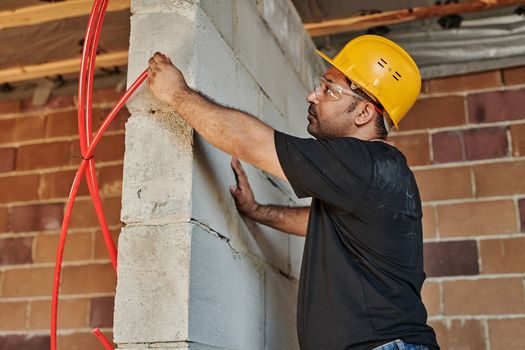
The criteria that actually drive the BOQ decision are density, compressive strength, lambda (thermal conductivity), water absorption, fire rating, and unit cost per m² of wall. On those axes the comparison is unambiguous: [S1]
AAC block vs insulation board (typical 2026 spec ranges, not project-specific):
• Dry density: AAC 550-650 kg/m³; EPS 15-30 kg/m³; XPS 25-45 kg/m³; rockwool 40-200 kg/m³; ceramic fiber 96-160 kg/m³ [S2][S3][S5][S6].
• Compressive strength: AAC 4-8 MPa; EPS 70-100 kPa; XPS 200-700 kPa; PIR 120-150 kPa. AAC is roughly 10-100× stronger.
• Thermal conductivity (λ): AAC 0.14-0.21 W/m·K; EPS ~0.035-0.038; XPS ~0.029-0.034; PIR ~0.022-0.024; rockwool ~0.035-0.040; ceramic fiber 0.045-0.085 at 200-600 °C [S5][S6].
• Fire behaviour: AAC is non-combustible (Euroclass A1) and gives 2-6 hours of fire rating depending on wall thickness and finish; EPS is combustible (E), XPS Euroclass E, PIR typically C-s2,d0 with facing, rockwool A1.
• Water absorption (24 h immersion): AAC 8-15% by mass; EPS 2-4%; XPS <1%; PIR <2%. XPS is the only board that is routinely used below DPC without an extra membrane [S5][S6].
• Indicative 2026 unit cost (ex-works, India, FOB-band): AAC block 6" ₹2,800-3,600/m³; EPS board 50 mm ₹110-180/m²; XPS 50 mm ₹220-360/m²; rockwool 50 mm ₹180-280/m². A 200 mm AAC wall typically lands in the same ballpark per m² of finished wall as a 50 mm EPS + plaster system once labour and finishing are added, so the real call is fire and moisture, not headline price.
Who AAC is for, and who should walk past it
Skip AAC for: below-grade waterproof walls (use concrete + XPS); high-temperature industrial linings (use ceramic-fiber board); thin partition where 75-100 mm would do, and a dry partition system is faster; or single-wythe external walls in a hot-humid climate with no separate thermal break, where a rainscreen + continuous insulation outperforms monolithic AAC [S1][S6].
Who insulation board is for, and where it does not belong
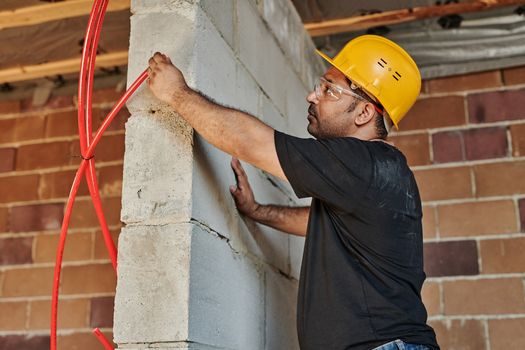
Insulation board is the right call for: EIFS/ETICS external plaster systems over masonry, cavity-wall insulation, flat-roof and inverted-roof insulation (XPS for inverted), below-slab and foundation perimeter (XPS), HVAC duct and plant-room lining (rockwool or PIR with foil), and kiln/furnace backup (ceramic-fiber) [S5][S6]. EPS board is the standard substrate for the thin-bed polymer-mortar AAC jointing system sold alongside AAC blocks (e.g. ModBond thin-bed mortar) because the joint thickness is 2-3 mm instead of 10-12 mm sand-cement, which kills thermal bridging through the bed joint [S2].
Skip insulation board for: any load-bearing role, any exposed exterior without a protective render or cladding (UV and impact degrade EPS/XPS fast), and any interior where a vapour-tight facing will trap moisture in a wall that already has none.
Stacking them: the 2026 hybrid wall that wins on U-value per rupee
The spec most mid-rise Indian and GCC projects are landing on in 2026 is a 200 mm AAC block (load-bearing, 4 MPa or 8 MPa grade), 30-50 mm of XPS or PIR fixed externally with mechanical anchors and adhesive, then 15-20 mm of polymer-modified base coat plus 1.5-2 mm finish coat (acrylic or silicate texture). For a typical 200 mm AAC + 40 mm XPS, total assembly U-value lands at 0.30-0.40 W/m²·K — comfortably inside ECBC+ and Estidama Pearl-2 envelopes — at a wall dead-load of roughly 165-185 kg/m² including finishes [S1][S2][S3].
Compared to a 230 mm solid clay-brick wall plus internal gypsum (~1.4 W/m²·K, ~270 kg/m²), the hybrid cuts U by 65-75% and dead load by 30-40% on the same project footprint. The AAC carries structure and fire, the XPS board cuts the U-value, and the thin-bed mortar joints stop the wall from leaking heat through every bed line. For waterproofing decisions at the same wall base, a separate waterproofing membrane choice often decides whether XPS or a dimpled HDPE membrane sits against the foundation.
Failure modes and constraints engineers should price in
AAC's main failure mode is shrinkage cracking at the bed joint if it is laid with conventional 10-12 mm sand-cement mortar instead of the thin-bed polymer mortar it is designed for; crack width at 90 days can exceed 0.3 mm on uncured or wet blocks, and that defeats the render [S2][S4]. AAC also absorbs water aggressively on site, so it must be covered in transit, dry-stacked on a dry platform, and not soaked before laying. Once rendered, it is fine.
Insulation boards fail in three characteristic ways: (1) EPS/XPS exposed to UV for more than 2-4 weeks oxidise and chalk, so any delay between fixing and rendering must be programmed; (2) XPS used in an inverted roof can float if ballast is mis-sized, so use 50 mm min. and ballast per supplier; (3) ceramic-fiber boards shed fibres during cutting, so on-site dust control and PPE for kiln work is not optional [S5][S6].
Standards and sourcing reality
AAC blocks are commonly produced to IS 2185 (India), EN 771-4 (EU) and ASTM C1386; insulation boards are covered by IS 4671 / ASTM C578 for EPS, IS 13205 / EN 13164 for XPS, EN 13165 for PIR, and ASTM C612 for rockwool. For a 2026 spec-gate check, confirm compressive-strength grade (3/4/5/7/8 MPa), dry density, declared thermal conductivity with 90/90 or 90/50 framing, and a 28-day shrinkage figure, before accepting any AAC delivery [S2][S3][S4]. For boards, request the lambda aged value (XPS λD), the Euroclass fire rating with facing, and a 24 h water absorption number for wet zones. For background on how AAC block interacts with the broader envelope system, the same chemistry rationale behind cellular concrete is why it has stayed the dominant Indian lightweight block for the past decade.
Trackable 2026 signals: (1) AAC HD-grade price movement as more Indian plants (Magma, Biltech, JK Lakshmi, UltraTech AAC) commission 8 MPa+ lines, which is putting downward pressure on premium HD pricing; (2) XPS and PIR lambda creep, with PIR foil-faced boards hitting 0.020-0.022 W/m·K on the better German and Korean lines, tightening the gap against mineral wool on thickness-constrained envelopes; (3) tighter fire-test reporting on AAC-render-EPS ETICS systems, with more manufacturers publishing BS 8414 / EN 13501-2 full-scale façade results through 2026.