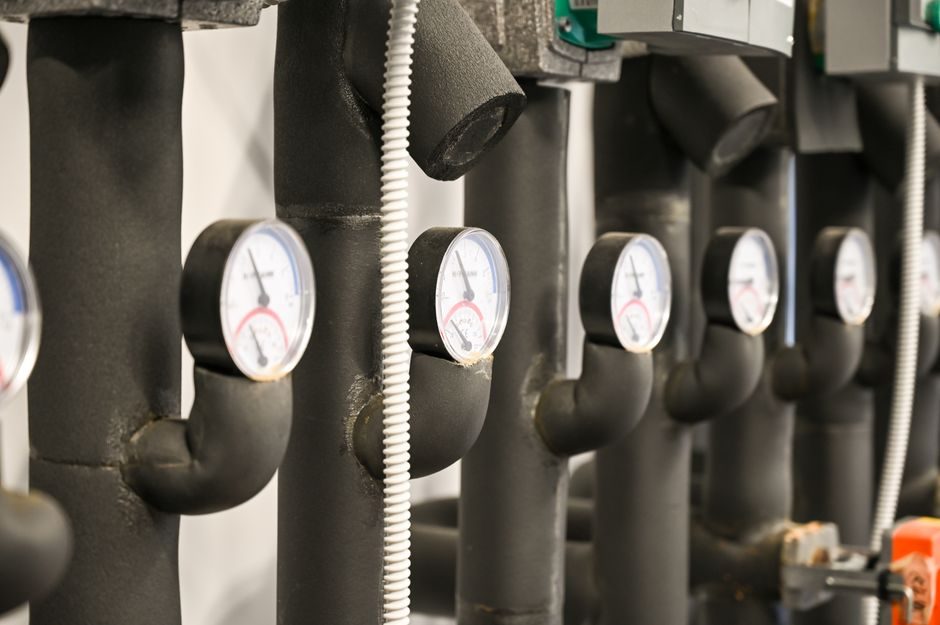
An absolute pressure transmitter referenced against a sealed vacuum reference — not atmosphere — is the only correct choice when the process includes vacuum, low absolute ranges below 1 bar(a), or tank headspace measurement that must remain accurate as barometric pressure swings [S1].
For 2026 procurement, the deciding factors have narrowed to five: sensing element (strain gauge, ceramic, piezoresistive, or silicon), analog vs digital output (4-20 mA, 0-10 V, HART, or Modbus), wetted-material compatibility, hazardous-area certification, and turndown ratio versus the calibrated span [S1][S3][S5][S6][S7][S8].
Why "absolute" reference matters more than the datasheet headline
A gauge transmitter reads against ambient atmosphere, so any 10 mbar weather swing shows up as process noise; an absolute transmitter reads against a sealed internal vacuum, which is mandatory for closed vessel headspace, condenser vacuum, and freeze-dryer chamber control [S1].
The ABB PGF100 strain-gauge absolute transmitter targets sanitary, food-and-beverage service in a compact stainless housing with a touch HMI and an Easy Set-up firmware option, illustrating how the hygienic variant is engineered around clean-in-place exposure rather than maximum overpressure [S1]. The ABB 266ASH pushes the same reference principle into harsher envelope: long-term stability in extreme ambient and process conditions, in-field replaceable electronics with auto-configuration, and TÜV Nord SIL 3 certification to IEC 61508 — relevant for burner management and ESD shut-off logic where the absolute loop is a safety function [S2]. For background on how absolute differs from gauge and differential architectures, see the pressure transmitter overview and the differential pressure transmitter reference.
Sensing technology comparison: strain gauge, ceramic, piezoresistive silicon
Strain-gauge absolute cells (e.g. ABB PGF100) are the default for general gas and hygienic service from vacuum to mid-range pressures, pairing a metal diaphragm with bonded foil gauges and a 4-20 mA loop [S1].
Ceramic-capacitive cells dominate the wet, slurry, and aggressive-media side: the Holykell HPT300-S offers an absolute ceramic sensor with 4-20 mA and 0-10 V outputs, and the VEGABAR S16 extends the ceramic approach to vacuum, gas, and liquid service with a flush diaphragm rated up to 16 bar (232 psi) [S3][S5]. Piezoresistive silicon absolute cells such as the Micro Sensor MPM4841B and the Schneider IAP05S target higher ranges and tighter response times; the IAP05S delivers a 125 ms response, 400:1 turndown, and HART + Modbus over a stainless/aluminum ATEX-rated housing to 207 bar (3,002 psi) and 85 °C process temperature [S6]. The technology split is a clean cost/durability trade: ceramic for chemical resistance, silicon for speed and turndown, strain gauge for the cost-driven general-purpose loop. For a deeper treatment of how absolute pressure compares with gauge and differential sensing, the absolute pressure transmitter reference page lays out the sealed-reference architecture.
Output protocols: 4-20 mA, HART, Modbus, Foundation Fieldbus
Most 2026 absolute transmitters still ship with a 4-20 mA analog output as the baseline; HART is layered on top of that 4-20 mA loop as FSK signaling for remote configuration and dual-variable readback, which is why units like the VEGAWELL 52 specify 4-20 mA while the Schneider IAP05S and ABB 266ASH list HART explicitly [S2][S6].
Modbus (RS-485) is the protocol of choice on compact silicon-cell units such as the IAP05S, useful when the loop is feeding a PLC or RTU rather than a DCS [S6]. HART does not replace the 4-20 mA current loop; the analog current still carries the primary process variable, with HART providing a digital channel on top. Where full digital control is needed, Foundation Fieldbus and PROFIBUS PA replace the 4-20 mA current with an entirely digital segment — these are not HART variants. For installers building or verifying these loops, a pressure calibrator is the field tool that can source the reference vacuum and mA signal simultaneously to certify the absolute reading.
Hazardous-area and material-of-construction gating
ATEX, IECEx, and NEMA 4X / IP66-IP67 ratings are the gating line for outdoor chemical, refinery, and offshore work; the Schneider IAP05S publishes ATEX, IP66, IP67, and NEMA 4X in a single spec block, while the ABB 266ASH carries TÜV Nord SIL 3 to IEC 61508 for safety-instrumented functions [S2][S6].
Material selection tracks the process fluid: stainless steel housings (PGF100, IAP05S) for food, pharma, and corrosive gas; aluminum housings (IAP05S) where weight and heat dissipation matter more than corrosion; flush ceramic diaphragms (VEGABAR S16, HPT300-S) for slurry, paint, and CIP-exposed lines where a recessed port would trap product [S1][S3][S5][S6]. For tank level and headspace where the absolute reading is converted to a hydrostatic or volume signal, the level transmitter cross-reference is worth a look — the headspace absolute pressure is half of the level calculation on sealed tanks.
Sanitary, vacuum, and submersible variants
Sanitary service is a distinct sub-class: the VEGABAR S16 explicitly lists "sanitary" as a characteristic and uses a flush diaphragm so the wetted face meets 3-A and EHEDG cleanability expectations on dairy, beverage, and biotech skids [S5]. The ABB PGF100 occupies the same hygienic tier with a stainless housing and backlit display tuned to washdown environments [S1].
Vacuum and low-absolute ranges call out the absolute reference specifically — both the VEGABAR S16 and VEGAWELL 52 list vacuum alongside absolute, confirming the sealed-vacuum cell is mandatory below 1 bar(a) [S5]. Submersible absolute service is its own niche: the VEGAWELL 52 is a suspended-probe absolute transmitter with ceramic cell and 4-20 mA output, designed for well-shaft and deep-tank headspace measurement where the cable replaces the impulse line.
Selection criteria mapped to the 2026 catalog
The following comparison table lines up representative 2026-vintage absolute transmitters against the four decision criteria that drive purchase orders in practice: sensing technology, primary output, hazardous-area/safety certification, and pressure-range envelope [S1][S2][S3][S5][S6].
ABB PGF100 — strain gauge, 4-20 mA, hygienic stainless housing, mid-range gas service [S1]. ABB 266ASH — long-term stability cell, HART, SIL 3 / TÜV Nord to IEC 61508, harsh ambient and process service [S2]. Holykell HPT300-S — ceramic, 4-20 mA + 0-10 V, general industrial absolute [S3]. VEGABAR S16 — ceramic, analog, vacuum to 16 bar, flush sanitary diaphragm [S5]. VEGAWELL 52 — ceramic, 4-20 mA, submersible suspended probe for well and tank headspace. Schneider IAP05S — piezoresistive silicon, HART + Modbus, ATEX/IP66/IP67/NEMA 4X, 0-207 bar with 400:1 turndown and 125 ms response [S6]. Micro Sensor MPM4841B — piezoresistive silicon, analog, threaded process connection for OEM panel builders.
Who this catalog tier is for — and where it falls short

An absolute transmitter in the PGF100 / 266ASH / IAP05S class is the correct fit when the loop must read vacuum, sealed-vessel headspace, or a low-absolute range independent of weather, and when the safety case demands SIL or ATEX paperwork on the same data sheet [S1][S2][S6].
These units are not the right pick for high-line static differential flow on orifice plates — that is a differential pressure transmitter application, not an absolute one, and forcing a single absolute cell into a dp role loses the square-root extraction and the static-pressure compensation that a true dp transmitter provides. They are also a poor fit for high-temperature boiler drum service above 85 °C process temperature, where a remote-seal absolute transmitter with capillary cooling is the standard answer; the IAP05S specifies 85 °C as its published ceiling [S6]. For linear-motion and pneumatic-cylinder force loops, see the linear guide reference — it covers position-sensor selection, which is the adjacent measurement problem, not pressure.
Procurement checklist and trackable signals
Spec sheets worth pulling before PO release: the SIL certificate number and the TÜV Nord issue date on the 266ASH [S2]; the ATEX/IECEx zone marking and IP66/IP67/NEMA 4X test report on the IAP05S [S6]; the 3-A / EHEDG cleanability statement on the PGF100 and VEGABAR S16 [S1][S5]; the turndown ratio and ambient-temperature derating curve on any ceramic-cell unit before you trust its 0.1% accuracy claim at the low end of the range [S3][S5].
Trackable signals to watch over the next quarter: revised IEC 61508 SIL certificate editions from ABB on the 266ASH platform, and any expansion of the IAP05S turndown ratio above 400:1, both of which would shift the shortlist for safety-loop and high-turndown applications. For adjacent process-instrument selection such as pH, turbidity, and flow in the same skid, the on-site guides on pH meter vs online pH analyzer selection and wastewater flow meter selection cover the rest of the measurement loop.