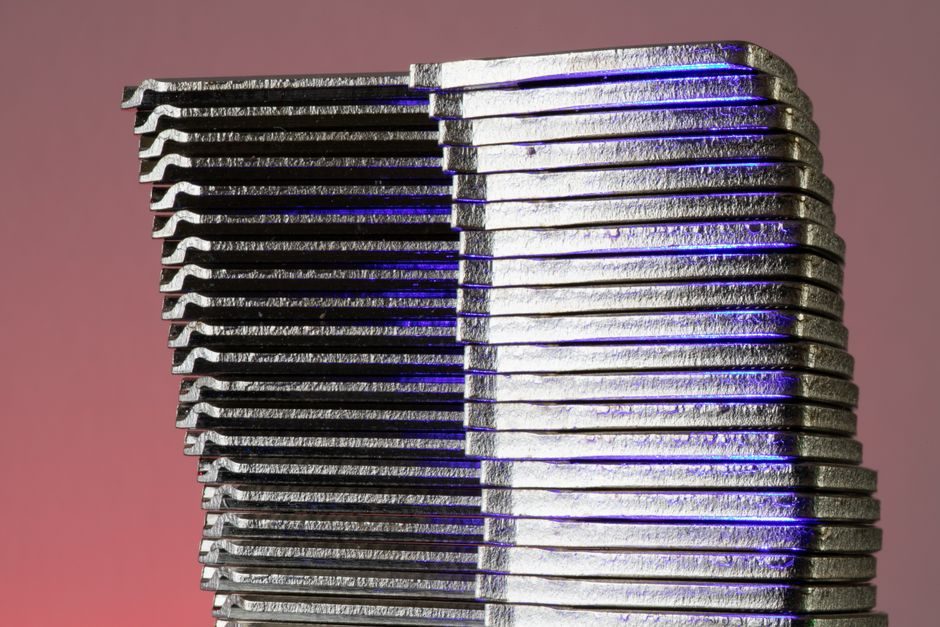
Additive manufacturing material is a process-specific subset of metal powder feedstock, tightened on particle size distribution, morphology, oxygen/nitrogen content, and traceability to meet layer-wise consolidation requirements rather than press-and-sinter economics [S1].
The most active 2026 reference frame is laser powder bed fusion (LPBF) and electron-beam PBF, where powder cost can run 5-10x the equivalent wrought bar stock, and process windows are narrow: typical LPBF layer thickness sits at 20-60 µm with PSD banded to roughly 15-63 µm versus the broader 20-212 µm envelope accepted by press-and-sinter [S1][S4][S6].
Definition and Scope: Where the Two Categories Overlap and Diverge
Generic metal powder covers any particulate metal produced by gas atomization, water atomization, plasma rotating electrode process (PREP), or hydride-dehydride routes, used in powder metallurgy (PM), metal injection molding (MIM), thermal spray, brazing, and additive manufacturing [S1].
Additive manufacturing material is a quality-graded subset: the same atomization line can ship different lots to AM and PM customers, with AM lots screened to lower oxygen (often <200 ppm for titanium, <100 ppm for reactive alloys), higher sphericity (>0.9 aspect ratio), tighter PSD (D10/D50/D90 controlled), and lower satellite content [S6]. HORIBA's 2026-05-06 powder-quality webinar explicitly frames laser-PBF and E-PBF feedstocks as needing tighter PSD and morphology control than conventional PM powder.
Selection Criteria: PSD, Morphology, Chemistry, Flow, and Reuse Budget
Particle size distribution is the first gate: LPBF commonly runs 15-45 µm or 20-63 µm cuts; directed energy deposition with blown powder can accept 45-105 µm; binder jetting and electron-beam PBF often want 45-105 µm with a coarser tail to improve spreadability and packing density [S1][S4][S6].
Morphology and flow are the second gate — Hall flow 14-25 s for 50 g through a 2.5 mm funnel, and Carney flow below ~30 s, are typical print-ready targets, with apparent density 55-65% of theoretical for gas-atomized spherical grades [S6]. Oxygen and nitrogen totals must be specified per alloy (Ti-6Al-4V Grade 23 caps oxygen around 0.13 wt%, 316L stainless typically 0.10 wt% max) and verified by inert-gas fusion LECO per the in-progress GB national standard on AM metal powder performance characterization, drafted 2026-04-30 by TC562 (National AM Standardization Technical Committee) [S2].
Reuse budget is the third gate: AM powder is recycled under controlled sieve-and-blend rules (typical sieving at 63 µm, blend ratio 30-70% virgin), with chemistry re-checked every 5-10 build cycles, because flowability and oxygen drift with cycle count [S6]. For specifiers mapping 2026 builds, the deeper criteria breakdown is in Additive Manufacturing Material Selection: 5 Process-Driven Criteria for 2026 Specifiers.
Who AM-Grade Powder Is For vs Who Should Walk Away
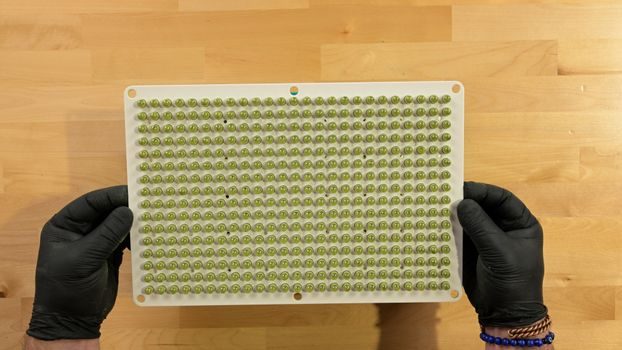
AM-grade powder pays back when part complexity, weight reduction, or part consolidation outweighs the powder premium — aerospace brackets and bionic implants, conformal cooling inserts in injection tooling, hydraulic manifolds with internal lattices, and topology-optimized structural nodes in motorsport and eVTOL [S1][S6].
AM-grade powder is the wrong choice for high-volume rotationally symmetric parts (shafts, fasteners, washers) where cold heading or turning of metal powder-derived bar stock wins on cycle time and cost, and for parts needing full-density fatigue performance that still trails wrought properties in 2026 production data [S3][S6]. Buyers in those buckets should spec conventional PM grades, MIM feedstocks, or wrought material and skip the AM powder tariff.
Criteria-Based Comparison: LPBF, E-PBF, DED, Binder Jet
Process choice drives the powder spec, not the reverse. LPBF wants fine 15-45 µm spherical gas-atomized powder with Hall flow 14-25 s; E-PBF takes coarser 45-105 µm Grade 23 Ti-6Al-4V to survive the 700 °C powder-bed preheat; laser DED with blown powder tolerates 45-105 µm cut at higher flow rates; binder jetting accepts 15-45 µm grades tuned for spreading and sintering shrinkage compensation [S1][S4][S6].
On cost per kg, 2026 commercial ballparks are 316L LPBF-grade around 80-150 USD/kg, Ti-6Al-4V Grade 23 LPBF/E-PBF around 250-500 USD/kg, and Inconel 718 LPBF around 100-200 USD/kg — typically 5-10x the same alloy in wrought bar [S1][S6]. On quality, the H20-steel-billet study (Physics of Metals and Metallography, 2021) shows AM microstructures are distinctly different from press-and-sinter PM, with finer cellular-dendritic spacing and higher achievable hardness at similar alloy content [S3].
On process risk, LPBF and E-PBF are mature for Ti-6Al-4V, 316L, Inconel 718, and AlSi10Mg; binder jetting in 2026 is scaling for large production runs but still requires sintering and infiltration steps, and DED keeps the productivity advantage for large parts at the cost of lower resolution [S1][S4][S6]. A complete feedstock-to-process matrix in the 2026 buyer cut can be cross-referenced against TIG Welder Selection: Process, Duty Cycle, Material Gates for downstream joining.
Standards, Testing, and Sourcing in 2026
The 2026-04-30 GB national standard "Additive Manufacturing — Methods to Characterize Performance of Metal Powders," drafted by TC562 under the China Machinery Industry Federation, is in the solicitation-of-comments stage with planned implementation six months after publication — once released it will give Chinese buyers a domestic test-method anchor that complements ASTM F3049, ASTM F3301, ISO/ASTM 52900, and ISO/ASTM 52907 referenced by international LPBF and DED work [S2].
Acceptance testing for AM-grade metal powder lots typically covers PSD by laser diffraction (ISO 13320 family), morphology by SEM image analysis, flow by Hall (ASTM B213) and Carney (ASTM B964) funnels, apparent density by Arnold and tap density per ASTM B527, and chemistry by ICP-OES plus inert-gas fusion for O/N/H [S2]. Build a spec clause that names the test method, acceptance band, and the lot certificate format (EN 10204 3.1) — vague "suitable for AM" wording fails audits [S2].
On sourcing, the 2026 supply map is led by established gas-atomization houses with PREP and EIGA capacity for reactive alloys, plus specialty recyclers; the modelability of LPBF chains is now mature enough that powder-feedstock modeling — continuum and level-set formulations for track- and part-scale thermal fields — feeds directly back into parameter windows for the next build [S5].
Failure Modes and Limitations Buyers Must Plan For
The dominant failure mode in 2026 LPBF builds is lack-of-fusion porosity from too-coarse PSD or under-scanned energy density; the second is keyhole porosity from over-scan; both are detectable by CT scan and tracked to the powder's Hall flow and PSD cut [S1][S4][S6]. Stale powder (high O, low flow) shows up as roughness spikes, post-print cracking in Ni-base superalloys, and re-use-cycle drift in tensile elongation.
AM mechanical properties still trail wrought for rotating-bending fatigue in critical applications — the 2026 build acceptance for fatigue-rated parts should require test bars per build, witness coupons, and a process-window map rather than a generic "per alloy" property claim [S1][S3]. Comparative H20-steel-billet data confirms AM microstructures can match or exceed PM hardness but require HIP to close residual pores for fatigue-critical service [S3].
Process control to head off these failure modes — PSD laser-diffraction checks per lot, build-chamber O2 below 1000 ppm (often <100 ppm for reactive alloys), substrate preheat within OEM window — is the same kind of process discipline that buyers of process instruments now build into Toxic Gas Detector vs Gas Alarm Controller: 2026 Spec Cut for Safety Loops on adjacent gas-detection lines.
For 2026 procurement, the actionable signals are: (1) the TC562 GB powder characterization standard is mid-public-comment and will land inside the next 6-12 months [S2]; (2) HORIBA's 2026-05-06 webinar agenda signals continued pressure on inline PSD and morphology QC at the atomizer; (3) AM-grade metal powder pricing has held its 5-10x wrought ratio through early 2026 as LPBF and binder-jet volumes scale, with no contraction in premium observed in the published 2026 industry guides [S1][S6]. Lock your PSD band, flow target, oxygen cap, and reuse rules in the PO — not in a side letter.
For component-level specifications, see additive manufacturing material, and metal curtain wall panel.