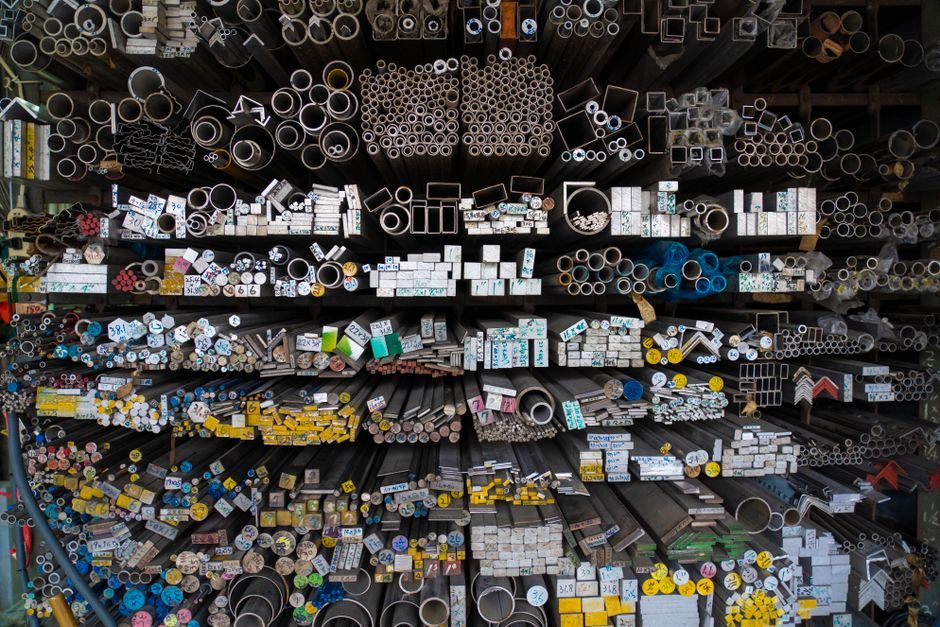
The additive manufacturing (AM) supply chain is built on three coupled flows — digital design IP (CAD/AMF files plus process parameters), certified feedstock (metal powder, polymer filament/resin, photopolymer), and post-processing capacity (HIP, machining, heat treatment, NDT) — and the economics of the chain are decided by how cleanly these three flows are synchronised at a part-number level [S1][S4].
For a process engineer deciding where to insert AM into a plant or product line, the chain looks fundamentally different from a conventional forging + CNC + warehouse network: tooling is largely digital, inventory can be held as a CAD file instead of a physical SKU, and lead time is dominated by powder lead time, build envelope queue time, and qualification throughput rather than die lead time [S2][S6]. A practical 2026 reference framework treats feedstock flow, digital inventory, and post-processing as the three control surfaces — and the same framework is detailed in How the 3D Printing Supply Chain Works: Feedstock Flow, Digital Inventory and Sourcing.
Flow 1 — Digital Design IP and Process Parameters
The first flow is data, not material: a print-ready STL/3MF/AMF file plus the build recipe — layer thickness (typically 0.02–0.08 mm for LPBF metals), laser power (often 100–400 W for maraging tool steel and Inconel 718), scan strategy, chamber oxygen content (commonly held below 100 ppm, often <50 ppm for reactive alloys like Ti-6Al-4V) — must travel with the part wherever it is reprinted [S1].
This is where the AM supply chain diverges from a forging chain: intellectual property can be moved electronically, and the same file can be printed at a service bureau in Singapore, a captive line in Stuttgart, or a depot in Houston without shipping the part itself [S2]. The supply-side consequence is that OEM service offerings (e.g. Siemens’ Additive Manufacturing portfolio) bundle CAD repair, build preparation, and machine-cell scheduling inside one digital thread, treating the part design as a controlled document subject to revision gates [S1]. The demand-side consequence is that a buyer evaluating an AM supplier should audit not only powder traceability but also the supplier's CAD-repair capability, revision-control system, and how the build file is versioned against drawing revisions — gaps here show up later as part-to-part variance rather than as a clear defect.
Flow 2 — Feedstock: Powder, Filament, Resin, Photopolymer
The second flow is the physical raw material, and it is the part of the chain that is most exposed to spec discipline. Metal AM powder spec is governed by ASTM F3049 (powder characterisation), ASTM F3055 (LPBF process for Ti-6Al-4V), ASTM F3187 (LPBF for AlSi10Mg), and ISO/ASTM 52900 (process taxonomy); polymer filament and resin specs are typically bracketed under ISO/ASTM 52900 and ISO 17296 series for plastics AM [S2][S3]. A 2026 sourcing decision is dominated by the powder spec band rather than by machine brand, and the Additive Manufacturing Raw Material Sourcing Guide: 2026 Spec Bands, Process Family Fit reference lays out the matching logic between alloy family, particle size distribution (commonly 15–45 µm or 20–63 µm for LPBF, 45–105 µm for DED), Hall flow, and atomisation source (gas-atomised vs plasma-atomised vs PREP).
Common 2026 sourcing pitfalls in this flow: a buyer specs "316L powder" without specifying atomisation (gas-atomised is the LPBF baseline; water-atomised is unsuitable), without specifying PSD cut (a 15–45 µm cut costs more than a 45–105 µm cut), and without specifying oxygen/nitrogen interstitials (typically <0.1 wt% O for Ti and <0.05 wt% N for reactive alloys). For polymer and resin chains the analogous failure is asking for "ABS" or "PA12" filament without melt-flow index, moisture content, or recyclate-percentage tolerances; vacuum-sealed spool handling and dry-storage at <20% RH are normal for hygroscopic feeds like PA12 and PA6, and omitting this is a common cause of inter-layer porosity and warpage [S2].
Flow 3 — Build Capacity and Post-Processing
The third flow is conversion of feedstock into qualified parts, and it is the bottleneck most often under-counted. A typical LPBF job in 2026 requires: build time (often 18–36 h for a small industrial bracket), stress-relief (e.g.
This sequence is why the same alloy in the same machine can be quoted at very different prices: the spread is almost always in the post-processing queue, not in the build chamber. Buyers should map the supplier's in-house post-processing capability cell-by-cell — a service bureau that outsources HIP and machining cannot meet the same week-3 delivery as a bureau that runs both in-house [S1][S4]. For corrosion-service or sour-service parts, ASTM A967 passivation and NACE MR0175 / ISO 15156 material limits on additive microstructure (residual porosity, lack-of-fusion defects, surface roughness) become gating items, and these are not negotiable downstream [S3].
Comparison: Conventional vs Additive Manufacturing Supply Chain
For a process engineer the easiest mental model is a side-by-side of the two chains on the same four criteria.
Conventional chain: tooling lead time typically 12–24 weeks for forging/machining, unit cost benefits start at lot sizes of 500+ parts, inventory carried as finished SKU, changeover cost dominated by retooling, MOQ 200–1000 typical. AM chain: tooling lead time 0–2 weeks (CAD prep only), unit cost benefits concentrated in low-volume / high-mix / spare-parts lots (often <500 parts/yr), inventory carried as digital file plus a small safety stock of post-processed parts, changeover cost dominated by build-prep + post-processing queue, MOQ 1 practical. The decision boundary between the two is set by lot size, part complexity, qualification cost, and the buyer's tolerance for AM-specific defect types (lack-of-fusion, residual porosity, staircase surface) [S2][S4][S6].
Use Cases Where the AM Chain Fits — and Where It Doesn't

A documented COVID-era case study showed AM being used to fill supply gaps when forging capacity was constrained, particularly for PPE-related and ventilator parts where traditional tooling lead time was incompatible with the demand curve [S5].
It is a poor fit for: very high volume (>10 000 parts/yr) where the per-part cost of LPBF/PBF and post-processing still exceeds injection moulding or forging at scale; large parts exceeding the largest commercial LPBF envelope (typical 2026 commercial envelope is 600×600×600 mm class, with a smaller number of suppliers offering 800×800×500 mm class); parts that must meet surface roughness requirements below Ra 0.8 µm without secondary finishing; and parts that require isotropic mechanical properties on safety-critical load paths without a working HIP + heat-treatment + NDT chain in place [S3][S6].
Standards, Qualification, and Sourcing Signals to Track in 2026
Spec discipline in 2026 is dominated by the ISO/ASTM 52900 series (process taxonomy), ISO/ASTM 52901–52904 (part-specific test methods), ASTM F3049 (powder characterisation), ASTM F3055 / F3187 / F3301 (process specs for Ti-6Al-4V, AlSi10Mg, and FDM polymer respectively), ISO 17296 (general plastics AM), and — for aerospace — SAE AMS7000-series (e.g. AMS 7000 for Ti-6Al-4V LPBF, AMS 7011 for Inconel 718 LPBF) [S2][S3]. For non-metallics and composites, the FRP Composite Supplier Map 2026: China OEM Cluster, Spec Bands and Sourcing Logic article covers an adjacent supply-chain logic where digital tooling data and qualified batch testing are equally critical.
Trackable 2026 signals worth following: (1) the spread between gas-atomised and plasma-atomised powder cost per kg for Ti-6Al-4V and Inconel 718, which historically moves with titanium sponge and nickel spot prices; (2) build-prep + post-processing queue time at the largest European service bureaus, which sets the practical lead time floor; and (3) the count of qualified machine + powder + parameter combinations on the SAE AMS7000 list, which is the proxy for "AM-qualified aerospace supply" [S2][S3]. For a working view of the full feedstock-to-finished-part flow including digital inventory patterns, the How the 3D Printing Supply Chain Works: Feedstock Flow, Digital Inventory and Sourcing reference is a useful companion read.
For component-level specifications, see additive manufacturing material, dc power supply, and switching power supply.