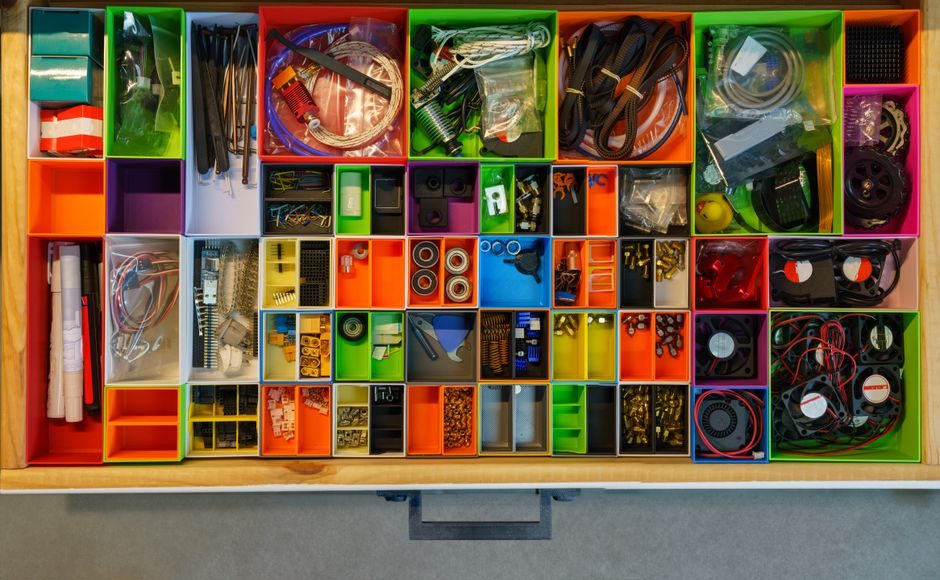
A 3D-printing bill of materials splits cleanly into seven material families: AlSi10Mg, CoCr, Inconel 718, Ti-6Al-4V, 17-4PH, 316L, plus PA 6/12 nylon powders, photopolymer resins and metal-plated composites [S2]. Each family carries a distinct tolerance, post-processing and qualification envelope, so the BOM is written around the functional part — not around the printer.
For a process engineer scoping a 2026 part, the decision starts with the dominant load path: metal DMLS/SLM for structural brackets and fluid hardware, SLS nylon for low-volume jigs and enclosures, SLA/DLP resin for dental and investment-cast patterns. KeyPrint's June 2026 release of KeyModel Ultra Sand and a pink colourway for KeySplint Soft shows resin houses are still pushing biocompatible and casting-pattern variants as the fastest-moving SKU band [S1].
Metal Powder Bed Group: AlSi10Mg, CoCr, Inconel 718, Ti-6Al-4V
The metal DMLS/SLM band is dominated by four alloys and each maps to a different part class in the BOM [S2]. AlSi10Mg is the workhorse for lightweight brackets, robot end-effector plates and heat-sink housings where density reduction matters more than high temperature — typical 0.8–1.0 mm wall sections print without supports on a 45° downskin. CoCr (ASTM F75 grade equivalent) routes into medical implants and dental substructures because of its biocompatibility and wear behaviour. Inconel 718 is specified for thermal hardware above ~600 °C service — turbine stators, exhaust manifolds, rocket thrust chambers — at the cost of a hot isostatic press (HIP) cycle to close residual porosity. Ti-6Al-4V (Grade 5) is the default for aerospace brackets, Formula-style suspension uprights and medical implants, with reported tensile strength near 950 MPa in the as-built plus HIP condition and elongation typically 10–14%.
For a side-by-side selection: Ti-6Al-4V vs Inconel 718 vs AlSi10Mg on four decision criteria — density (4.43 / 8.19 / 2.67 g/cm³), max continuous service temperature (~315 °C / ~700 °C / ~200 °C), post-processing (HIP optional / HIP strongly recommended / stress-relief only), and relative powder cost index (high / very high / low) [S2]. AlSi10Mg wins every cost-sensitive bracket; Inconel 718 wins every high-temp manifold; Ti-6Al-4V wins fatigue-critical aerospace links. These four alloys are the core of any metal 3D scanner reverse-engineering-and-reprint workflow because the STL or rebuilt CAD mesh is fed straight back into the same parameter set.
Stainless Steel Band: 17-4PH vs 316L for Industrial Hardware
Stainless splits into two clearly separated use cases, and conflating them is the most common BOM error [S2]. 17-4PH (condition H900) prints to ~1310 MPa UTS with ~10% elongation and is the pick for shafts, shaft key carriers, tooling inserts and any part that needs post-build heat treatment to reach full hardness. 316L prints in the ~480–530 MPa UTS range with ~30–40% elongation in the as-built state and routes into corrosion-resistant fluid hardware, valve bodies, sanitary fittings and any part exposed to chloride-bearing media. The two grades are NOT interchangeable on a drawing: 17-4PH is a martensitic precipitation-hardening grade, 316L is an austenitic corrosion-resistant grade, and the powder morphology plus build parameters differ.
Selection rule of thumb: if the part spec sheet calls out NACE MR0175 / ISO 15156 sour-service exposure, 316L is the default; if the spec calls out a hardness window above ~HRC 28 or a fatigue life figure, 17-4PH H900 is the default. Both are commonly HIP'd for pressure-containing service — relevant when a 3D-printed part is bolted into a pressure transmitter manifold block or a flow meter body where leak-tightness at rated pressure is non-negotiable.
Polymer Powder Band: PA 650, PA 850 Black, Duraform HST, PA 615 GS
The polymer SLS band is dominated by nylon PA 12 variants, and FacFox's selection guide lists PA 650, PA 850 Black, Duraform HST and PA 615 GS as the working set [S2]. PA 650 is a general-purpose unfilled PA 12 with tensile strength in the ~45 MPa region and elongation around 20%, used for low-volume jigs, fixtures and enclosure prototypes. PA 850 Black is a higher-modulus black PA 12 with better UV behaviour, used for functional covers and operator-facing parts. Duraform HST is a glass-filled / mineral-filled high-stiffness PA 12 with flexural modulus roughly 1.5–2× unfilled, used for structural brackets where SLS replaces injection-moulded glass-filled nylon at low volumes. PA 615 GS is a glass-spheres-filled PA 6 with better thermal behaviour than PA 12, used under-the-hood and around heat sources.
Polymer SLS parts sit in the BOM wherever a 50–500 piece/year volume bracket is too small for injection moulding but the part is too complex for sheet metal. The four grades line up against four criteria: stiffness (Duraform HST > PA 850 > PA 650 ≈ PA 615 GS), surface-as-printed roughness (~10–15 µm Ra for all four before bead blasting), moisture pick-up (PA 6 grades > PA 12 grades), and tooling cost (zero, vs the four-figure to six-figure mould amortisation of injection). For a procurement spec, the BOM line item is almost always "PA 12, SLS, ±0.3 mm or ±0.1% whichever greater" — that single clause covers the bulk of jigs and brackets.
Photopolymer Resin Band: SLA / DLP / LCD Pattern and Dental
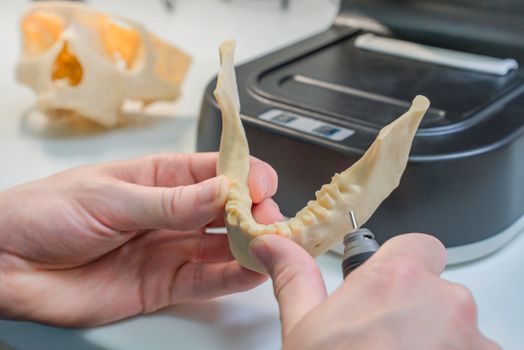
Resin printing in industrial use is not a "draft" process — three of the resin grades in the 2026 reference set are investment-cast pattern materials, not prototypes [S2]. Accura 60 and Somos 9120 are low-ash burnout resins used as master patterns for investment casting of jewellery, aerospace blades and small impellers, with burnout schedules matched to standard flask cycles. Accura SL 5530 is a clear, ABS-like structural resin for snap-fit assemblies and flow-visualisation models. MicroFine is a high-resolution resin (25–50 µm XY pixel) for microfluidic devices, micro-scale medical models and small dental patterns.
The KeyPrint June 2026 line extension illustrates where the resin band is going: KeyModel Ultra Sand adds a sand-filled colour to the casting-pattern line, and the international rollout of pink KeySplint Soft extends the occlusal-splint SKU [S1]. KeySplint Soft is a Class IIa biocompatible photopolymer — flexural modulus in the ~1.0–1.5 GPa region, elongation ~50–80% — used for night guards and occlusal splints printed on 385/405 nm LCD/DLP systems. For the BOM, the resin band is best scoped as: casting pattern (Accura 60, Somos 9120, KeyModel Ultra Sand), structural snap-fit (Accura SL 5530), micro-fluidic (MicroFine), and dental/medical (KeySplint Soft, KeyTray, KeyGuide). Each line item in the BOM should name the resin grade, not "SLA resin" — the burnout ash content, biocompatibility file and post-cure schedule are not interchangeable.
Specialty Band: RenShape 7820, Metal-Plated, and Composite Hybrids
The specialty band is short but the parts it produces are the ones that drive engineering attention [S2]. RenShape 7820 is a stereolithography board stock used for foundry patterns and master models, machined after cure rather than printed in final geometry — it sits in the BOM as a tooling line, not a product line. Metal-plated SLS is a hybrid where an SLS polymer part is electroless-copper + electrolytic-copper + nickel plated to produce RF shields, antenna housings and decorative metal-look covers, typically 30–80 µm of total metal thickness over a 1.5–3.0 mm polymer substrate.
For a 3D-printed manifold block that has to take rated pressure, the spec'd stack is: DMLS 316L body → HIP cycle at ~1150 °C / 100 MPa → CNC machining of sealing faces → pressure-test to 1.5× rated pressure. That block then mates into an industrial valve stack or a pressure sensor cavity, and the additive-manufactured BOM line is filed with the HIP cert and powder-traceability sheet. The Cornell FibreSeeker-style continuous-fibre work covered in New Atlas's 3D-printing feed in late June 2026 is the same trajectory: the BOM is moving from "print geometry" toward "print material behaviour", and the procurement clause has to follow [S4].
The KravitzLab FED1 design rule — "all parts slide or twist together to reduce the precision needed for successful interlocking" — captures the engineering reality that consumer and prosumer FDM prints at ±0.2–0.4 mm, so snap features and bolted joints should be designed with a 0.3–0.5 mm clearance band, not the 0.05–0.1 mm a machined BOM would carry [S3].
Writing the BOM Clause: Material, Process, Tolerance, Post-Processing
A 2026-ready 3D-printing BOM line item should carry four mandatory fields and two conditional ones [S2]. Mandatory: material grade (e.g. "AlSi10Mg, EN AC-43000 equivalent" or "316L, ASTM F3184-16"), process (DMLS / SLS / SLA / MJF), tolerance ("ISO 2768-mK or ±0.1 mm@25 mm whichever greater"), and post-processing (as-built / stress-relieved / HIP / heat-treated to H900). Conditional: surface finish ("bead-blasted, Ra 6.3" or "as-built, Ra 10–15 µm") and certification (powder batch trace, HIP chart, biocompatibility file). Without those four fields the part will be re-quoted or rejected at incoming inspection — this is the single biggest source of add-on cost in additive procurement.
For a procurement engineer building a kit, the right reference companion pieces sit next to the additive BOM: a linear module stack for any gantry-style 3D-printer integration, and a cable drag chain spec for the moving harness on a Cartesian or CoreXY build. The industrial-robot BOM pattern — six functional groups, component bands, sourcing logic — is also a useful template when the 3D-printer is itself a cell inside a robotic line, because the printer is one functional group among six industrial robot BOM.
Two signals to track into the second half of 2026: KeyPrint's dental SKU expansion and the continuous-fibre FDM demos (FibreSeeker-class) point to resin and composite bands still moving faster than the metal band [S1][S4]. The metal band is consolidating on the four workhorse alloys (AlSi10Mg, Ti-6Al-4V, 316L, 17-4PH) and the two high-temp grades (Inconel 718, CoCr), with HIP certification and powder traceability becoming the de-facto acceptance gate.