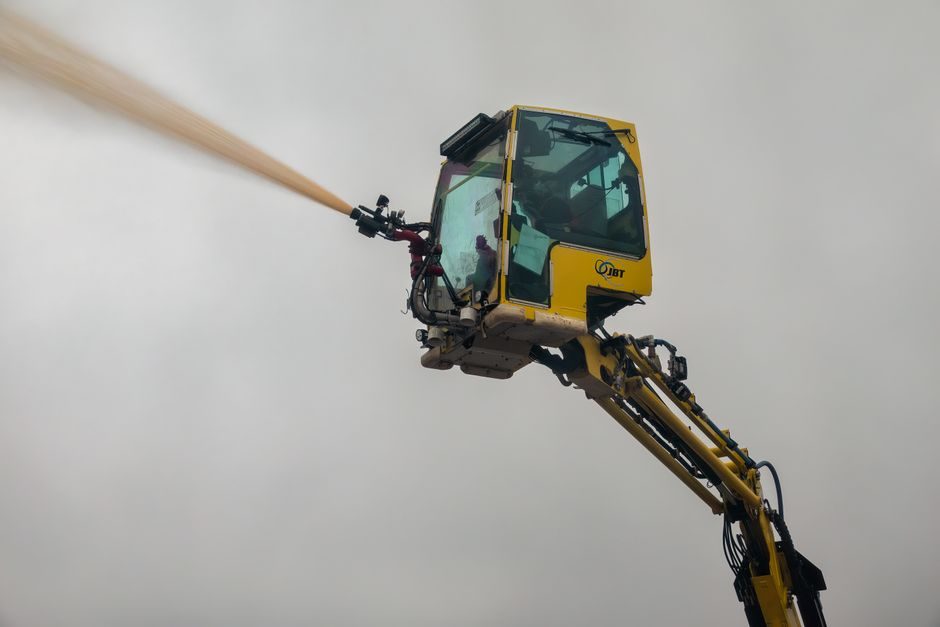
The five functional families of aerial work platforms — scissor lift, telescopic boom lift, articulating boom lift, vertical mast, and suspended platform — are defined by their lift mechanism, deck geometry, and rated working height, not by chassis brand [S2].
On the Chinese OEM market, current catalogue lines cover working heights of roughly 6 m to 12 m (e.g. GTZ-6 / GTZ-8 / GTZ-10.5 / GTZ-12 series at 7.7–12 m platform height) with minimum-order quantities as low as 1 unit and monthly supply capability up to 500 units per OEM [S2]. Standards governing the equipment include CE marking under the EU Machinery Directive and ISO 16368 for mobile elevating work platforms, both referenced on manufacturer datasheets [S4].
Family 1 — Scissor Lifts: Vertical Lift, Wide Deck, Indoor-Outdoor Duty
Scissor lifts deliver purely vertical elevation through crossed-arm actuation, with working heights typically spanning 6 m to 14 m in production catalogues and deck load ratings commonly in the 230–450 kg band for single-scissor electric models [S2]. The deck is rectangular and large enough for two workers plus material, which is why electrical and HVAC interior fit-out is the dominant application.
Drive variants divide cleanly: DC-battery electric for finished-floor indoor use (no emissions, low noise), and diesel or dual-fuel for rough-terrain outdoor sites. The narrow-track 0.8–1.2 m chassis dimension and tight 1.5–2.2 m turning radius on GTZ-series units allow operation in confined industrial aisles [S2].
Family 2 — Telescopic and Articulating Booms: Outreach + Height
Telescopic boom lifts use a straight extending arm to reach working heights commonly from 12 m up to 40+ m, with horizontal outreach typically 40–60% of the maximum working height; articulating booms add a knuckle joint between the main boom and the jib to combine outreach with up-and-over capability around obstructions. [S2]
These two are the go-to categories whenever the work point cannot be approached directly from below — steel erection, shipyard hull painting, façade glazing, and sign installation. Outdoor rough-terrain chassis with 4×4 diesel drive is the norm, and deck capacity usually sits at 230 kg (two-person unrestricted) per ANSI A92.20 / ISO 16368 family rules. Where a boom-style aerial work truck is mounted on a commercial vehicle chassis, the same boom geometry applies but with road-going mobility added.
Family 3 — Vertical Mast Lifts: Single-Person, Narrow-Aisle, Low-Height
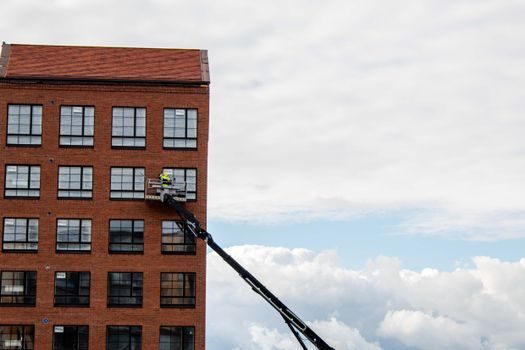
Vertical mast (or push-around / self-propelled mast) lifts use a single aluminium or steel mast to elevate one worker plus a small tool load to working heights of roughly 4 m to 9 m. The deck is typically a 0.6 × 0.7 m platform rated 120–150 kg. [S2]
For warehousing, retail fit-out, and mechanical-room maintenance, the mast lift competes directly with a suspended platform when ground access is restricted — but mast lifts win wherever the floor can carry the outrigger load and the work is intermittent rather than continuous. CE-marked mast models from Chinese OEMs list platform heights of 6–8 m at the entry level [S2].
Family 4 — Suspended Platforms: Facade and High-Rise Envelope Work
Suspended platforms (also called gondolas or cradle platforms) hang from roof-mounted outriggers via wire ropes, with the work deck suspended at the façade. The ZLP-series steel-and-aluminium suspended platform shown on OEM datasheets carries a rated load of 1000 kg and runs on electric power, certified to TUV / ISO / CE [S4].
Suspended platforms are the default for continuous vertical work on building envelopes — curtain-wall cleaning, plastering, painting, window replacement — because they can be sized in modular 1–3 m sections to cover a full façade width and can dwell at a precise elevation for hours. They are not mobile in the X-Y plane, so each suspension rig is dedicated to one face of one building.
Decision Matrix: Picking the Right Family
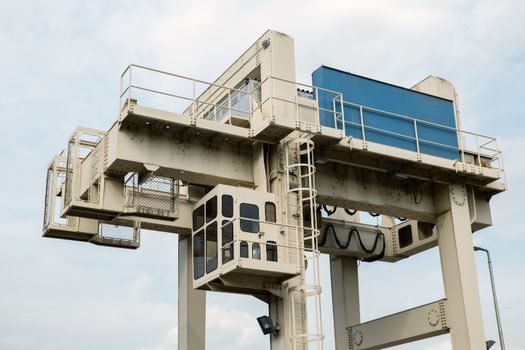
Three criteria separate the families in practice: working-height band, required horizontal outreach, and ground-versus-roof support.
Below 9 m with no outreach need and finished-floor access → mast lift or compact scissor. 6–14 m with vertical-only lift and material on the deck → scissor lift. Above 12 m or any outreach / up-and-over requirement → articulating or telescopic boom. Continuous work on a vertical envelope above ground level → suspended platform. Outdoor rough terrain plus road travel → boom on a truck-mounted aerial work platform chassis.
Selection also needs to weigh the platform-scale and platform-trolley load cases: scissor and boom decks must be specified against worker + tool + material mass with the rated capacity never exceeded, and a general aerial work platform guideline page covers the cross-family CE / EN 280 marking logic for European deployment.
Power, Drivetrain, and Certification Constraints
Three power platforms dominate: lead-acid or lithium DC battery packs for indoor electric units, diesel for outdoor rough-terrain, and bi-energy (battery + small diesel genset) for jobs that move between indoor and outdoor zones. Hydraulic actuation is universal on the lift function; only the lightest push-around masts use manual or screw-drive lift. [S2]
For European projects, CE marking under EN 280 (mobile elevating work platforms) is the baseline compliance requirement, with operator training tied to ISO 18878. US projects fall under ANSI A92.20 (vehicle-mounted), A92.22 (self-propelled), and A92.24 (low-level). Chinese OEM datasheets commonly display CE, ISO 9001, and in some cases TUV SüD for suspended platforms [S4].
Application Map: Which Family Goes Where

Construction — scissor for slab and ceiling work below 14 m, boom for steel and façade glazing above 14 m, suspended for high-rise envelope. Warehousing and logistics — mast lift for racking and mezzanine access, narrow-aisle scissor for order-picking, rough-terrain scissor for yard loading. Industrial maintenance — articulating boom for process-pipework and tank exteriors, suspended platform for boiler casing and chimney inspection. Telecoms and utilities — telescopic boom for line and antenna work, truck-mounted boom for road-going patrol. [S4]
The full cross-family aerial work platform reference consolidates CE marking logic, duty classification, and selection thresholds in one place for spec teams comparing Chinese OEM lines against Western builds. Buyers sourcing from Chinese OEM directories should also weigh steel grade consistency on the chassis and boom structure, since structural steel and welding qualification drive the platform's residual life cycle.
Limits, Failure Modes, and Sourcing Watch-Outs
Three failure modes recur across families: outrigger / stabiliser mis-set on soft ground (scissor and boom), wire-rope fatigue on suspended platforms (10-year replacement is typical), and load-sensor bypass on second-hand imports. Wind speed limits are family-specific: suspended platforms usually shut down above 12–15 m/s; boom lifts derate or shut down above 12.5 m/s; mast lifts are normally restricted to indoor or low-wind outdoor use.
For sourcing, the watch-items on Chinese OEM lines are: (1) verified CE certificate number, not just a CE logo, (2) actual load-test report at 1.25× rated capacity, (3) hydraulic-hose age and replacement-part availability, and (4) whether the listed monthly supply capability matches the buyer's delivery window — GTWY-series suppliers have published capability of 30 sets/month, while GTZ-series capacity runs to 500 units/month on some OEM listings [S2].
Track over the next quarter: any new EU Machinery Directive amendment affecting EN 280 mobile-elevating-work-platform rules, Chinese OEM movement on lithium-battery scissor lines replacing legacy lead-acid, and updated suspended-platform ZLP load-class offerings beyond the current 1000 kg rating [S4].