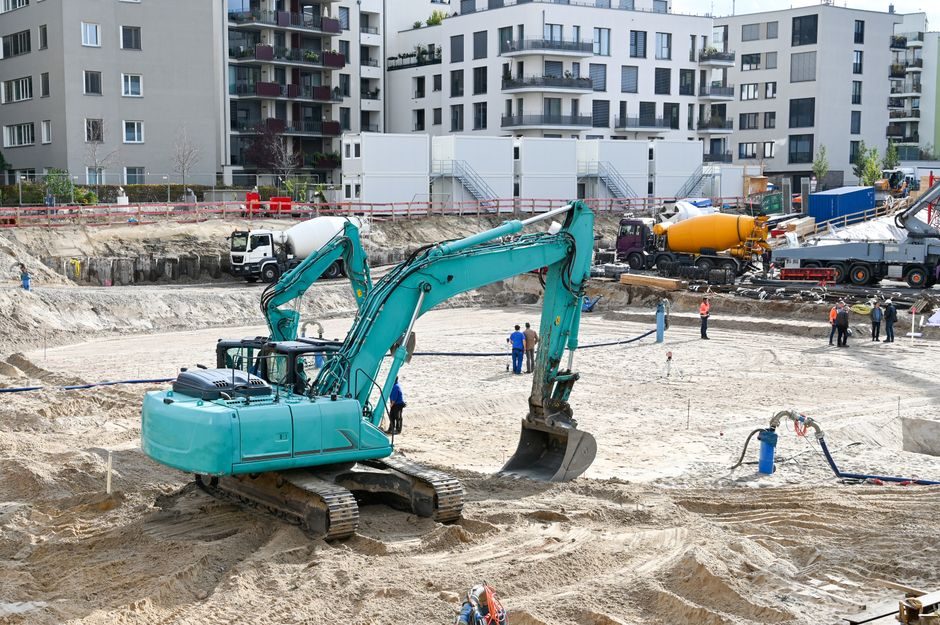
A slurry pump is a fixed or mobile centrifugal machine that moves water-laden solids (tailings, dredge spoil, mineral concentrate) through a pipeline at relatively low differential pressure; a concrete pump truck is a truck-mounted positive-displacement piston machine that places structural concrete through a multi-section boom at high pressure [S3].
The two equipment classes share a "fluid with solids" label, but their operating envelopes diverge by roughly an order of magnitude on every axis that matters: differential pressure, particle hardness tolerated, flow profile, and the way the machine is mounted to its host [S1][S3].
Pressure Class and Flow Profile
Concrete pump truck ZLJ5401THB ships with a Max. Theo. Concrete Output Pressure of 11 MPa at 120 m³/h, dropping to 7 MPa at 70 m³/h on a two-speed pumping curve, and a Rated Working Pressure of 35 MPa for the hydraulic circuit [S3]. A heavy-duty centrifugal slurry pump such as the CHS/CHSPP/CM/CL series is engineered for low-head bulk transfer, with duty points typically under 1 MPa differential and flow rates that scale with impeller diameter rather than displacement stroke [S1].
Concrete placement is a pulsed, high-pressure, positive-displacement process driven by twin hydraulic cylinders stroking 2100 mm against an S-valve; slurry transfer is a continuous, low-pressure, centrifugal process where head comes from impeller tip speed [S3]. Engineers who try to substitute a slurry pump for concrete placement will see the impeller stall within minutes on a 25 MPa mix; engineers who try to push tailings through a concrete S-valve will chew the wear plate in a single shift [S1][S3].
Solids Handling: Abrasive Slurry vs Structured Aggregate
Slurry pumps in the CHS, CCR/CCU, CHF/CF, and CZ series are built for hard, angular mineral particles: high-chrome white iron liners, rubber or polyurethane liners for fine cut, and heavy-duty bearing assemblies rated for continuous solids-laden flow [S1]. The same product family covers metal mining, coal preparation, sand aggregate, and dredging service, with manufacturers such as Haiwang running a 3000 m² test base for cyclone and pump validation [S2].
Concrete pump trucks, by contrast, handle a graded aggregate mix (typically ≤ 40 mm stone) suspended in a cement paste that must NOT segregate inside the delivery pipe. The 125 mm inner-diameter boom pipe and 230 mm bore × 2100 mm stroke concrete cylinder form a system optimised for rheology control, not abrasion resistance [S3]. Pumping abrasive mineral slurry through a concrete boom would grind the S-valve and chrome-plated cylinder wall; running structural concrete through a slurry pump would settle out the aggregate and crack the volute [S1][S3].
Mounting, Mobility, and Site Footprint
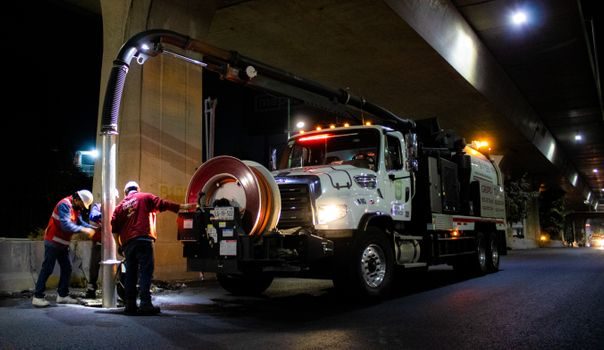
A concrete pump truck is a self-contained mobile unit: Actros 4141 8×4 chassis, OM501LA engine at 300 kW/1800 rpm, 400 L fuel tank, 38800 kg overall weight, 12980 × 2500 × 4000 mm envelope, top speed 85 km/h, with a 5-section boom unfolding 46.6 m vertical and 42.6 m horizontal from a single pad [S3]. Set-up is one machine, one operator, one stabiliser spread.
A slurry pump is typically skid- or baseplate-mounted next to a sump or pipeline, with a separate motor drive, separate pipeline, and no road-going chassis; the "mobile" versions (submersible slurry pumps, dredge pumps on pontoons) are still site-rigged, not highway-legal trucks [S1][S4]. For an operations team choosing between a 47-ton truck concrete pump with 1500 PCS/month supply availability [S7] and a skid-mounted heavy-duty slurry pump, the decision is mobility vs continuous duty, not one machine versus the other.
Comparison Matrix: Selection Criteria
Four criteria separate the two equipment classes cleanly. (1) Differential pressure: concrete pump 11 MPa output / 35 MPa hydraulic rated [S3] vs slurry pump well under 1 MPa differential. (2) Solids nature: concrete pump handles graded aggregate ≤ 40 mm in a non-segregating paste; slurry pump handles abrasive ore, sand, tailings, or dredge spoil [S1][S2]. (3) Mounting: concrete pump is a road-going boom truck with stabilisers; slurry pump is a stationary or pontoon-mounted centrifugal unit [S3][S4]. (4) Use case: concrete pump is for structural placement at building, bridge, or high-rise sites; slurry pump is for process transfer in mining, mineral processing, dredging, and tailings circuits [S1][S2].
A buyer who needs concrete placed in a column 40 m above grade should spec a 5-section boom truck with 42–47 m horizontal reach, manual + remote control, automatic lubrication, and a 780 L oil tank [S3]. A buyer who needs 500 t/h of copper tailings moved 2 km to a dam should spec a CHS/CHSPP heavy-duty slurry pump with high-chrome liners and a truck-mounted concrete pump should never enter that specification. The two machines do not compete — they sit on opposite pages of the same plant equipment list.
Adjacent Equipment You May Be Confusing
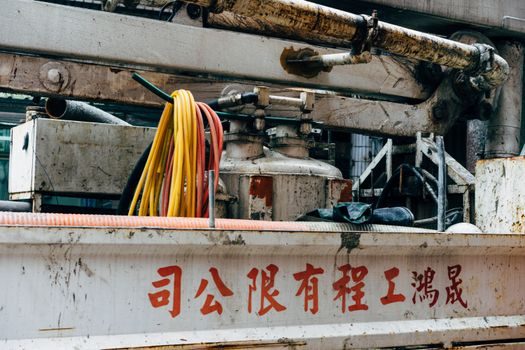
Engineers occasionally cross-shop slurry pumps against diaphragm pumps or peristaltic pumps for low-pressure abrasive service, and against concrete mixer trucks for site logistics. A concrete mixer truck carries and agitates the mix; it cannot place concrete vertically. A truck-mounted concrete pump cannot mix — it only pushes. A slurry pump can neither mix nor place structural concrete; it only transfers. [S7]
For highway-licensed transfer of mineral concentrate, a dump truck carries the dry or dewatered product; for a high-pressure fluid-handling comparison that includes the structured-aggregate constraints covered here, the diaphragm and peristaltic comparisons in the news archive give the per-axis spec bands. None of these are substitutes for a slurry pump on abrasive duty or for a concrete pump truck on placement duty — they are neighbours, not replacements.
Sourcing and Used-Market Signals (as of 2026-07-30)
New concrete pump trucks in the 47-ton class are offered at 1500 PCS/month supply capability from Shanghai-port exporters [S7], with new-build 52 m, 56 m, and 62 m units on Mercedes-Benz chassis visible in the used-dealer inventory alongside 2020–2023 Sany and Zoomlion stock [S5]. Slurry-pump OEMs in Hebei (Central Minerals) and Weihai (Haiwang) publish product lines covering CHS, CCR/CCU, CHF/CF, CZ, vertical sump, submersible, dredge, and gravel pump variants, with wear parts and abrasion-resistant piping sold as a complete mill package [S1][S2].
Trackable next signals: a concrete-pump buyer should watch for stabiliser-spread drawings matching the 5-section boom unfold angles of 90°/180°/180°/250°/250° [S3]; a slurry-pump buyer should verify liner material (high-chrome white iron vs rubber) against the cut size of the ore before signing a mill-package PO [S1]. Both equipment classes are mature, supplier-rich, and well-documented — a spec-driven comparison is the only reliable way to keep them on the right side of the equipment list.