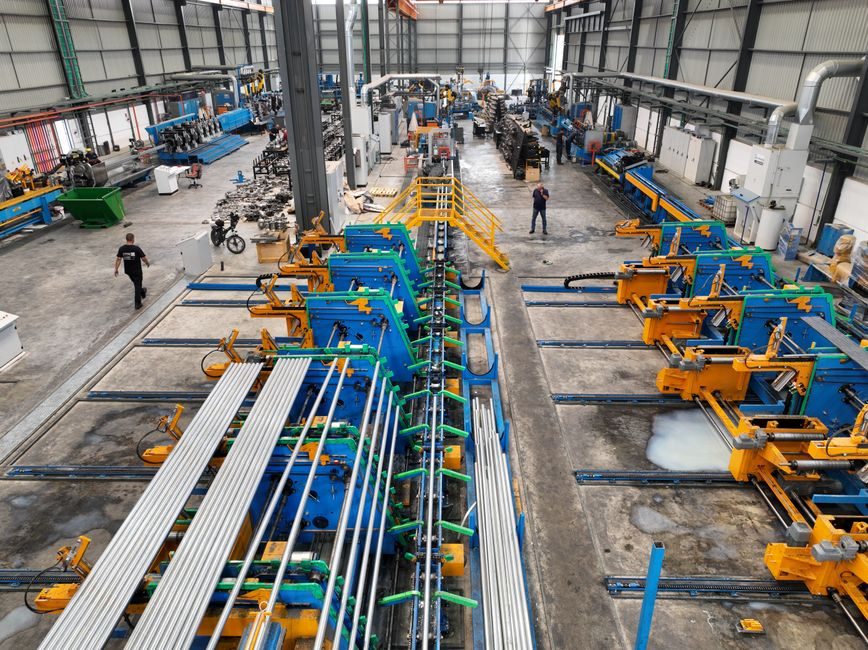
Steel quality control rests on four pillars: a named material grade (ASTM A36, A572, A516, EN 10025 S235/S275/S355, or JIS G3101 SS400), a defined mechanical envelope (yield, tensile, elongation, Charpy impact), a composition check by X-ray Fluorescence or Optical Emission Spectrometry, and a mill certification chain tied to ISO 9001 or IATF 16949 [S3].
As of 2026-07-31, regional mills are doubling down on traceability: Orrcon Steel (Australia) holds ISO 9001 quality system certification, ACRS third-party product certification, and runs hot-rolled structural pipe and tube to AS/NZS 1163 and AS 1074 [S7]. Karachi Steel reports over 35 years of production, established in 1988, and emphasises QC at billet and rebar stages [S4]. Gujrat Steel (Pakistan) lists custom fabrication for storage tanks, mezzanines, and pedestrian bridges with international safety standard compliance claims [S1].
What "Meeting Standards" Actually Means at the Mill
Steel mill certification is layered: ISO 9001 covers the quality management system; the material standard (ASTM, EN, JIS, AS/NZS) defines chemistry, mechanical, and dimensional limits; and the test report (MTC/EN 10204 3.1) ties the heat/lot to actual test results. Orrcon Steel explicitly discloses ISO 9001, ACRS product certification, and an in-house NATA-accredited mechanical testing laboratory for AS/NZS 1163 and AS 1074 pipe and tube [S7].
For purchasers, the actionable ask is the test certificate level. EN 10204 3.1 (mill-issued, independent of production) and 3.2 (mill-issued, independently validated — typically by a third-party inspector) are the two tiers that separate commercial stock from pressure-service or CE-marked constructional steel [S7]. Karachi Steel anchors its claim in ASTM-aligned production for rebar and structural sections, a common baseline for South Asian and Middle East export markets [S4].
Guided by practical specification discipline, the reference entries on alloy steel, carbon steel, and silicon steel map chemistry bands to typical service envelopes — useful when a buyer needs to decide between ASTM A36 (general structural, 250 MPa yield minimum) and ASTM A572 Grade 50 (high-strength low-alloy, 345 MPa yield minimum) for a given load case.
The Analytical Stack Behind a Heat Certificate
Handheld XRF spectrometers give rapid, non-destructive elemental composition for incoming scrap and raw-material sorting, while lab-grade OES instruments push detection limits for trace elements (Nb, V, Ti, Mo, B) down to tens of ppm [S3]. Prompt Gamma Neutron Activation Analysis (PGNAA) and Pulsed Fast Thermal Neutron Activation (PFTNA) deliver real-time, online bulk analysis on conveyor belts, closing the loop between furnace feed and ladle chemistry adjustments [S3].
Process Analytical Technology (PAT) is the bridge between lab certificate and live production. PGNAA/PFTNA lets operators drift-correct C, Mn, S, and P during BOF or EAF tapping rather than after the ladle has been deslagged, which materially improves first-heat yield on low-sulphur and HSLA grades [S3]. For context, the same emission-monitoring pattern that air quality monitor systems use for SO2 and NOx stack compliance is now being repurposed at the conveyor level to flag contamination events in the scrap feed stream [S3].
Radiation detection systems are a second-line safeguard. Personal radiation detectors and portal monitors block contaminated scrap — typically Co-60, Cs-137 sources from orphan medical or industrial gauges — from entering the furnace, where melting would volatilise contamination into off-gas and slag [S3]. This is a documented worker-safety and product-integrity control, not optional.
Decision Criteria: Picking a Steel Source by Application
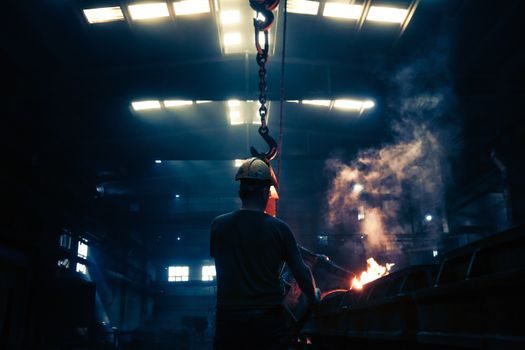
Four criteria dominate the buy decision for structural and pressure-service steel: (1) grade certification depth (ISO 9001 only vs ISO 9001 + third-party product certification like ACRS), (2) test certificate level (EN 10204 3.1 vs 3.2), (3) dimensional tolerance class (standard vs precision for cold-formed tube), and (4) lead time tied to mill geography [S7].
For a 200-metre pedestrian bridge in a high-wind coastal zone, a fabricator typically pairs ASTM A36 or A572 Gr. 50 plates with Charpy-tested welds to AWS D1.1 and a 3.2 certificate for the main load-path plates [S1]. For a 10,000-litre oil storage tank, the same fabricator shifts to ASTM A516 Gr. 70 (pressure-vessel plate) with UT testing per ASME Sec. VIII, again on 3.2 paperwork [S1]. The point: the grade, the test, and the certificate level move together, not in isolation.
Mills located inside the buyer's customs territory cut lead time to weeks rather than months. Orrcon Steel, operating Australian-local mills for pipe and tube, can land structural and precision tube on east-coast job sites in days, with AS/NZS 1163 grade options such as C250L0 and C350L0 documented on every MTC [S7]. Imported equivalents from East Asia typically clear customs in 6-10 weeks and must be re-checked for EN 10204 paperwork completeness on receipt.
Clean Steel, Scrap Quality, and the Sustainability Overlay
"Clean steel" is a metallurgical term, not a marketing slogan: it denotes tight control of residual elements (Cu, Sn, Cr, Ni, Mo) and dissolved gases (N, H, O), which directly influence formability, HIC resistance in sour service, and through-thickness ductility for thick plates [S3]. Handheld XRF is the first gate — scrap trucks are positively identified before they tip, and the mill rejects loads that exceed residual thresholds for the target grade [S3].
Electric-arc-furnace (EAF) producers using high scrap ratios face the strictest residual control. PFTNA on the scrap conveyor lets the charge modeler blend DRI/HBI with selected scrap to hold residuals within the target grade's envelope, reducing the need for ladle dilution and ferroalloy additions [S3]. The result is both a cost and a CO2 reduction, since every avoided ladle addition saves roughly 1.5-2.0 MWh of electric-arc energy per heat in a 100-tonne EAF, depending on tap temperature and alloy density.
Worker-safety monitoring — for airborne dust, noise, and radiation — is itself a quality control layer. Air quality monitors track SO2, NOx, and PM at the stack, while personal radiation detectors sweep the scrap bay; both feed records that are increasingly required for ISO 14001 and ISO 45001 certification alongside ISO 9001 [S3].
Who This Spec Map Is For (and Who It Is Not For)
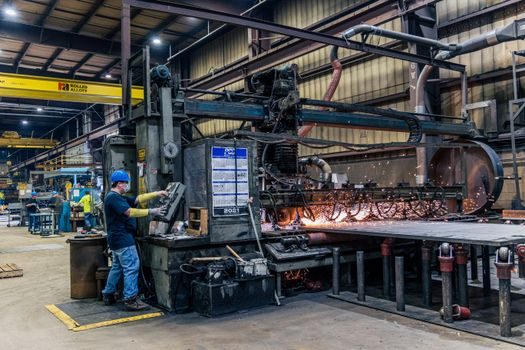
This map fits procurement engineers, EPC sub-contractors, and QA managers sourcing hot-rolled plate, structural sections, or precision tube for buildings, bridges, storage tanks, and general industrial fabrication [S1][S4][S7]. It is also useful for QA auditors who need a checklist of certificate levels, third-party marks, and test methods before signing off on a mill.
It is not for stainless steel pressure-vessel procurement (ASTM A240 / A312 / A358, with separate corrosion and intergranular attack testing) and it is not for high-purity electrical steel where grain orientation, core loss in W/kg at 1.5 T/50 Hz, and lamination coating chemistry dominate the spec [S3]. For those, the silicon steel reference is the correct starting point, with ISO 9001 plus a customer-specific PPAP or First Article qualification.
It is also not for rebar-only procurement, where ASTM A615 / A706 grade, seismic detailing, and country-specific bend/rebend tests overshadow the ISO 9001 question — though Karachi Steel's ASTM-aligned rebar output falls into that adjacent box [S4].
Limitations, Failure Modes, and Trackable Signals
The most common procurement failure is a test certificate that names a standard but omits the test results. Mills selling on ISO 9001 alone can ship material inside spec by the certificate but outside spec on chemistry if the in-house lab is not NATA- or equivalent-accredited — which is why Orrcon's disclosure of a NATA-accredited lab is a real differentiator, not a marketing line [S7].
A second failure mode is dimensional. Cold-formed tube to AS/NZS 1163 has tighter OD and wall tolerances than hot-finished structural tube to ASTM A500, and mixing them in a single fabrication run causes fit-up issues on site. Always match the tolerance class to the engineering drawing, not to the price list [S7].
A third mode is residual-element drift on EAF feed. Without PGNAA/PFTNA on the conveyor, a contaminated scrap load can push Cu+Sn over 0.40 wt% in a single heat, and the resulting plate will surface-crack during hot rolling. The signal to watch: a sudden drop in first-pass yield on the mill, with the chemistry trending high on residuals [S3]. Trackable next nodes: (1) any disclosed NATA/ISO 17025 lab accreditation on the mill's website, (2) explicit EN 10204 3.2 mention in tender responses, and (3) PGNAA/PFTNA on-line analyser presence on the scrap conveyor line. For deeper sourcing context, the industrial magnet suppliers 2026 sourcing map shows how grade-bound component makers approach a similar cert chain, and the investment casting suppliers 2026 capacity map covers the alloy end of the spec chain.