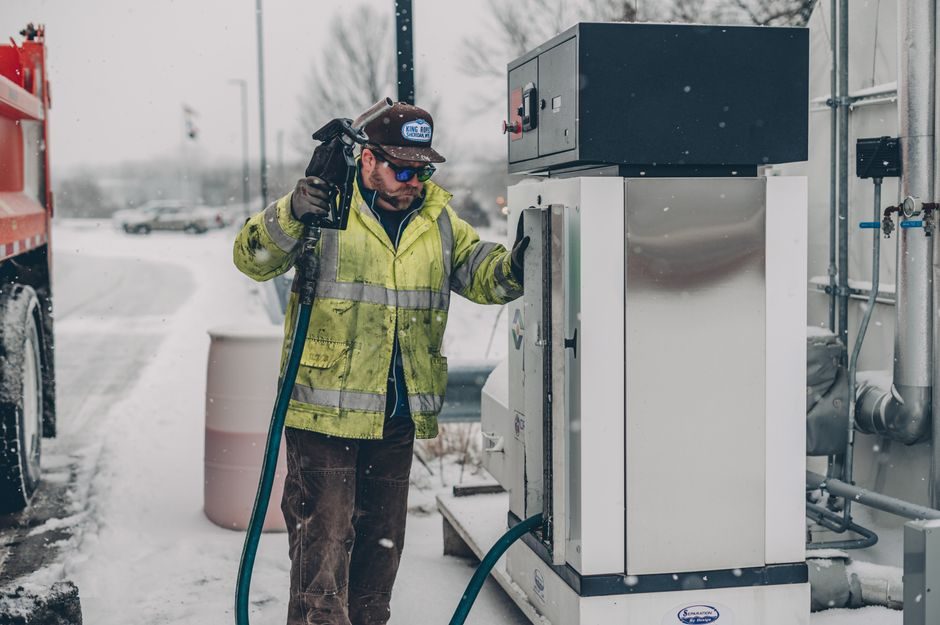
Submersible pumps and concrete pump trucks sit in different fluid-handling categories, but they get cross-quoted by buyers specifying site dewatering or aggregate placement [S1][S2]. The two machines share a pumping core but diverge on power class, flow regime, head pressure, and the medium being moved; comparing them on the same spec sheet is a category error that leads to wrong equipment on site.
Reference data points: a 33-ton-class truck-mounted concrete pump (ZLJ5331THB 43X-5Z) delivers 120 m³/h theoretical max output, 11 MPa theoretical concrete pressure, 35 MPa rated hydraulic working pressure, 22 min⁻¹ pumping frequency, 550 L hopper, 43 m placing depth, 39 m horizontal reach, and a 5-section 43X-5Z boom on an Actros 3341 6×4 chassis with OM501LA engine rated 300 kW @ 1800 rpm [S3]. Against that, an India-built submersible pump set from a CE- and ISO-certified Ahmedabad line typically runs 0.75–25 kW, 50–500 m³/h, 30–250 m head, in V3 / V5 / V6 borehole families plus SS-fabricated, open-well, and horizontal monoset variants for water supply, irrigation, agriculture, and dewatering [S2]. The order-of-magnitude gap in power and flow rate is the first thing any spec comparison must show.
Fluid medium and operating pressure: the dividing line
A concrete pump truck discharges a non-Newtonian abrasive slurry with 12–23 cm slump, 40 mm max aggregate, through a 125 mm delivery pipe at up to 11 MPa concrete-side pressure backed by 35 MPa hydraulic working pressure [S3]. A submersible pump handles water or low-solids dirty water; the S-valve and 130 mm × 2100 mm oil cylinder / 230 mm × 2100 mm concrete cylinder geometry of a boom pump has no analog in a water-duty submersible. For aggregate handling and boom placement, the truck-mounted concrete pump truck is the only correct category. For borehole, open-well, and sump dewatering, the correct category is a submersible pump — those duties need 50 mm to 200 mm column-pipe diameters, SS-fabricated impellers, and CE-certified motors, not a boom truck.
The mixing of the two on a buyer's RFQ usually traces to one of three causes: site dewatering during foundation pour (submersible pumping water out of the excavation while a concrete pump truck places the slab), mine dewatering where submersible drainage pumps run next to shotcrete pumps, and EPC packages where a single procurement line pulls both flow packages. Treat them as separate spec lines.
Power, flow, and head: side-by-side spec bands
The ZLJ5331THB 43X-5Z runs a 11.946 L displacement OM501LA diesel at 300 kW @ 1800 rpm, 2000 N·m @ 1080 rpm, 400 L fuel, 780 L hydraulic oil, Euro III exhaust, 32700 kg total weight, 11800 × 2500 × 4000 mm envelope, 8540 × 8490 × 8530 mm outrigger span, with auto-lubrication and manual + remote control [S3]. Concrete output has two operating points — 120 m³/h @ 7 MPa and 70 m³/h @ 11 MPa — chosen by stroke rate, not by hardware swap. A trailer or boom pump in this 30–40 m reach class typically discharges 80–170 gpm of concrete at line pressures above 1500 psi.
Submersible pump sets in the V3 / V5 / V6 family and SS-fabricated line from a CE-certified Indian manufacturer cover 0.75–25 kW, 50–500 m³/h, 30–250 m head, with V3 / V5 / V6 designations corresponding to bore diameters and stage counts, plus separate domestic, horizontal monoset, self-priming, centrifugal submersible, and open-well sub-families [S2]. Submersible flat and round cables and UPVC column pipes are stocked as part of the same product tree, not as accessories — that is why the supplier's BOM read on a quotation reads as a complete borehole string. For a dewatering application on a concrete pour, the relevant decision is flow × head at the duty point, not boom reach.
Use-case split: who each machine is FOR and who it is NOT for
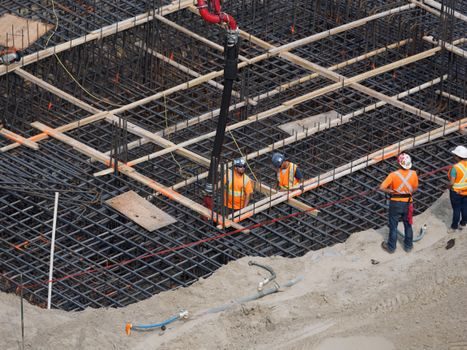
A concrete pump truck is FOR high-rise slabs, bridge decks, tunnel linings, mass foundations, and any pour where boom reach (39 m horizontal / 43 m depth on the ZLJ5331THB) replaces crane-and-bucket logistics [S1][S3]. A truck-mounted concrete pump is NOT for dewatering sumps, mine pits, or agricultural irrigation — the 32700 kg GVW, 4000 mm height, and 11 MPa concrete-side plumbing make it the wrong tool by an order of magnitude in weight and an order of magnitude in pressure overshoot. A trailer pump (line pump) is the closer fit when boom reach is unnecessary and the pour is below boom-truck reach; Cole & Lambert's new-and-used line explicitly splits between concrete boom pumps and trailer pumps as separate inventory classes [S1].
A submersible pump is FOR borehole water supply, drinking water schemes, agricultural irrigation, fountain circulation, sewage and mud handling, dewatering, and self-priming duties on a construction site where the pump can be dropped into a sump and left to run [S2]. A submersible pump is NOT for placing structural concrete — the impeller geometry, elastomer selection, and motor cooling are designed for water, not 40 mm aggregate at 12–23 cm slump. Specifying a submersible for concrete placement is a procurement error that ends in a seized impeller within hours.
Selection criteria: five-point comparison
Five criteria separate the two categories cleanly: medium handled, pressure class, mobility, power source, and BOM scope. Medium: water / low-solids vs 12–23 cm slump concrete with 40 mm max aggregate [S2][S3]. Pressure class: 30–250 m head (≈0.3–2.5 MPa) on the submersible side vs 11 MPa concrete-side and 35 MPa hydraulic working pressure on the boom pump side [S3]. Mobility: submersible is portable by hand or hoist, column-pipe coupled, and lives in the sump; concrete pump truck is a 32700 kg, 11800 mm long, 6×4 chassis-mounted boom unit with 8540 × 8490 × 8530 mm outrigger footprint and 8500 mm min boom-opening height [S3].
Power source: submersible uses grid or genset AC at 0.75–25 kW with CE-certified motor and matched flat or round submersible cable, plus UPVC column pipe and tank-gauge integration via an EM02 submersible pump controller [S2][S4]. The boom pump is self-powered through a 300 kW @ 1800 rpm OM501LA diesel with 400 L fuel and 780 L hydraulic reservoir, Euro III exhaust compliant, automatic lubrication, and manual + remote control [S3]. BOM scope: a submersible line item includes pump + motor + cable + column pipe + control panel; a concrete pump truck line item includes the truck, the placing boom, the spare-parts package, and the wear-plate / S-valve / end-hose wear items sourced through dedicated aftermarket channels [S5].
Standards, sourcing nodes, and aftermarket parts
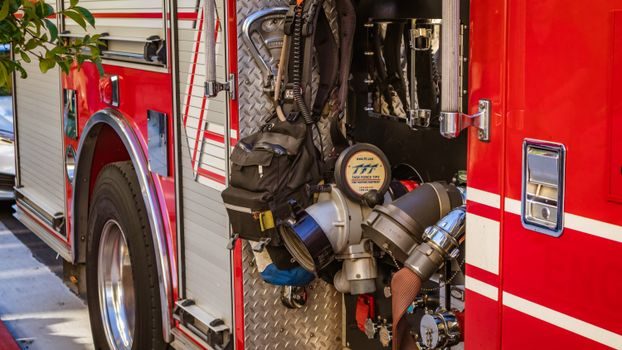
Submersible pumps from the Ahmedabad manufacturer carry CE certification and ISO certification for the pumps and motors, with V3 / V5 / V6 / SS-fabricated families produced under in-house testing protocols covering low-voltage performance, energy efficiency, electricity consumption, and functional life [S2]. The EM02 submersible pump controller manages power supply to the submersible pump electric control cabinet and integrates with SS-series tank gauges, a useful datapoint for water-supply and irrigation automation [S4]. A concrete pump truck carries chassis-level certifications (Euro III on the ZLJ5331THB) and places concrete to typical structural tolerances; placing depth and horizontal reach on the 5-section 43X-5Z boom are 43 m and 39 m respectively with a ±350° slewing angle and 90°/180°/242°/180°/250° section folding angles [S3].
Sourcing nodes diverge: submersible sets, cables, column pipes, and control panels are typically bundled from one ISO-certified Indian or Chinese vendor with sub-assemblies in the same shipment [S2]. Boom pumps route through brand-specific dealer channels — Cole & Lambert is an authorised distributor for Putzmeister, Olin Pump, and Multiquip in the Northeast Continental U.S.A., with new-and-used inventory, repair service via a dedicated Pump Rescue truck, and a sourcing service that locates specific used units across the U.S. [S1]. Wear parts and consumables for either machine are sourced separately; SANF positions itself as a factory-direct aftermarket supplier for concrete pump and concrete mixer parts across multiple brands, which is the typical channel buyers use for S-valve, wear plate, delivery cylinder, and end-hose replacement [S5]. Buyers comparing the two should not co-mingle spare-parts inventories.
Spec sheet, watch-outs, and the decision rule
On a single-row spec comparison, the concrete pump truck is the only option when the duty is structural concrete placement above 30 m³/h with boom reach, and the submersible pump is the only option when the duty is water or low-solids fluid below 250 m head at sub-25 kW power. Mis-specifying either direction costs project time and hardware — submersible in concrete destroys the impeller; boom truck in a dewatering sump burns fuel at 300 kW to move 50 m³/h of water that a 5 kW submersible handles for under $0.50/h in electricity. A 5-section 43X-5Z boom with 8790/7320/7370/7745/7775 mm section lengths and 3 m end hose is sized for placing-boom work, not sump work [S3]; a V3 / V5 / V6 submersible in 50–200 mm column-pipe sizes is sized for borehole work, not placement [S2].
Two trackable signals to watch over the next procurement cycle: 1) The ZLJ5331THB class of 5-section 43 m reach boom pumps is the current Indian / Chinese export reference for 30-ton-class truck-mounted booms; any move to a 6-section 50+ m reach at the same 32700 kg GVW would shift the spec band. 2) Submersible pump set V4, SS-fabricated, agriculture, and solar submersible families are flagged for imminent launch by the Ahmedabad manufacturer, which will extend the V3 / V5 / V6 spec band into solar-direct and stainless-steel borehole classes [S2]. For pour-side logistics, a concrete mixer truck is the upstream supply for the boom pump and a separate spec line that should not be conflated with either unit. For deeper drilling on placement, see Diaphragm Pump vs Concrete Pump Truck for the small-line-pump comparison that sits between trailer pumps and boom pumps.