An aerial work truck outrigger typically carries 8 to 18 tonnes per leg, and the pad beneath it must be sized so ground pressure stays below the allowable bearing capacity of the surface. On finished asphalt, allowable pressure is commonly 150 to 300 kPa; on soft shoulder ground (sandy fill, sabkha, reclaimed soil), the same 8 to 18 t leg load needs a pad rated for as little as 75 to 120 kPa, which roughly doubles the required pad footprint.
The sizing rule is the same in both cases, pad area = maximum outrigger load / allowable ground bearing pressure, but the answer diverges by a factor of 2 to 4 depending on whether the truck is set on a paved lot or on the verge of a county road. This article lines up the two cases side by side with numbers a setup crew can act on, drawing on boom-truck and aerial-lift sizing guidance published between May and October 2026 [S1][S2][S3].
Two-Surface Decision Matrix: Pad Footprint and Material
The core decision is which surface you are setting on, because that single variable changes both the minimum pad area and the material choice. Reference allowable pressures used in October 2026 boom-truck sizing guides are rock or compacted aggregate at 300 kPa, compacted fill at 200 kPa, sandy ground at 120 kPa, and sabkha, soft, or reclaimed ground at 75 kPa [S2]. On a 10-tonne leg load, those numbers produce a minimum pad area of 0.33 m² on aggregate, 0.50 m² on compacted fill, 0.83 m² on sandy ground, and 1.33 m² on sabkha, a 4x swing for the same machine [S2].
For an asphalt shoulder the practical target is to keep the contact pressure below the asphalt's allowable bearing capacity, which on a sound 50 to 100 mm overlay typically falls in the 150 to 300 kPa band (close to the compacted fill / compacted aggregate numbers above) [S2]. On a soft unpaved shoulder, treat the ground as sandy at best, often worse, and size for 75 to 120 kPa with a 1.5x safety factor on top of the static calculation [S2]. A 24 x 24 in (610 x 610 mm) pad is the practical floor for a small bucket truck on asphalt, while a 36 x 36 in to 48 x 48 in (910 x 910 to 1220 x 1220 mm) composite pad is the common starting point for the same truck on a soft shoulder [S5].
Pad Area Calculation, with Asphalt and Shoulder Examples
Start with the maximum outrigger reaction from the manufacturer's load chart, then apply the area formula, then add a safety factor, then round up to the next standard pad size [S2][S3]. A common shortcut is the 3x rule: the pad should be at least three times the square surface area of the outrigger shoe or float on Grade A soil, but this is a minimum, not a substitute for the calculation [S6].
Worked example for an 18-tonne aerial work truck plus 5-tonne payload (23 t total) on the worst leg, using the planning 60% assumption: 23 × 0.60 = 13.8 t = 135.4 kN. With a 1.5x safety factor that becomes 203.1 kN. On asphalt rated at 200 kPa, minimum area = 203.1 / 200 = 1.02 m², so a 1000 x 1000 mm pad just barely qualifies, and a 1200 x 1200 mm composite pad (for example, a 60 mm thick unit rated at 180 t) is the smallest standard that passes [S2]. On soft shoulder ground rated at 75 kPa, the same 203.1 kN needs 2.71 m², which pushes you into 1700 x 1700 mm territory or a stacked wood-on-composite setup. The calculation is the same; the answer changes because the denominator changes.
Material Choice: Composite, Wood, Steel, or a Stack
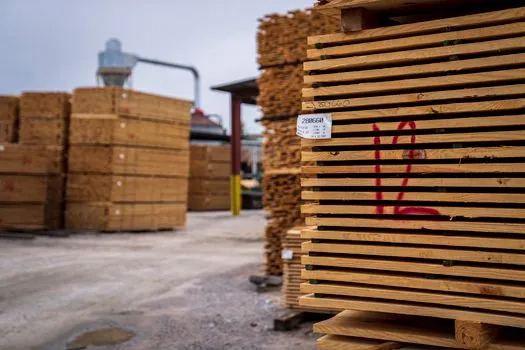
Composite pads (typically UHMWPE or HDPE-based engineered sheets) have become the default for aerial and boom-truck work because they combine high strength-to-weight ratio, controlled deflection, and resistance to moisture and cracking, with no rust and lower handling weight than steel [S1][S3]. Wood remains the cheapest option and is rigid under load but will break if overloaded, and its life drops sharply in wet-then-humid cycles, while composite pads handle that swing better [S3][S4]. Steel is reserved for extreme loads where a crane outrigger exceeds what composite can carry, and it brings rust and a need for machinery to move it [S3].
On the soft-shoulder side, a stacked setup is the field-tested answer: a wood pad on top of a composite pad broadcasts the load to a wider area of the composite, reduces deflection, and provides a wider footprint for the outrigger float [S4]. For an aerial work platform or bucket truck that gets set and re-set many times a day, the weight and handling penalty of a full steel set is rarely justified, while a 36 x 36 in composite at 2 to 4 in thick can be manhandled and reused for years. Reference GBC numbers that drive these choices: soft clay 7 to 14 psi (~50 to 100 kPa), firm soil 14 to 28 psi (~100 to 195 kPa), compacted gravel 35+ psi (~240+ kPa), and concrete 100+ psi (~690+ kPa) [S3].
Setup Discipline and Failure Modes
Pad sizing is only half the problem; the other half is what the crew does on the ground. A pad centred under the outrigger float, on ground that has been levelled and cleared of loose material, set clear of trench edges, drains, manholes, and buried services, and re-checked after rain or any sign of settlement, is the minimum that should appear on a pre-lift checklist for any boom or aerial truck [S2]. The same pad size should be used under all four outriggers unless the load chart says otherwise, and pads should be inspected between jobs for cracks, deep gouges, or warping [S2].
Common boom-truck mistakes that show up in incident reports include setting outriggers on kerb edges or asphalt seams, using bare outrigger floats with no pad at all on finished surfaces, and assuming a single pad size works for every job [S2]. On soft shoulder ground the dominant failure modes are pad punch-through, pad tilt from uneven seating, and progressive sinkage during the lift as the soil yields; a thicker pad and a larger footprint reduce the first, a level prepared base reduces the second, and a mid-lift re-check after the boom comes off the stowed position catches the third [S2][S4]. A related deep dive on geometry constraints for outrigger placement appears in the guide to truck-mounted crane lifts below grade, outrigger geometry and confined-space limiters, which complements the pad-sizing rules here when the truck is set in a pit or next to a wall.
Sourcing, Standards, and What to Verify Before Lift
There is no single harmonised international standard that pins a universal pad-size formula, so the calculation leans on the manufacturer's load chart, a documented allowable ground bearing pressure for the surface, and a stated safety factor, with cribbing assembled on-site held to a minimum of three layers for 3-inch planks or two layers for 4-inch planks [S7]. Crews should record the leg load from the chart, the assumed GBC, the resulting minimum area, the chosen standard pad, and the safety factor used; that single line of paperwork is what an auditor or incident investigator will look for first.
Two trackable signals to watch over the next planning cycle: the steady migration of fleet specification sheets toward engineered composite pads in the 24 x 24 to 48 x 48 in size range for utility bucket trucks, and the wider adoption of the 60% planning leg-load assumption as a placeholder when the load chart is not at hand, to be replaced with the real figure before any lift [S1][S2][S3]. Both point the same direction: a smaller, lighter, more consistent pad on asphalt, and a larger, thicker, often stacked pad on any soft shoulder, with the area formula as the only honest tie-breaker between the two.