The dominant engineering rule for an aerial work truck is that the chassis GVWR class and the boom working height must move together, because counterweight, outrigger spread, and rear-axle rating all scale with platform reach.
U.S. truck classification runs 1 through 9 by GVWR, and the cutoff points are stable across the industry: Class 3 sits at 10,001-14,000 lb, Class 4 at 14,001-16,000 lb, Class 5 at 16,001-19,500 lb, Class 6 at 19,501-26,000 lb, and Class 7 at 26,001-33,000 lb, with Class 8 covering everything above 33,000 lb [S3][S6]. The 26,001 lb threshold is also the federal CDL trigger for non-articulated single units, which is why a fleet can save a license cost by staying at 22,000-25,950 lb [S3][S8].
Boom Reach Bands and the GVWR Class They Demand
Bucket trucks in the 30-45 ft working-height band sit comfortably on Class 3-5 chassis because the folded boom, two-man platform, and standard outriggers rarely push payload above 8,000 lb once the bare chassis weight is counted; a typical 45 ft non-overcenter sign-and-light truck on a 14,000-16,000 lb Class 4 frame is a proven DPW workhorse [S1].
The 50-65 ft band, which covers the popular overcenter insulated units used by utilities and telecom crews, lands squarely in Class 6 territory at 19,501-26,000 lb GVWR, and the 22,000 lb DPM2-52 platform on a Class 6 chassis is a current OEM data point showing this range is deliberately kept below the 26,001 lb CDL line to preserve non-CDL operation for municipalities [S8].
Once working height passes about 65 ft, side reach and platform capacity force the build into Class 7 (26,001-33,000 lb) or Class 8 (above 33,000 lb); the Terex Hi-Ranger XT60 at 65 ft working height and the Altec AA55 at 60 ft both belong to this band, and the 1.3-1.5 percentage-point uptime gap between them is far smaller than the chassis-choice error of pinning a 60 ft boom on a Class 5 frame [S5].
Why a Smaller Chassis Cannot Safely Carry a Taller Boom
A taller boom does not just add length; it adds moment, so the counterweight, the outrigger pad reaction, and the rear-axle load all climb faster than the linear height gain would suggest, which is why a Class 5 truck specced to 55 ft will show tire scrub on every set-up and premature leaf-spring cracking within 30,000 miles [S1].
Stability calculations on these units use ANSI A92.2 vehicle-mounted categories, and the practical effect is that the rated platform capacity (typically 300-500 lb for two-person buckets) can only be delivered when the chassis GAWR, the outrigger span, and the slope limit (usually 5 degrees) are all respected; a 22,000 lb chassis derated by an oversized boom will fail the stability test before the boom test, which is exactly the failure mode that drove the 21 percent downtime reduction reported after a mid-size DPW standardized its builds on correctly-classed chassis [S1].
The cab-to-axle dimension matters as much as GVWR, and the related spec guide on cab-to-axle selection for aerial work truck chassis walks through how a 60 in. CA on a Class 5 versus an 84 in. CA on a Class 6 changes both the rotation bearing load and the body compartment length.
Class-by-Class Comparison: 30 ft, 55 ft, and 75 ft Reference Builds

The clearest way to read the chassis-vs-boom rule is to line three reference builds against the four decision criteria that drive a spec: GVWR, working height, platform capacity, and CDL requirement [S3][S6].
Build A is a 30-40 ft telescopic, non-insulated, on a Class 3 chassis (10,001-14,000 lb GVWR), 300 lb platform, no CDL required; this is the workhorse for sign shops and small tree-service operators and is the segment where a towable boom lift with its 40-60 ft working height becomes a real cost alternative at $1,200 per week versus outright purchase [S1][S2].
Build B is a 55 ft overcenter, insulated fiberglass upper boom, on a Class 6 chassis (19,501-26,000 lb GVWR), 500 lb platform, still below the 26,001 lb CDL line when the 22,000 lb DPM2-52 configuration is chosen; this is the dominant spec for investor-owned utility line work and is where fleet uptime benchmarks such as 97.8 percent for the Altec AA55 are measured [S5][S8].
Build C is a 75-100 ft articulating-telescopic on a Class 7-8 chassis (26,001-50,000 lb+ GVWR), 600-1,000 lb platform, CDL Class B required; this build is for transmission-line work, sign contractors on highway overpasses, and large-tree removal, and it is the segment where rental at roughly $1,200 per week is dominated by outright purchase after 12 weeks of continuous use [S1].
The trade is straightforward: a Class 6 build delivers roughly 90 percent of the working height of a Class 8 build at 60 percent of the chassis cost, and it preserves non-CDL operation, which is why most DPW and telecom fleets spec 50-65 ft units and only step up when the side-reach requirement exceeds about 30 ft.
What the Towable Boom Lift Versus Bucket Truck Choice Tells You About Class
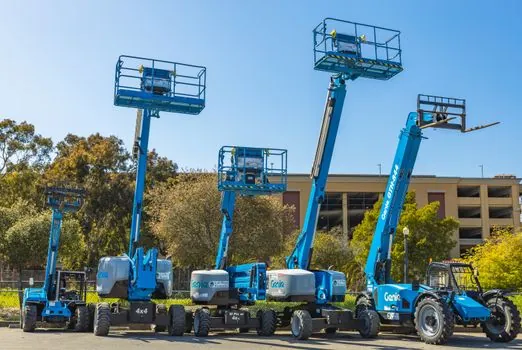
A towable boom lift on a trailer-style chassis, typically rated to 40-60 ft of working height, is mechanically a smaller moment load than a truck-mounted bucket of the same height because the trailer's tongue weight transfers reaction into the tow vehicle's rear axle; this is why contractors who only need 40 ft of reach and have a stable tow vehicle often pick the towable over a Class 3-4 bucket truck, and why the rental math works out at $1,200 per week before the 12-week purchase crossover [S1][S2].
For anything above 60 ft of working height, the truck-mounted build is the only practical answer because the trailer's stability footprint and the road-speed penalties of a heavy towed load become uneconomical, which is the engineering reason the 22,000 lb DPM2-52 platform is truck-mounted and not trailer-mounted despite the boom length being close to the towable envelope [S2][S8].
Who Should Pick a Larger Class Than the Boom Strictly Needs
Fleets that run heavier crews, carry more tools in the body, or work on grades above 5 degrees should spec the next GVWR class up, because platform capacity and slope performance both consume stability margin faster than the boom height alone suggests; the matching guidance on platform racks and tool trays in mounting cable trays and tool racks on aerial work truck platforms is a useful cross-check because added body weight directly reduces the payload available for counterweight and crew. [S5]
Fleets that should NOT step up include low-mileage municipal DPWs with predictable flat-terrain routes, because the extra chassis cost, the extra fuel, and the CDL requirement of a Class 7-8 truck add operating expense that 50 ft builds on Class 6 chassis do not justify; the same logic applies to seasonal sign-and-light contractors whose peak reach is 35-40 ft and whose annual hours do not justify a Class 6 build at all.
Selection Rules and Common Failure Modes
Rule 1: Match GVWR class to working height using the bands above, and never run a 60 ft boom on a Class 5 chassis because the outrigger pad reactions will exceed the tire contact patch before the boom reaches its rated envelope [S3].
Rule 2: If the boom is insulated for live-line work, add one full class of GVWR because the fiberglass upper boom, the liner, and the dielectric hardware add 400-800 lb that the stability calc must absorb, which is why most 55 ft overcenter insulated units are spec'd on Class 6, not Class 5 [S1][S5].
Rule 3: Respect the 26,001 lb CDL line unless the operational case for Class 7-8 is real, because forcing every driver into a CDL program is a hidden cost that frequently exceeds the chassis price difference; the 22,000 lb DPM2-52 exists specifically as a non-CDL Class 6 alternative for fleets that need 52 ft without the licensing burden [S3][S8].
Failure mode 1: Derating a Class 6 chassis to fit a budget by selecting a 60 ft boom rated for a heavier frame, leading to outrigger pad sinking on soft asphalt and a tip-over near the boom's rated limit.
Failure mode 2: Speccing a Class 5 chassis to keep the truck under 19,500 lb and then adding a 1,200 lb crane-style winch for material handling, which destroys the stability margin and which is the same physical reason a boom truck for material and a bucket truck for people are specced to different chassis classes from the start [S1][S4].
Sourcing, Standards, and Trackable Signals

The classification thresholds in this article are taken from the U.S. GVWR system as published by DOT-aligned sources, and the boom-vs-class mapping reflects the 2025-2026 OEM and upfitter data points cited above rather than any single standard's table [S3][S6].
For verifying any specific build, the most useful primary sources are the OEM specification sheets (Altec, Terex Hi-Ranger, Versalift, Dur-A-Lift), the upfitter's body-load drawing for a given cab-to-axle, and the ANSI A92.2 stability test report for the mounted unit [S5].
Two trackable signals to watch for in the next spec cycle: the 22,000 lb non-CDL Class 6 segment, currently represented by the DPM2-52 [S8], and the hybrid-electric bucket-truck platforms entering municipal bids in 2025-2026 with silent lift modes for residential night work, which compresses idle hours and changes the duty cycle on the chassis [S1].
Detailed specification references: dump truck.