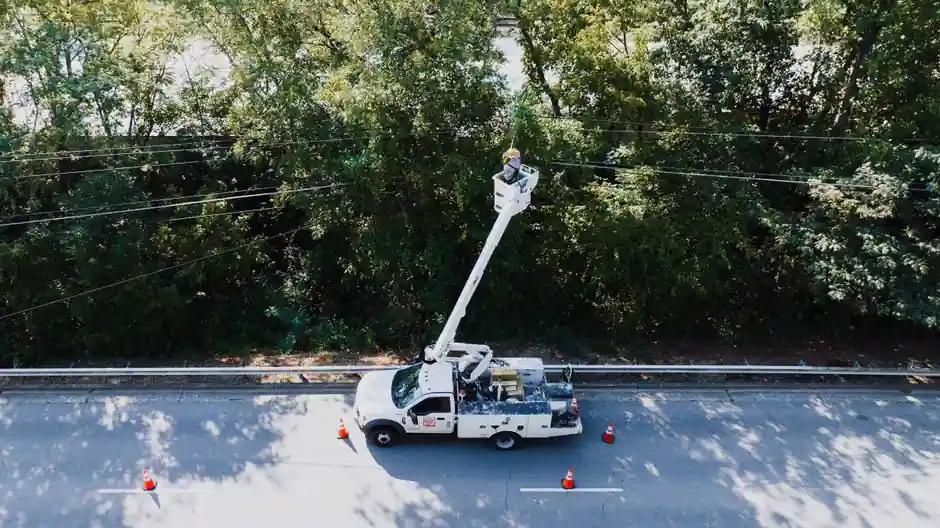
Personnel bucket trucks are spec'd for 1-2 workers plus tools in the 300-1,000 lb range, while material-handling bucket trucks and crane-configured boom trucks are spec'd for 1,000-36,000+ lb loads on a different rating basis [S3][S5].
Engineers specifying fleet equipment need to know that OSHA treats the personnel bucket as a MEWP (per ANSI A92.22 referenced in OEM guidance), while a material-handling aerial device is rated as a crane on a load-chart basis [S1][S7]. Mixing those two envelopes is the most common spec error in the field.
Why the Two Capacity Numbers Are Not the Same
Platform capacity on a personnel bucket is the combined live load of workers, tools, and consumables the basket is rated to hold; typical scissor-lift and boom-lift baskets land between 300 lbs on a single-person vertical mast and 500-1,000 lbs on a two-person articulating boom [S5]. On a material-handling bucket truck, the same physical bucket is re-rated as a crane attachment and the chassis, outriggers, and boom moment diagram dictate the load chart, so published capacities step up into the 1-5 ton range for typical units and well above that for crane-class boom trucks [S1][S2].
The distinction matters because a personnel bucket is governed by stability and tip-over tests on a level surface with no outriggers, while a material-handling device assumes outrigger deployment, a defined load radius, and a load chart that derates capacity as reach increases [S1]. The reference for a boom-mounted chassis configuration also drives the difference: shorter cab-to-axle chassis favour personnel work, longer CTA favours material lift.
Capacity Bands by Machine Class
Standard scissor lifts land at 500-1,000 lbs of platform load, heavy-duty scissor lifts reach 1,000-1,500+ lbs, and specialized platforms can exceed 2,000+ lbs [S3]. Rough-terrain scissor lifts hold the 1,000-1,500+ lb band while still tackling uneven ground, which is why they are the default for exterior construction with tools and materials [S3].
Telescopic boom-lift baskets are usually 500-660 lbs for personnel, but the same chassis sold as a material lift trades the bucket for a jib and a load hook, pushing published capacity into the multi-ton range [S3]. Boom trucks (the crane variant) routinely post 5-30+ ton charts depending on boom length and outrigger spread [S2][S7]. Material-only lifts and rough-terrain forklifts listed for indoor and outdoor construction can reach 8,000+ lbs for rough terrain and 36,000+ lbs for heavy indoor models [S3].
For comparison, a typical bucket-lift or small personnel bucket is described in field guides as having a weight limit under 1 ton and being designed to carry people safely at height rather than as a material hoist [S6]. The aerial work platform reference page carries the same personnel-bucket framing, while the aerial work truck reference allows either the personnel or material configuration on the same truck family.
Decision Matrix: Personnel vs Material-Handling Bucket Truck
Use the matrix below to pick a configuration; the four criteria are the ones that actually drive the spec, not marketing language. Capacity is platform or load-chart live load in lbs, reach is the working height or radius the spec is published at, integration is the chassis and outrigger work required to deploy the unit, and typical use is the job the OEM literature puts the unit on. [S5]
Personnel bucket truck: 300-1,000 lbs platform capacity, 20-50 ft typical working height, drop-in chassis build with no permanent outriggers, suited to utility linework, signage, and tree care [S1][S5]. Articulating-telescopic personnel bucket (e.g. Terex LT40, Versalift VST-7500-E108): 500-1,000 lbs platform, 40-75 ft working height, still drop-in chassis, suited to overhead utility and telecom where side reach and reduced tail swing matter [S1].
Material-handling bucket truck: 1,000-5,000+ lbs on a load-chart basis with outriggers deployed, working radius 20-50 ft, requires outrigger pads and a level site, suited to HVAC unit setting, sign installation with heavy steel, and glazing work [S1][S7]. Boom truck (crane variant): 5-30+ ton load chart, 50-180+ ft boom, full outrigger spread and counterweight, suited to structural steel, tree removal with logs, and utility pole setting [S2][S7].
When a Personnel Bucket Is the Wrong Tool
Personnel bucket platforms in the 440-500 lb band move slower than full-sized booms and will not accept a concrete block, a steel I-beam, or a packaged HVAC unit without overloading the basket [S5]. A scissor or boom lift basket that exceeds its combined weight rating increases tip-over risk and exposes the operator to OSHA citations, regardless of whether the lift is on level ground or rough terrain [S4].
Material-handling bucket trucks and boom trucks are not a free upgrade either: the load chart derates rapidly as radius grows, outriggers must be deployed on a bearing surface, and the chassis must be specced for the moment load, not for personnel-only duty cycles [S1][S2]. The most common field failure is treating a personnel bucket as a material lift by removing the liner and setting a load in, which voids the OEM rating and the inspection paperwork [S4][S6].
Sourcing, Standards, and Spec Discipline
OEM-published capacity should always be cross-checked against the nameplate on the physical unit, because options (jibs, winches, second platforms) change both the personnel and material ratings [S4]. The OSHA definition of an aerial lift is a vehicle-mounted device used to elevate personnel, which means a material-handling configuration is typically reclassified under crane rules when a hook or jib replaces the basket [S5].
When comparing published numbers from different vendors, normalize by working radius and outrigger spread, not by peak capacity alone; a 5-ton boom-truck chart at 10 ft radius is not equivalent to a 5-ton chart at 40 ft radius [S2][S7]. For mixed-fleet buyers, the material handling and storage handling reference pages are useful for the forklift-class comparisons on the high end of the capacity scale.
Track these signals over the next procurement cycle: OEM literature continues to merge personnel and material ratings under one chassis (Altec, Versalift, Terex) [S1]; OSHA enforcement data on aerial-lift tip-overs is the public record to watch for changes in basket-rating guidance; and load-moment indicator (LMI) adoption on smaller boom trucks is the leading indicator of where the material-handling aerial truck market is heading into 2027.