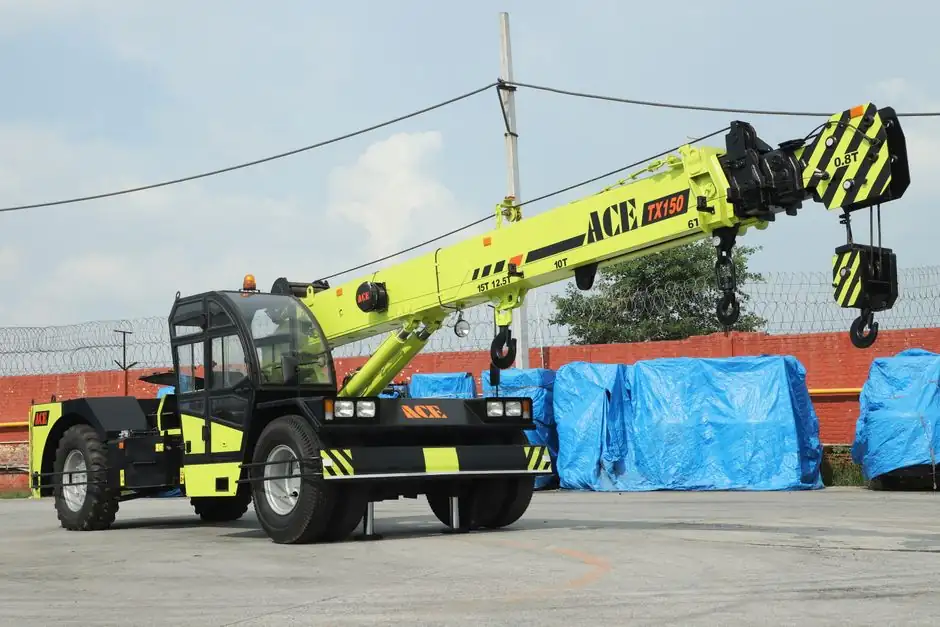
OSHA's Cranes and Derricks in Construction standard places ground-condition responsibility on the employer: the surface under a mobile crane, including a truck-mounted crane set beside a trench, must be sufficiently firm and level to support the machine through the lift [S1]. For below-grade picks this is non-negotiable, because trench walls, shoring, and the soft excavated bench can all fail before any load chart is exceeded.
Below-grade lifting is fundamentally a confined-space lift. Tunnel cross-sections commonly run 3 m to 5 m in diameter, and that envelope caps both jib angle and the vertical clearance between hook and load [S4]. Once that headroom is gone, a conventional boom truck stops being a crane and the work falls to hydraulic jacking, segment erectors, or purpose-built TBM davit arms [S4].
Why Below-Grade Picks Fail: Tipping Geometry, Not Just Capacity
Tipping is the most common crane accident mode, and the side quadrant is the least stable load position on most mobile cranes [S2]. A truck crane parked parallel to a trench with the boom over the side is therefore in its worst quadrant at the same moment the trench wall removes any margin for an outrigger punch-through. Lifting over the rear usually offers the highest load chart values, but the tipping axis becomes the rear outrigger pair, so a soft trench shoulder directly under that pad can pivot the whole machine [S2].
Rough-terrain cranes attack the geometry problem with H-pattern outriggers, oversized flotation tyres, and a deliberately lowered centre of gravity, holding lift capacities from roughly 30 t to 165 t with booms from 30 ft to 205 ft on unprepared ground [S5]. For trench work, those outrigger pads still have to land on bearing pads or crane mats, never on the trench edge itself, because the manufacturer's load chart assumes a level, fully seated outrigger pad, not a tipping edge [S1][S5].
Outrigger Setup, Pad Bearing, and the Trench Shoulder
OSHA Section 1402 (Ground Conditions) requires the assembly/disassembly and operation area to be inspected and verified firm and level before any load is applied, and the operator's manual plus the machine-specific load chart govern what "level" means numerically [S1]. For a truck crane on a trench bench, three concrete data points drive the setup: outrigger pad size (cm²), allowable ground bearing pressure (kPa), and the horizontal stand-off from the trench wall to the centreline of the pad.
As a sizing rule of thumb, doubling the outrigger pad area halves the ground bearing pressure, and a 0.5 m increase in pad stand-off from a trench face measurably raises the resisting moment against a punching shear failure, though the exact factor depends on soil class and shoring design [S1][S2]. Where the bench cannot provide both, the practical answer is a longer-reach boom rather than a wider pad, because moving the load radius out improves the lift geometry but degrades the load chart non-linearly as the radius grows [S2].
Confined-Space Envelope: Virtual Walls and Rated-Capacity Limiters

Underground lifting in tunnels and shafts adds three fixed hazards that simply do not exist on an open site: a literal ceiling, lateral walls, and a slew arc that can collide with steel, concrete, or ventilation ducting in seconds [S4]. In sprayed-concrete-lined tunnels, mobile and truck-mounted cranes are routinely used, but they are fitted with software limiters that enforce "virtual walls" and "virtual ceilings" using a height-and-slew-rated-capacity indicator such as the James Fisher Prolec PME500 [S4].
The system combines height limiting, rated-capacity indication, and slew limiting, and is a standard rather than an option on UK tunnelling work because BS7121 plus LOLER require the same duty of care as open-site lifts, while BS6164 layers in tunnelling-specific hazards [S4].
Truck Crane vs Rough-Terrain Crane vs Crawler for Trench Work
Three machine classes show up on below-grade work, and they trade off against five criteria. A truck-mounted crane on a roadable carrier is fast to mobilise and cheap to position, but needs firm, level pads and gives up side-quadrant capacity. A rough-terrain crane adds oversized tyres, all-wheel drive and steering, H-pattern outriggers, and pick-and-carry capability, but is not road-legal and must be low-loaded between sites [S5]. A crawler crane moves on tank-style tracks, so it can straddle soft ground that would sink a rubber-tyred machine, but the tracks concentrate load on a longer footprint and the machine is slower to reposition, which matters on a long linear trench [S3].
On a single 4 m deep utility trench with a 6 m working width, the truck crane usually wins on mobilisation time and cost, the rough-terrain crane wins when the bench is soft or sloped, and the crawler wins on a continuous pipe-laying spread where the same machine sits for weeks. The wrong pick is most often a truck crane on a wet clay bench, where a 30 t machine on standard outrigger pads can exceed 150 kPa ground pressure and punch through within a few cycles of slewing.
Selection Criteria: When a Truck-Mounted Crane Is the Right Tool Below Grade
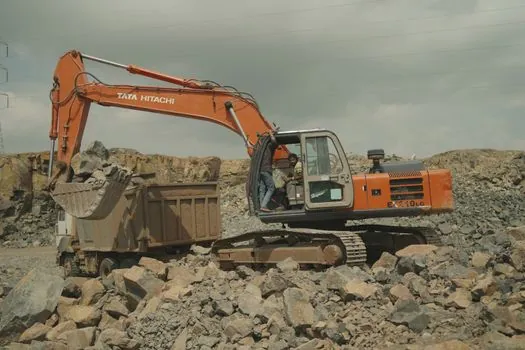
A truck-mounted crane suits a trench lift when the bench is dry and level, the outrigger spread fits inside the working width, the lift is over the rear or over the front (never primarily over the side), and a height/slew limiter can be programmed to the trench geometry. It is the wrong tool when the trench is deeper than roughly 1.5 boom lengths below the outrigger pads, when the operator cannot see the hook without slewing, or when ground bearing pressure under the pads is below about 75 kPa, which is the soft-clay range where standard timber crane mats stop being adequate [S1][S2].
Two further rules of thumb from the field: pick a boom length that places the load radius at no more than about 70 % of the maximum chart radius, because most real lifts land 20-30 % heavier than the rigging weight estimate, and a moment limiter set below 100 % of chart catches that error before the back outriggers lift [S2]. For deeper excavations, the practical alternative is a purpose-built lifting vehicle such as a pick-and-carry rough-terrain unit or a reach truck-style industrial carrier with crane attachment, both of which keep the load close to the chassis and dramatically reduce the tipping moment on a soft bench [S5].
Standards, Codes, and the Compliance Stack
In the US, OSHA Subpart CC (29 CFR 1926.1400-1441) is the controlling rule for crane use in construction, and it is the source of the ground-conditions duty quoted above [S1][S6]. Section 1402 covers ground conditions, Section 1417 covers operation, and Section 1427 covers operator certification, with the certification deadline extended to November 10, 2017 by OSHA's 2014 final rule [S1]. In the UK, the equivalent stack is LOLER plus BS7121 for general crane use, plus BS6164 for tunnelling-specific hazards when the trench or shaft functions as a tunnel [S4].
For lifting into utility trenches that fall under general construction rather than tunnelling, the OSHA ground-conditions clause plus the manufacturer's load chart and an engineered lift plan are the three documents the inspector will ask for. The lift plan should name the maximum intended load, the load radius at every position the boom will occupy, the outrigger pad size and bearing pressure calculation, and the stop-work authority for the signal person, all of which are addressed in OSHA Sections 1417-1419 and 1425 [S1][S6].
Trackable signals to watch in the next planning cycle: adoption of virtual-wall limiters as default rather than optional on smaller truck cranes (currently standard on UK tunnelling machines but aftermarket on most US utility work), tightening of ground-bearing-pressure requirements in OSHA Subpart CC ground-conditions guidance, and broader use of truck-mounted concrete pump-style outrigger-monitored carriers for trench work where a separate crane is currently mobilised. For a deeper look at how boom length and section count affect reach geometry on truck cranes, the spec trade-offs in Telescopic Boom Length vs Section Count on Truck Cranes: 3- to 7-Section Trade-offs sit naturally next to the outrigger-geometry decisions above.