
Specifying an aerial work truck for a food or beverage plant is a corrosion, contamination and washdown problem dressed up as a height-access problem, and the three pass/fail selectors are boom material, hydraulic-fluid certification and the enclosure IP rating.
The base machine — chassis, axle load, working height, outreach envelope — still follows the same envelope logic as a construction or utility unit (see the aerial work platform reference); what changes for F&B is everything that touches the air, the oil, and the water that hits the truck every shift.
Boom and Steel: Why 304L/316L Stainless Beats Painted Carbon
Plants running CIP (clean-in-place) cycles, hot foam washdowns at 60–80 °C and daily exposure to chloride-bearing sanitisers see painted carbon-steel booms start showing red rust inside 12–18 months on the upper-knuckle pin area, and once the paint film is breached, hydraulic-oil drips are treated as a foreign-body contamination event by QA [S2][S4].
Standard 304 stainless is acceptable for dry-side bakeries and dry-goods warehouses, but wet processing rooms, breweries, dairies and any line with >500 ppm chloride in the wash water should spec 316L on the upper boom, platform railing and scissor arms — same 18 % Cr / 10 % Ni baseline with 2–3 % Mo added for pitting resistance. A typical spec band is the upper 4 m of boom in 316L with the lower boom in hot-dip galvanised or 304, since 316L carries a 25–40 % material premium over 304 and most OEM chassis rails stay in HDG carbon steel [S4].
Hydraulic Fluid: H1 Food-Grade vs. H2 Industrial — The Audit Line
If the truck elevates a technician above an open product zone, a seal failure drops NSF H1-registered fluid into the product path; this is the single biggest write-up on F&B audits and the only point where an aerial work truck interacts with the dump truck class's hygienic-handling rules. [S1]
NSF H1 lubricants are registered for incidental food contact (≤10 ppm in the product is the typical trace limit processors plan around), and the major hydraulic-oil makers — Shell, Mobil, TotalEnergies, FUCHS, Castrol — all list H1 options in ISO VG 32 and 46 that drop straight into a standard aerial-truck hydraulic reservoir with no seal or filter change. H2 industrial fluid is acceptable only on trucks that work exclusively outside the product zone — yard maintenance, exterior lighting, roof gutters — and the H1/H2 line must be hard-split at the chassis; mixing the two in a shared reservoir is a non-conformance in every major F&B audit scheme.
Electrical and IP Rating: Surviving the Daily Washdown
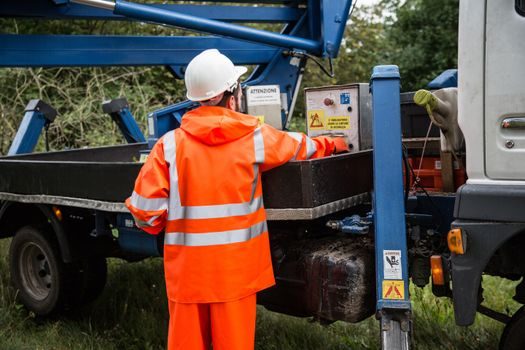
Food-processing floors are hosed down, not mopped, so an F&B aerial work truck needs a minimum of IP65 on all upper-boom junction boxes, pendant controls and limit switches, with IP67 on any box that sits below platform-rail height where direct jet exposure is unavoidable [S2].
Stainless (316 preferred) control pendants, PUR-jacketed cable (not PVC) for boom harnesses, and silicone-free cable entries are the three small parts that decide whether the truck survives a Q3 or comes back to the workshop after a Q1 washdown cycle. For cold rooms below 0 °C, hydraulic-oil tank heaters and arctic-grade hoses (to −30 °C) keep the H1 fluid flowing; for bakery ovens and retort rooms above +50 °C ambient, the heat soak on a black-painted boom forces a shift to stainless cladding or white reflective paint to keep hydraulic oil inside its 60–80 °C viscosity window.
Chassis, Wheel and Floor Hygiene: Where Most F&B Specs Slip
Standard truck tyres shed carbon-black and rubber into the washdown drain, and most F&B plants require non-marking, white or grey solid tyres on any aerial work truck that enters a hygienic zone — these typically carry a 200–400 kg per-axle derating versus pneumatic but are accepted across the dairy, brewery and meat sectors [S3].
For pallet-flow and ASRS aisles, electric chassis with 48 V or 96 V LiFePO₄ battery packs are now the default over diesel — zero on-site exhaust, no hydraulic-fume accumulation in cold rooms, and a typical 8-hour shift on a single charge at a 30 % platform duty cycle. A short-wheelbase electric chassis in the 5–7 t GVM class with a 12–18 m articulating boom covers roughly 80 % of F&B indoor-maintenance use cases; anything above 18 m working height almost always steps back to a diesel or hybrid chassis because of the counterweight requirement, and at that point the truck is locked to outdoor work and the H1 fluid question becomes moot.
Selection Matrix: Three Build Levels for F&B Service
Three F&b build profiles cover the majority of procurement decisions, and the criteria — boom material, fluid grade, IP rating, chassis, tyre type — are the same axes a buyer should score against an RFQ: [S2]
Level 1 — Dry-side / outdoor only: HDG carbon-steel boom, H2 hydraulic fluid, IP54 electrical, diesel chassis, pneumatic tyres. Lowest cost; acceptable for exterior lighting, gutter, signage work. Not for any wet-processing room.
Level 2 — Wet-processing indoor: 304 boom with 316L scissor/knuckle pins, H1 fluid, IP65 boxes / IP67 below rail, electric chassis, non-marking solid tyres. Covers brewery, dairy, beverage bottling, bakery wet zones. The default spec for a multi-site F&B fleet.
Level 3 — Cold room or retort room: 316L boom throughout, H1 low-temp fluid (−20 °C pour point arctic grade) or tank heater, IP66 + heated enclosures, electric chassis, cold-room-rated non-marking tyres, stainless hardware. Premium 25–35 % above Level 2; justified only for sustained sub-zero or sustained +50 °C ambient work.
For buyers mapping a 2026 fleet upgrade, the aerial work truck selection framework covers the chassis and boom-type decision tree, while the concrete-mixer truck and reach truck references sit alongside as the other two plant-floor specials that share the same stainless / washdown decision logic.
Failure Modes and Audit Traps Specific to F&B
The four recurring F&B audit findings on aerial work trucks are: (1) hydraulic-oil sheen on the floor under a parked boom — almost always a worn cylinder-rod seal, not a hose burst; (2) paint flaking into an open product line during overhead work, traced to galvanic corrosion between carbon steel and a stainless patch plate; (3) pneumatic-tyre carbon-black smears in a hygienic zone; (4) food-grade fluid drum on a pallet next to a H2 drum — auditors treat co-storage as cross-contamination even if the lines are separated. [S3]
The fix for (1) is a quarterly rod-seal inspection and a documented drip-tray policy; for (2), spec dielectric isolation between dissimilar metals on any retrofit; for (3) and (4), fleet SOPs plus a one-line spec note on the purchase order — both are free if written into the RFQ, expensive if added after delivery.
Sourcing Signals and 2026 Lead-Time Note

Stainless-boom aerial work trucks from European OEMs (Time Versalift, Ruthmann, Oil&Steel, Bravi) typically carry a 6–9 month lead time in 2026, with 12–14 months for the 20 m+ insulated or arctic variants; Chinese OEM supply (Hangzhou Aichi, Hunan Runshare, XCMG) has compressed to 3–5 months for 14–18 m articulating booms but with a longer spare-parts tail. [S4]
Track the next signal: any 2026 Q3 / Q4 release of a factory-fit 316L upper-boom option on a Chinese OEM electric chassis, and any update to NSF H1 registration of bio-based hydraulic fluids (current shelf-life and seal-compatibility data still trails mineral H1 by 12–18 months).