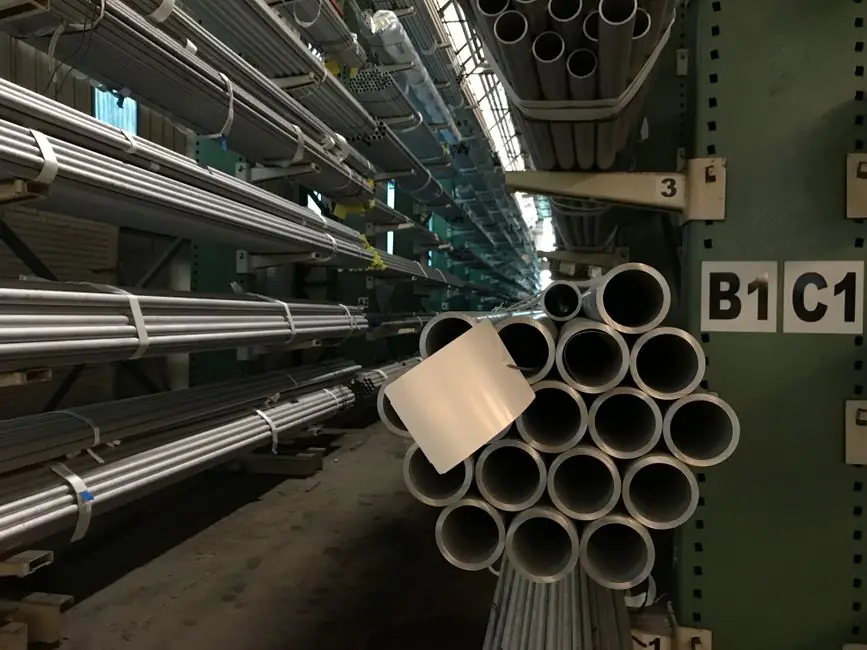
AMS 4911 certified plate lead times in 2026 run 8 to 16 weeks, with Grade 5 pricing at $22 to $45 per kilogram depending on certification level and lot size, while AMS 4928 bar and integrated forge-to-finish cycles are quoted at 14 to 18 weeks by dedicated aerospace forging suppliers [S2][S9].
Tube and certain billet forms sit well outside that window: titanium and nickel tubing lead times were still 50 to 60 weeks as of February 2026, against a pre-pandemic norm near 20 weeks, and that gap is the real schedule variable on most airframe programs [S3]. Underneath those numbers, the U.S. Geological Survey reported 100% net import reliance for titanium sponge in 2025 with sponge imports of about 44,000 metric tons, which is why qualified mill capacity, not raw availability, is the binding constraint in 2026 [S3].
Product Form vs Lead Time: Where the Schedule Actually Slips
Plate, bar, and forging lead times are not interchangeable, and conflating them is the single most common RFQ error seen in 2026 procurement. Plate is rolled, bar is extruded or forged, and forgings carry their own die, heat-treatment, and inspection chain, so a single "titanium" weeks number hides three different cycle structures [S2]. Aerospace plate is defined under AMS 4911 from 0.250 inch (6.35 mm) to 4.000 inches (101.6 mm) with elongation minimums stepped by thickness, and AMS 4928 governs bar and forgings as a separate specification with its own mechanical and inspection envelope [S2].
For integrated forge-to-finish cycles that include ultrasonic, fluorescent penetrant, and mechanical testing, suppliers are quoting 14 to 18 weeks with in-house NDT, which the same suppliers describe as about 60% faster than the industry average for fully outsourced chains [S9]. The qualifier matters: an 18-week forge-to-finish promise assumes a single supplier controls melt pedigree, forging, heat treatment, and release testing, so the moment a buyer splits ingot source from forge source the cycle reopens [S3][S9].
AMS 4911 vs AMS 4928 vs BMS 7-247 vs ABS 5125: Picking the Right Spec
AMS 4911 is the SAE International specification for Ti-6Al-4V annealed sheet, strip, and plate used in flight structures, while AMS 4928 covers bar, billets, and forgings in the same alloy family, and the two are not interchangeable in an RFQ [S2]. Boeing BMS 7-247 and Airbus ABS 5125A/B/C are OEM-specific supplements layered on top of AMS 4911, and any Tier-1 airframe shipment must satisfy them in addition to the base SAE spec [S2].
On the mill side, the 2026 grade mix confirms why Ti-6Al-4V dominates the discussion: alpha-beta alloys, with Ti-6Al-4V as the workhorse, hold a 51.0% share of titanium alloy demand in 2026, and mill products account for 51.0% of aerospace titanium product form value in the same year, so most RFQs are really Ti-6Al-4V mill-product RFQs in disguise [S4][S8]. For U.S. defense work, DFARS compliance requires verifying the country of melt, not just where the plate was cut or finished, which is a separate qualification step that buyers routinely miss until acceptance [S2].
Five-Gate Qualification: Why Price Is the Wrong First Filter
Procurement in 2026 is structured around five gates: material form, specification and OEM supplement, melt pedigree and DFARS status, inspection and NDT scope, and delivery control, with each gate disqualifying a supplier before price is even discussed [S3]. A real example from March 2026: a Tier-2 aero-structure buyer in Hamburg accepted a $28/kg "aerospace grade titanium plate" quote with no spec number, no heat-treatment disclosure, and no melt origin, then rejected the lot at PMI for oxygen at 0.24% versus the AMS 4911 maximum of 0.20%, which added eight weeks of slip and over $40,000 in expedite costs [S2].
That is the actual cost of skipping the qualification gates, and the broader market is moving to formalize it. voestalpine's High Performance Metals Division secured aerospace orders worth about EUR 1 billion over five years announced on April 8, 2026, with titanium alloy forgings produced at Kapfenberg and titanium sheet at Muerzzuschlag, packaged with heat treatment, surface treatment, and a global logistics network rather than as standalone tons [S3]. Airbus reported 9,037 aircraft in its backlog at the end of March 2026 with Q1 deliveries at 114 versus 136 a year earlier, and that backlog, combined with Pratt & Whitney engine shortages, is what keeps qualified titanium channels tight even as headline prices drift [S3].
Decision Comparison: Plate, Bar, and Forging Buyers
The right buy depends on which constraint binds the program, and the constraints are not the same. Plate buyers optimizing for skin and structural panels care most about AMS 4911 plus the Boeing or Airbus supplement, with 8 to 16 week lead times and DFARS melt origin as the dominant gates [S2]. Bar buyers for machining stock need AMS 4928 conformance and tighter chemistry windows because every chip that leaves the cutting tool has to trace back to a qualified heat.
Forging buyers are buying a process chain, not a shape, and the relevant trade is open-die versus closed-die versus near-net-shape, with grain flow, defect tolerance, and buy-to-fly ratio as the real cost drivers, since additive and cast alternatives still lose to forging on fatigue-critical load paths [S5]. Across all three forms, the underlying market is growing: Future Market Insights puts aerospace titanium at USD 2.2 billion in 2026 rising to USD 5.1 billion by 2036 at 8.9% CAGR, while other market reports cite a 7.60% CAGR off a 2026 base of $4,218.6 million and an 8.6% CAGR off a 2025 base of USD 3.1 billion, so capacity is expanding but qualified capacity is the bottleneck [S1][S4][S6]. For a deeper read on the fastener side of the same supply squeeze, see this 2026 field note on titanium and nickel-alloy aerospace fastener lead times, and for the adjacent casting bottleneck feeding the same airframe programs, the aerospace investment casting capacity shortage 2026 piece is a useful cross-check.
Limitations and Failure Modes Buyers Should Plan For

The most expensive failure mode in 2026 is chemistry drift on a low-priced plate, exactly the 0.24% oxygen case against an AMS 4911 maximum of 0.20% that already cost one buyer eight weeks and $40,000 in March 2026 [S2]. The second is treating additive-manufactured titanium as a drop-in for forged or rolled forms, which is not how fatigue-critical airframe structure is qualified today even though AM is reshaping buy-to-fly economics on brackets and fittings [S3][S7]. The third is assuming that the 8 to 16 week plate window applies to tubing, since titanium and nickel tubing was still running 50 to 60 weeks as of February 2026 with no clear normalization [S3].
For a process engineer, the takeaway is to plan qualification work in parallel with RFQ release, not in series, and to require the country of melt, the AMS specification, the OEM supplement, and the NDT scope on the purchase order itself, because every gate left implicit at quoting tends to be reopened at acceptance [S2][S3].
Track these two signals into Q4 2026: whether AMS 4928 forge-to-finish lead times stay inside the 14 to 18 week band as new forging capacity at Kapfenberg-class sites ramps, and whether tubing lead times compress below 50 weeks, since both will set the cadence for 2027 airframe build rates.
For the relevant spec sheets and selection criteria, see lead screw, time relay, and titanium alloy.