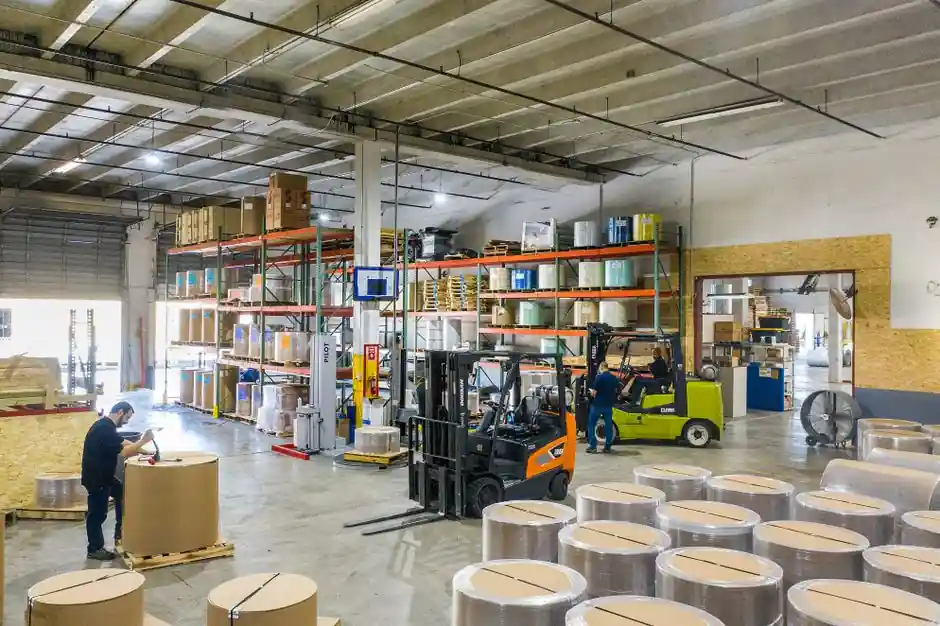
Unit-load AGVs carry a single pallet or platform on their deck, while tow tractor AGVs hitch to and pull trains of wheeled carts across a facility, and that single mechanical difference cascades into payload, aisle, throughput, and infrastructure choices [S2][S4].
The selection question reduces to four variables: what is on the load, how much mass per trip, how far per trip, and how the floor is marked, and every credible AGV vendor page routes through that same matrix [S3][S5].
Defining the two families and the work each one actually does
A unit-load AGV carries its cargo on top of the vehicle using a fork, lift platform, conveyor deck, or under-ride mechanism, and is found in warehouses, pallet handling lines, and heavy-payload transport up to multi-ton steel coils and truck tires [S2][S3]. The same class includes counterbalance, reach, very narrow aisle (VNA), and pallet-truck AGV variants, all sharing the on-board deck concept but differing in mast, lift height, and turning radius [S2][S4].
A towing AGV, also called a tugger or tow tractor, hitches to wheeled carts or trailers and pulls one or more in a train, and is suited to larger quantities and longer distances in production supply, waste removal, and assembly-line part delivery [S1][S5]. The towing AGV is mechanically an automated version of a human-driven tractor and can run hybrid manual or autonomous in some product lines [S2].
Decision matrix: which type fits which load profile
Compare the two families on the four criteria that drive every spec sheet: payload per trip, trips per shift, aisle and turning geometry, and infrastructure overhead, because these are the only inputs that change the recommendation. [S2]
On payload, unit-load AGVs cover light palletized goods up to multi-ton coils and heavy industrial loads, and counterbalance variants add a rear ballast that stabilizes the forks for bulky items like pallets, racks, and rolls [S3][S9]. Tow tractor AGVs offer towing capacities up to several tons per train and excel at moving heavy-wheeled loads through tight spaces by pulling rather than lifting [S1][S2].
On throughput per vehicle, tow tractors win on long runs because they move several carts at once, while unit-load AGVs win on single-pallet cycle time when each pallet is a discrete order or batch [S2][S5]. On geometry, automated platform trucks built like under-ride units are noted for being efficient in very tight spaces, lifting and setting down carriers directly from a transfer station, and this is a different geometry profile from a counterbalance forklift AGV that needs truck-class aisle width [S4].
On infrastructure, towing AGVs travel the same track-guided or natural-feature navigation rails as any other AGV, so the choice between magnetic strip, laser reflector, or SLAM-based mapping is independent of cart vs pallet [S4][S5]. What does change is the fleet size, and a 2026-side reference confirms that underride AGVs are often deployed in large fleets, most notably in automotive production [S2].
Specific product data points to anchor the comparison
Linde's P-MATIC autonomous electric tow tractor with stand platform moves towing loads of up to 5,000 kg, a concrete rated capacity that defines the upper envelope of common single-tractor AGV tugs in production-supply service [S4]. The same vendor confirms that any industrial truck class known in manual operation, including autonomous tractors, pallet stackers, counterbalanced forklift trucks, reach trucks, and very narrow aisle trucks, can be automated, so the choice between tow and unit-load is a fleet-mix decision, not a vendor lock-in [S4].
For unit-load extremes, DTA of Spain produces large-capacity unit-load AGVs rated for 25-ton steel coils, a data point that shows the same on-deck AGV family scales from light-pallet to heavy-coil service by changing the chassis and not the architecture [S2]. For comparison, the MasterMover MasterTow line is rated for cart-towing applications up to 44,000 lbs (about 20 tonnes) per train, which sits between the Linde single-tractor 5-tonne and the DTA unit-load 25-ton extremes and is a useful mid-range anchor [S1].
Use cases that map cleanly to each type
Towing AGVs are the right call for moving large quantities of goods like paper rolls or die carts, parts-to-line delivery in automotive and discrete manufacturing, and waste or empty-container removal over set routes that repeat every shift [S3][S5]. They are also the workhorse for high-volume, longer-distance loops where one tractor can serve many drop points without reloading the deck each cycle [S1][S5].
Unit-load AGVs are the right call for palletized goods handling, single-pallet put-away and retrieval, VNA warehouse racks, and very heavy or very bulky items that need a counterweight or a tall mast, with reach truck and counterbalance variants available for the same underlying deck-load job [S2][S3][S4][S9]. Heavy-payload nuclear casks, air bearing modules, and heavy-duty transporters are also handled by forklift-style AGVs in the unit-load family [S3].
Limitations and failure modes that change the answer

Tow trains fail at sharp turns and uneven floors, because the cart string can jackknife or tip a light cart, and they also impose a hard cap on per-stop selectivity since every cart in the train arrives at the same drop point [S5]. Unit-load AGVs fail at long horizontal moves with single-payload-per-trip economics, and the heavier the unit-load class, the more the floor slab, transition points, and lift mechanism drive the project cost, not the vehicle itself [S2][S3].
Track-guided navigation still forces a fixed-route network, and any subsequent route change is often costly, so specifying a tow or unit-load AGV on magnetic-track navigation commits the facility to a route map that is hard to revise [S4]. Specifying a load cell or load cell module on the deck or hitch is a common path to overload protection, and that instrumentation needs to be specified alongside the AGV, not retrofitted after commissioning.
Standards, safety, and sourcing that should appear in any spec
ANSI/RIA R15.08-1-2020 is the U.S. safety standard for industrial mobile robots and defines the AGV/AMR split by how each traverses its operating environment, with AGVs following predefined guide paths and using collision avoidance, and AMRs setting their own paths with obstacle avoidance [S2]. This matters for selection because a towing AGV on a fixed guide path has a different safety case and integration effort than an AMR doing the same job.
Track-guided versus natural-feature navigation is the second specification lever: magnetic or optical tracks are rigid and low-flexibility, while laser-based natural-feature navigation maps the surroundings at commissioning and can be rerouted with little effort, and Linde uses natural-feature navigation in its MATIC trucks as a baseline choice for flexible intralogistics [S4]. For broader context on mobile robotics categories, the AGV robot encyclopedia entry covers the full navigation and safety taxonomy in one place.
When to pick a unit-load AGV, when to pick a tow tractor

Pick a unit-load AGV when each trip is a single pallet or single heavy item, when the warehouse has wide aisles and well-defined pathways, and when the load is too heavy, too tall, or too awkward to stack on a wheeled cart [S3][S4]. Pick a tow tractor AGV when many smaller items need to move to many drop points in a single loop, when the route is long and repeatable, and when the carts already exist in the facility [S1][S5].
For mixed facilities, the working answer is rarely one or the other, because the Linde and antdriven references both note that any industrial truck class can be automated, so a single site typically runs a fleet mix of tow tractors for line supply and unit-load AGVs for pallet and rack duty [S2][S4]. Charging and duty-cycle sizing for that mixed fleet is a separate decision covered in a 2026 spec comparison of opportunity charging versus battery swap for AGV fleets.
Track two signals before locking the spec: confirm the rated towing or payload figure at the worst-case aisle turn, not on the data sheet straight line, and confirm that the navigation type (track-guided or natural-feature) matches the expected route-change cadence, because a route change on a magnetic-track AGV is a project, while a route change on a laser-mapped AGV is a configuration file [S4][S5]. For sites that lean more toward flexible routing than fixed-path heavy haul, the AGV versus AMR fixed-route trade-off is a useful side read on where each class breaks down.