
An AGV battery sized for full-shift operation is built from a single equation, Required energy (Wh) = average power (W) × shift duration (h), then padded with a 20–30% margin for depth-of-discharge limits, end-of-life degradation, and auxiliary loads [S1].
Typical AGV power draw sits between 1 kW and 5 kW depending on payload and speed, and an 8-hour single-shift duty at 2,000 W lands at 16,000 Wh base, or roughly 20 kWh nominal after the standard 25% margin [S1]. Choosing the charging strategy before running the numbers matters: a double shift with opportunity charging drops pack sizing to 4–5 hours of capacity, while 24/7 hot-swap fleets size for one shift plus margin, a swing of 40–50% on required capacity for the same fleet [S1].
From energy to amp-hours at the right voltage
Common AGV pack voltages are 24 V, 36 V, 48 V, and 72 V, with 48 V the most common in modern AGV and AMR platforms and 72 V reserved for heavier industrial vehicles that need higher power transfer [S1]. Higher voltage cuts current for the same power, which reduces I²R heat in cables, connectors, and the BMS, a meaningful gain for a pack that may cycle twice a day for years. Once voltage is fixed, capacity falls out of Required capacity (Ah) = Required energy (Wh) ÷ Nominal voltage (V), so a 20,000 Wh pack at 48 V is 416 Ah nominal, dropping to 333 Ah usable at 80% depth of discharge [S1].
For opportunity-charged fleets, sizing targets a 2–4 hour operating window rather than a full shift, because the pack is being topped up during loading pauses, shift changes, and idle windows [S2]. That smaller pack, paired with a 1C-capable LFP cell, is the pattern now standard in warehouse automation. If you are also mapping the drivetrain side of the equation, see this walkthrough of AGV onboard controller and traction motor sizing, which covers the same power-conversion chain from the motor-controller side.
Chemistry and cycle life: LFP versus NMC versus lead-acid
LFP has displaced lead-acid as the baseline for AGV duty because it delivers 3,000–6,000 cycles versus 300–500 for VRLA, accepts 1C charge rates (full charge in one hour) compared with 0.1–0.2C (5–10 hours) for lead-acid, and tolerates partial state-of-charge cycling without the sulfation that destroys lead-acid packs in opportunity-charge service [S2]. NMC cylindrical cells such as 21700 at 70% DoD are quoted at 700–1,000+ cycles at 260–322 Wh/kg, a higher energy-density option for weight-constrained robots but with a shorter cycle envelope than LFP [S1].
Across modern AMR and AGV deployments, lithium-ion (LFP plus NMC) holds over 85% of the robot battery market, with average cycle life around 3,500 cycles [S4]. A three-shift operation at two charge cycles per day runs more than 2,000 cycles in three years, so cycle life, not energy density, is the design driver for warehouse AGV duty [S1]. LFP is preferred for 24/7 industrial AMRs in environments with high-value equipment or flammable materials, while NMC fits robots where size and weight are more tightly constrained [S4].
Charging strategy and pack capacity trade-offs
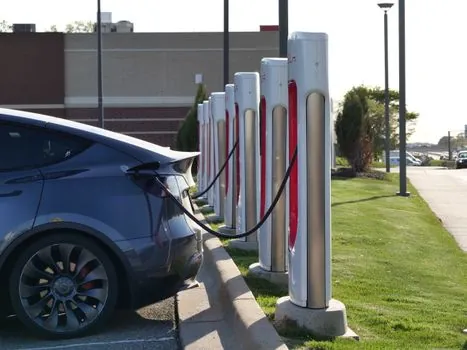
Charge strategy is not a footnote, it is a sizing input. Single-shift operations with full recharge between shifts are sized for the full 8 hours; double shifts with opportunity charging are sized for 4–5 hours; 24/7 hot-swap fleets are sized for one shift plus a safety margin [S1]. Opportunity charging allows modern AGV systems to reach 80% state of charge in 30–45 minutes, making it the right fit for high-utilization environments [S3]. Advanced multi-voltage lithium systems can complete a full charge in as little as 45 minutes, enabling true opportunity charging during short operational breaks [S4].
Battery swapping is the alternative. In optimized setups, a human operator or automated mechanism can swap a depleted pack in as little as 84 seconds, the fastest path back to operation, but the inventory penalty is linear: every robot added to the fleet demands a proportional increase in spare packs and charging-bay capacity, and packs are rarely interchangeable across robot models or brands [S4]. Charging inefficiencies still consume 20–30% of total robot operational time across industries, so shrinking that window is a direct throughput lever, not a maintenance nicety [S4].
Power-conversion losses that eat into the energy budget
The drivetrain quietly subtracts from any pack you spec. For a PMSM-driven AGV, battery voltage must overcome the maximum back-EMF at the application's top speed plus the I·R drop across the phase resistance at peak current, governed by V_BAT = √3·√2·(I_MAX-PH·R_PH + ω·K_E) [S5]. Inside the drive, conduction losses (I²R during PWM on-time), switching losses (proportional to PWM frequency), and quiescent losses (processor, DC-DC, encoder, comms) all subtract from available energy [S5].
Inside the motor, copper losses track I²R and rise with temperature, core losses scale with speed and rotor pole count, and the gearbox adds its own mechanical-loss term [S5]. Copley Controls flags that overcompensating for these losses drives up pack size, weight, and cost, so the sizing loop is iterative: choose a battery voltage, then iterate the winding and gear ratio to match it, rather than the reverse [S5].
Real-world operating envelope and runtime bands

AGV mobile robots typically operate for 8–16 hours on a single battery charge, depending on workload, environment, and battery type [S3]. Cold-warehouse environments can reduce battery capacity by up to 20%, while excessive heat accelerates chemical degradation, and dust, humidity, and floor conditions change how hard the traction motors work, all of which shift the runtime band [S3]. Lithium-ion packs typically handle 2,000–5,000 charge cycles before capacity drops to 80%, so avoiding complete discharge and maintaining optimal charge levels are the cheapest life-extenders available [S3].
Sizing workflow and decision matrix
Start with the energy equation and a measured or modelled average power (not peak). Apply the 20–30% margin, then convert to Ah at the chosen nominal voltage. Verify against a criteria-based comparison before locking the cell chemistry: LFP wins on cycle life (3,000–6,000 cycles), PSOC tolerance, and thermal runaway margin at the cost of lower energy density; NMC wins on energy density (260–322 Wh/kg for 21700 at 70% DoD) at the cost of shorter cycle life and stricter thermal management; lead-acid only makes sense on capex for low-duty, single-shift operations with available battery-room ventilation [S1][S2][S4].
Decide the charging strategy first, then size: single-shift full charge, opportunity-charge with 2–4 h pack, or hot-swap with one-shift-plus-margin pack [S1]. For warehousing and material-handling robots built around these duty cycles, the AGV robot architecture and selection reference covers the vehicle-side trade-offs that interact with battery choice, including how motor voltage and payload shift the sizing equation. If the fleet is going into a broader plant that also handles fluids and gases, the flow meter selection criteria and industrial valve specification principles are the same kind of energy-budgeted, standards-anchored workflow applied to a different subsystem.
Track these three signals to validate the spec in the field: actual measured average power over a representative shift (not the motor nameplate), end-of-shift state-of-charge with the chosen charging cadence, and cycle count versus rated cycle life at the operating DoD window. If measured power runs more than 15–20% above the design value, the pack will starve the shift well before the 20–30% margin is consumed.