
Air-freight cartons are double-wall corrugated kraft containers rated at 51 ECT (Edge Crush Test) and 350# Mullen burst strength, built to survive stacking loads, cabin-pressure swings, and the rough handling typical of belly-cargo and freighter operations [S1][S7].
Two industry-standard sizes dominate U.S. air freight: the EH container (34.75″ × 20.38″ × 20.38″, ≈10 ft³) for moderate-weight consolidations, and the E container (41.25″ × 28.25″ × 24″, ≈18 ft³) for bulky machinery, electronics, and high-volume consolidations [S1]. Pack Kontrol air-freight containers extend the same construction philosophy to heavier consolidations where standard RSC (regular slotted carton) boxes would crush [S3].
What an Air-Freight Carton Is, and Why It Differs from a Standard Box
An air-freight carton is a double-wall corrugated format built from two fluted medium layers sandwiched between three kraft liner sheets, giving it the structural ceiling that single-wall 32 ECT or 44 ECT shipping cartons cannot reach [S1][S2]. The 51 ECT rating indicates the box can resist vertical compression during pallet stacking and ULD (Unit Load Device) build-up without crushing, while the 350# burst strength is the Mullen-tested pressure (pounds per square inch) the wall can absorb before rupturing [S1][S7].
Both tests are graded and labelled separately: ECT measures stacking performance, Mullen measures puncture and rough-handling resistance, and the two ratings together bracket the full air-cargo threat model [S7]. For reference, standard domestic single-wall cartons typically test at 32 ECT / 200# or 44 ECT / 275#, well below the air-freight specification band.
Decision Criteria: Size, Stacking, and Weight
Three measurable variables drive air-freight carton selection: declared volume, stack height, and gross weight. The EH (≈10 ft³) container is the right call for single-item or small-consolidation shipments under roughly 70 lb, while the E container (≈18 ft³) covers consolidated loads up to the airline's per-piece maximum (commonly 150–200 lb on passenger freighters) [S1][S6].
Stack-height planning ties back to the 51 ECT rating: each layer in a ULD contributes compression load to the layers below, and the safe stack height is governed by the box's ability to withstand vertical compression from multiple stacked boxes without crushing [S1]. For a process engineer, the rule of thumb is: never stack air-freight cartons beyond 3 layers unless the 51 ECT rating is printed on the spec sheet and humidity is controlled below 70% RH [S1].
Material Options: Kraft Corrugated, Plastic, Wood, and Hybrid
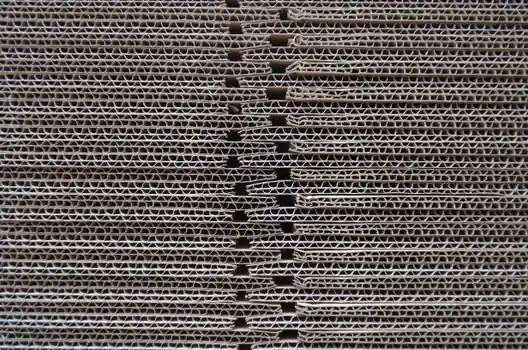
Material selection for air cargo breaks into four practical families, each with a different weight-versus-strength profile [S4][S5]:
Kraft corrugated double-wall (51 ECT / 350#) is the default air-freight format: recyclable, cost-effective, and accepted by every commercial carrier. Plastic crates add water resistance and higher impact tolerance at roughly 2–3× the tare weight, a meaningful penalty when carriers charge by chargeable weight (the greater of actual mass and volumetric mass). Wooden crates and ISPM-15-marked plywood cases become mandatory for heavy machinery, hazmat, or any unit exceeding 70 kg per piece, and must carry the IPPC ISPM 15 heat-treatment or fumigation stamp on the outer surface. Hybrid formats pair a corrugated outer sleeve with internal foam or corrugated fitments, useful for electronics and medical-device shipments where shock control matters more than wall strength.
A practical comparison matrix:
Cost per cubic foot: kraft < plastic < wood. Recyclability: kraft > plastic (mono-material) > wood (reusable, repairable). Humidity tolerance: wood > plastic > kraft. Weight penalty: wood > plastic > kraft. Airline acceptance: kraft universal; plastic restricted on some passenger carriers due to non-conductive cargo-bay concerns; wood restricted to ISPM 15-marked pieces on international legs [S4][S5][S6].
Airline and IATA Compliance: What the Carrier Will Reject
Air carriers reject shipments that fail three checks: dimensional fit on the ULD grid, weight per piece, and dangerous-goods marking. Standard EH and E sizes align with common ULD contours (LD-3 contour for EH, LD-7 / LD-11 for E at full footprint) so shippers rarely face dimensional surcharges [S1][S2].
For hazmat or lithium-battery shipments, IATA DGR (Dangerous Goods Regulations) Section 4 specifies packaging standards including 1.2 m drop tests, 3 m stack tests, and humidity conditioning; an unrated corrugated RSC will fail this gate, which is the reason freight forwarders route hazmat toward UN-rated 4G boxes rather than generic air-freight cartons [S6]. For a related reference on bulk-container selection under the same compliance regime, see this IBC tank selection for air cargo spec map.
Who Should Use a 51 ECT Air-Freight Carton, and Who Should Not

Use a 51 ECT / 350# double-wall air-freight carton when the shipment is general cargo, electronics, automotive parts, machinery components, or consolidated B2B freight moving internationally, with gross weight per piece inside the airline's standard acceptance band and no hazmat class declared [S1][S2][S6]. Do not use this format for: lithium-ion battery packs above the carrier's watt-hour threshold (route to UN 4G packaging); liquids over the carrier's limited-quantity threshold (route to combination packaging with inner receptacles); perishable pharma or cold-chain (route to insulated EPS foam containers with gel packs, not corrugated alone); and any single piece over 150 kg on a passenger freighter or 250 kg on a dedicated freighter without a heavy-cargo airline approval [S4][S6].
Failure Modes and Engineering Limits in the Real World
Three failure modes dominate air-freight carton damage claims, and each maps to a specific spec oversight [S1][S7]. Edge crush failure (the box wall buckles under a stack) traces to ECT rating underspec, almost always because a 32 ECT box was substituted for a 51 ECT requirement. Burst failure (the wall ruptures on a sharp corner) traces to Mullen underspec or to a single-wall substitution. Deformation failure (the box survives but contents shift because the carton bowed) traces to underfilling, which is why carriers and pack-out guides recommend fill ratios of 85–95% with dunnage [S6].
Humidity is the silent multiplier: a 51 ECT box at 50% RH retains its full rating, while the same box at 90% RH drops to roughly 60–70% of its rated ECT, so tropical-origin and monsoon-season lanes should be specified up one ECT step or wrapped in a humidity barrier [S1].
Sourcing, Standards, and Process-Engineer Checklist

Source air-freight cartons from suppliers who publish both ECT (per TAPPI T 811) and Mullen burst (per TAPPI T 810) values on the spec sheet, and who can certify compliance with airline general-cargo acceptance plus IATA DGR Section II for any limited-quantity hazmat lane [S1][S7]. For background on the rating systems themselves, see the carton box reference. The standard 51 ECT / 350# combination, in EH (34.75″ × 20.38″ × 20.38″) or E (41.25″ × 28.25″ × 24″) sizes, remains the engineering default for general air cargo; deviations are only justified by hazmat class, weight, or humidity exposure outside the assumed envelope. Two signals worth tracking: airline-published per-piece weight limits, which have shifted modestly upward on widebody freighters through 2026, and ISPM 15 enforcement tightening on international legs out of South and Southeast Asia, both of which directly affect carton and crate specification on the shop floor.
For the relevant spec sheets and selection criteria, see carton erecting machine, and air pick.