
For chemical freight in 2026, a UN-rated corrugated box rated to 49 CFR Part 178 standards is the default outer package; single-wall ECT 32 / Mullen 200 is the minimum baseline, and double-wall ECT 48 / Mullen 275 is the more common specification for liquid or higher-density chemical packs [S5][S6].
Scope covers the outer fiberboard box only, not the inner containers (bottles, cans, liners) that carry the actual chemical. Selection of the carton box is governed by the mode of transport, the UN Packing Group (I, II, or III), and the four-packaging test results codified under 49 CFR 178.516 for fiberboard and matched against IATA DGR for air and IMDG for sea [S1][S4][S5].
How UN-Certified Corrugated Boxes Are Rated
Corrugated fiberboard boxes for hazardous materials must use strong, solid, or double-faced fiberboard (single or multi-wall), pass the Cobb water-absorption test, be cut and slotted without cracking or surface breaks, and use a water-resistant adhesive; the geometry of the box must also fit the inner packagings, per 49 CFR 178.516 [S5].
Before any hazmat shipper can use a design, the package must pass the Stacking, Leakproofness, Hydrostatic Pressure, Drop, and Vibration tests, and the same design must be re-qualified once every 12 months by testing packages prepared as for final shipment, including the inner packagings, with non-hazardous simulants matched for grain, size, and viscosity [S5].
Mullen vs. ECT: Which Rating System Fits Chemical Packs
The two rating systems for corrugated are not equivalent in use. The Mullen (Burst) test, first used in 1887, measures the pressure a panel resists before bursting and is more accurate for boxes handled individually, hand-trucked, stacked and re-stacked; the Edge Crush Test (ECT) measures the edgewise compressive load and is the more accurate predictor for pallet-stacked boxes and for double-wall constructions [S3].
For chemical shipping, the choice has practical consequences: a 200# Mullen single-wall box is the standard entry-level, an ECT 32 single-wall is its ECT equivalent, and ECT 48 double-wall is the typical spec for chemical drums or bottles palletized for truck or rail [S3][S6]. A useful comparison for buyers selecting a carton box for liquid chemicals: Mullen 200 single-wall (ECT 32) is the budget spec for Packing Group III solids, ECT 48 double-wall is the workhorse for Packing Group II liquids, and ECT 51 double-wall (Mullen 275) is required where heavy inner containers or long stacking columns drive edge-load past 40 lb/in. [S3][S5][S6].
Tests a Hazmat Box Must Pass Before Shipment
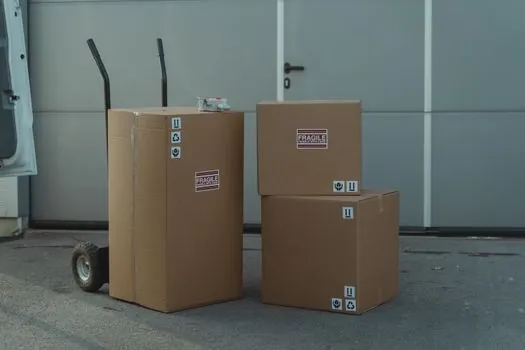
The 49 CFR design-qualification stack is the same whether the chemical is corrosive, flammable, or toxic, but each test stresses a different failure mode. The Drop test simulates free-fall impact onto the hazard face, edge, or corner, typically from 1.2 to 1.8 m depending on Packing Group; the Stacking test applies a static load equal to the equivalent stack height of similar packages for 24 hours; the Hydrostatic Pressure test, used for liquids, holds the package at 100 kPa (or higher for Packing Group I) for 30 minutes with no leakage; the Leakproofness test is the air-pressure alternative for liquids, marked with the letter "L" on the UN mark; and the Vibration test sweeps 3 Hz at 1 in. double-amplitude for 1 hour on each of three orthogonal axes [S5].
Two non-obvious constraints complicate design choice. First, every inner packaging must be chemically compatible with the contents, with a documented filling limit, a maximum density or specific gravity, and an internal pressure ceiling recorded against the Packing Group designation [S4]. Second, the 12-month re-qualification rule means a box that worked last quarter is not automatically legal this quarter, so most chemical plants maintain a documented test register, not a one-off certificate [S5].
UN Markings, Box Maker's Certificate, and Mode-of-Transport
After a box passes, the UN mark must be durable, legible, and correctly sized and placed; it must include the country of origin, the last two digits of the year of manufacture, the package weight in kilograms (or liters for liquids), and the Packing Group designation, with an "L" suffix added when the Leakproofness test was used [S5].
Mode of transport changes the legal floor, not just the paperwork. Ground in the U.S. is governed by 49 CFR, air by IATA DGR, and sea by IMDG, with multimodal shipments needing to satisfy the strictest applicable regime, and the box's test certification has to cover the same mode the package will actually travel under [S1][S4]. A practical example: a Packing Group II corrosive on a road-only lane can use a 4G fiberboard box per 49 CFR 178.516; the same shipment booked on a passenger aircraft typically drops to a smaller inner-container fill and may require a combination pack with absorbent, so the outer carton erecting machine line has to hold tighter dimensional tolerances for IATA-spec assemblies than for ground-only 4G [S2][S4][S5].
Where the Corrugated Box Stops Being the Right Choice

Corrugated fiberboard is not the right outer for every chemical. Strong acids and bases at elevated concentration, organic peroxides, and large volumes of Class 3 flammables generally require 1A1 steel, 1H1 plastic, or 4G combination packagings, not 4G fiberboard alone; the box only enters the picture as the outer overpack in those combinations, with the leak barrier carried by the inner drum or bottle [S1][S2].
Other failure modes are spec-driven, not chemical-driven. Boxes fail in service when ECT is undersized for pallet-column height, when Cobb water absorption exceeds the limit after humid storage, when the closure tape loses adhesion in transit, or when shippers stack past the tested configuration; for these reasons, chemical plants that ship regularly tend to standardize on ECT 48 or ECT 51 double-wall rather than gamble on the single-wall minimum [S5][S6].
Spec Selection Workflow for Chemical Buyers in 2026
The shortest path to a defensible spec: (1) classify the chemical under 49 CFR 173 and assign the Packing Group; (2) pick the inner containers (glass bottle, HDPE, metal) and confirm chemical compatibility; (3) select the outer box rating, single-wall ECT 32 / Mullen 200 for Packing Group III solids, double-wall ECT 48 / Mullen 275 for Packing Group II liquids, double-wall ECT 51 / Mullen 275 for Packing Group I or heavy inner packs; (4) confirm 49 CFR 178.516 compliance and run Stacking, Leakproofness, Hydrostatic Pressure, Drop, and Vibration tests, then re-qualify every 12 months; (5) verify mode of transport (49 CFR / IATA / IMDG) and lock the correct UN mark, including the "L" suffix where the Leakproofness test was used [S1][S4][S5].
Trackable signals worth watching: any change to the 49 CFR 178.516 Cobb water-absorption limits, the 12-month re-qualification window, and IATA DGR updates to the 4G combination packaging rules, since each of these has historically been the leading edge of compliance-driven box redesign for chemical shippers [S4][S5].
The underlying component specifications are covered under chemical anchor.
Related analysis: Pinch Valve Selection for Chemical Processing: Sleeve, Pressure, and Media Criteria.