
An air pick (pneumatic needle scaler / chisel scaler) is selected by stroke energy, blows-per-minute, and air consumption per stroke; in 2026 the working band for hand-held scalers sits at 1000-4500 BPM with 5-15 J per stroke, while chipping-hammer conversions cover 8-12 mm chisel shanks at 1500-3000 BPM [S5].
Buying on brand name alone burns budget. The right first filter is the application class (light bodywork vs heavy concrete vs weld descaling), then the air-supply budget at the work point, then vibration and noise class. A $300 chisel scaler that pulls 25 CFM will sit idle on a 7 CFM compressor all day; the 12 CFM unit in the same brand family is the one that actually works on a job site [S5].
Piston class, stroke energy and BPM bands
Air picks split into three functional classes. Light-duty panel/beating scalers run 0.6-1.5 kg handpiece mass, 1000-3000 BPM, and 2-5 J per stroke; they are sized for thin-gauge sheet metal, weld slag on car body panels, and graffiti/paint stripping. Mid-range chipping hammers (2-3 kg) deliver 5-10 J per stroke at 1500-3000 BPM and accept 12-19 mm hex or round shank chisels. Heavy descaling hammers top out at 8-15 J per stroke, 1000-2000 BPM, and 5-7 kg handpiece mass for boiler-tube and ship-hull descaling [S5].
Two engineering points matter more than catalogue BPM. First, BPM and J are inversely linked inside a given piston displacement - more blows means lighter hits. Second, air consumption per stroke scales with piston bore, not with BPM number, so a 3/4 inch bore scaler at 2500 BPM will demand 18-22 CFM at 90 psi, while a 1/2 inch bore unit at the same BPM draws 10-14 CFM. The spec to read is CFM per minute at rated BPM, not the BPM figure alone [S5].
Air supply: CFM, hose ID and pressure class
Hand-held pneumatic scalers need 6-25 CFM at 90 psi (6.2 bar) working pressure; that range covers the 1/2 inch to 1-1/8 inch bore spread seen in current 2026 catalogues [S5]. The 1/2 inch bore class (panel work) typically asks 4-6 CFM, the 5/8 inch class 7-10 CFM, the 3/4 inch class 12-18 CFM, and 1 inch+ descaling hammers 20-30 CFM.
Three rules of thumb hold in field practice. (1) Hose ID must be at least 3/8 inch for the 1/2 inch bore class, 1/2 inch for the 3/4 inch class, and 3/4 inch for 1 inch+ bore; undersized hose drops effective pressure at the tool and the BPM number on the nameplate no longer holds. (2) Add 30-50% margin on compressor CFM rating because a reciprocating compressor's delivered CFM is typically 70% of its displacement figure at 90 psi. (3) For body-shop and underbody work, a 1/2 inch impact-rated hose with quick-connect nipple 1/4 inch NPT is the most common working point, and pairs with an air impact wrench on the same compressor drop [S5].
Chuck and shank compatibility

Three shank systems dominate 2026 air-pick fittings. Round shank 10-12 mm covers light chipping, hex shank 12-19 mm (10.6 mm hex, 14.6 mm hex, 17.3 mm hex, 20 mm hex) covers most chipping-hammer chisels, and the 1/2 inch square or 3/4 inch hex covers rotary-hammer conversions for concrete. Quick-change retainers (spring or twist-lock) appear on the 2-3 kg class; they cost more but cut chisel-change time on a production line by an order of magnitude [S5].
Match chuck to the consumable inventory, not the catalogue. A shop already running 12 mm hex scaling chisels should not buy a 10.6 mm hex scaler; the small dimension difference locks out the existing inventory. For paint and weld-slag work, the 12-needle scaler head (replaceable 3 mm steel needles in a cage) is the production workhorse, with needle sets in standard, beveled, and chisel-tip forms. Needles are consumable - the cost-per-hour is part of the selection [S5].
Vibration, noise and operator-fatigue class
Hand-arm vibration (HAV) is regulated exposure: most hand-held air picks sit at 15-25 m/s² triple-axis (a_hv), and the EU/UK threshold limit value of 5 m/s² A(8) (8-hour exposure) means a 20 m/s² tool triggers mandatory action time around 30 minutes per shift [S5]. Vibration-damped handles and ISO 28927-compliant test data are the spec to look for; bare catalogue claims of 'low vibration' are not load-bearing.
Noise is the second fatigue factor. Pneumatic scalers run 85-105 dB(A) at the operator ear depending on piston bore and exhaust configuration; built-in silencers drop 5-10 dB(A) and are well worth the upcharge on production lines. For comparison, a linear guide or crossed-roller guide on a CNC slide makes 60-70 dB(A) - the difference is the exhaust frequency of the pneumatic tool, not the working speed [S5].
Selection by application
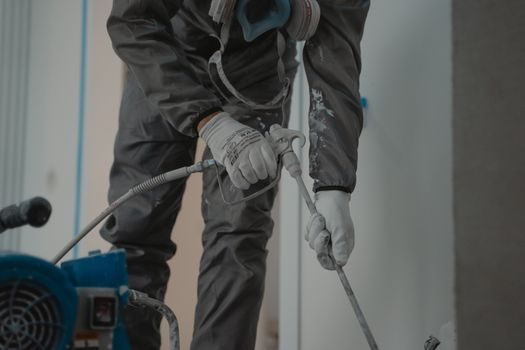
Three application gates line the main options up against decision criteria. Underbody and body-shop paint/weld-slag work: 1-1.5 kg, 1/2 inch bore, 2500-3500 BPM, 4-6 CFM, 12-needle head, vibration-damped handle. Production-line weld descaling and ship-hull: 2-3 kg chipping hammer, 5/8 or 3/4 inch bore, 1500-2500 BPM, 8-12 CFM, 14.6 mm hex chuck, quick-change retainer. Boiler-tube and heavy concrete: 4-7 kg descaling hammer, 1 inch+ bore, 1000-2000 BPM, 20-30 CFM, 17-20 mm hex chuck, integrated silencer [S5].
Two classes are not fit-for-purpose for an air pick. Abrasive blasting (use a media blaster), and high-frequency vibration demolition of concrete over 100 mm depth (use a rotary hammer with SDS-max). The pneumatic scaler occupies a specific gap - percussive chisel work on metal and light concrete - that no other tool class covers economically; the wrong tool class either does the job badly or burns compressor air for no useful stroke [S5].
Standards, sourcing and 2026 procurement signals
Three standards govern air-pick selection. ISO 28927 (hand-held portable power tools - vibration test methods) gives the a_hv figure on the data sheet. ISO 3744 / ISO 11201 governs the sound-power and sound-pressure declarations. For ATEX zone 1/21 work (tank farms, refineries), a tool spec'd to ATEX 2014/34/EU with group II category 2 is the working point; a general-purpose scaler is not [S5].
Procurement signals worth tracking into Q3 2026: (1) Several major pneumatic-tool lines refreshed their HAV data sheets in late 2025 with full ISO 28927 triple-axis values - the previous single-axis declarations are being withdrawn; ask for the updated data sheet. (2) Brushless-motor-driven air alternatives (hybrid) have entered catalogues as low-vibration alternatives for paint-strip work; the price premium is roughly 2-3x a comparable pneumatic unit, with the air quality monitor requirement relaxed. (3) Quick-connect chucks standardised on 10.6 mm / 14.6 mm hex are now the dominant production-line pattern, displacing older round-shank 10 mm - new inventory should match the hex pattern, not the legacy round shank [S5].
Final pre-purchase check: confirm compressor CFM at 90 psi (not displacement), hose ID matches bore class, chuck pattern matches existing chisel inventory, and the a_hv figure is triple-axis ISO 28927 - not a marketing line. Walk the bench with a representative job piece, time the chisel change, and measure the air drop on a air solenoid valve test rig if one is available. The cheapest unit in a brand family is rarely the right unit; the right unit is the one sized to the work piece and the compressor drop, with consumable inventory that already lives on the floor.
For related coverage, see Air Impact Wrench 2026 Buying Guide: Drive, Torque, Clutch and Air Budget.