Air solenoid valve selection is a 5-axis decision: port size (commonly 1/8" to 1/2" NPT/BSP for pneumatics, with 4 mm push-in fittings on miniature bodies per the 2V025-08 pattern listed at retail [S1]), valve function (2-way, 3-way, 5-way, 2-position or 3-position), actuation principle (direct-acting, pilot-operated, step-by-step diaphragm, or step-by-step piston), pressure class (vacuum to roughly 1.0 MPa on common pneumatic bodies, higher on dedicated high-pressure units [S2]), and coil voltage (AC220V is the dominant Asian mains rating; DC24V dominates control panels) [S1][S2].
Get the function/port combination wrong and the cylinder never strokes; get the pressure class wrong and the body cracks or the coil chatters; get the duty cycle wrong and the coil burns inside a season. The rest of this article walks the engineering logic in the same order a process spec should be written.
Valve Function: 2/2, 3/2 and 5/2 in Real Circuits
2-position 2-way valves (2/2) are the simplest on/off shut-off for a single air line and are routinely built as direct-acting on small orifices — the 2V025-08 retail example is exactly this: 2-way, 2-position, NC, with 4 mm push-in fittings on a 1/4" port thread base [S1]. 2-position 3-way valves (3/2) pilot a single-acting cylinder or vent a port to atmosphere, and they exist in both direct-acting and pilot-diaphragm variants depending on flow demand [S2].
5/2 and 5/3 valves are the standard for double-acting cylinders. The 5/2 routes supply to one side of the cylinder while exhausting the other; 5/3 adds a centre position (closed-centre, exhaust-centre, or pressure-centre) for mid-stroke holding. Cylinder-control circuits in machinery packaging and assembly almost always end up on 5/2 or 5/3, never on a 2/2 [S2]. For more on how a 5/2 ties into a cylinder circuit versus a vacuum generator, see the comparison of pneumatic actuator vs vacuum generator engineering logic.
Direct-Acting vs Pilot-Operated: Where the Line Falls
Direct-acting solenoid valves move the plunger against the seat using only the magnetic force of the coil — no minimum pressure differential is required, and they will open from full vacuum up to their rated pressure, which is why they are the only choice for low-pressure, zero-differential, or vacuum service [S2]. Pilot-operated valves use line pressure to assist a diaphragm or piston; the coil only cracks a small pilot orifice, which lets the same coil size shift a much larger main flow at higher pressure but requires a minimum operating pressure differential (commonly ~0.02–0.05 MPa depending on design) and a minimum flow to refill the pilot chamber.
Step-by-step (cascade) pilot diaphragm and step-by-step pilot piston are intermediate architectures: a small direct-acting pilot stage energises a larger diaphragm/piston, giving a wider pressure range than pure direct-acting while keeping the coil small [S2]. The selection rule: pick direct-acting for low pressure, vacuum, or dirty/dry air that may not have enough differential to hold a pilot open; pick pilot-operated for anything above ~0.3 MPa and larger orifice; pick step-by-step when you need pilot pressure range but a smaller coil than full-pilot-piston. For a deeper primer on the solenoid valve categories and how the plunger, spring and diaphragm interact, the encyclopedia entry lays out the cross-section.
Port Size, Cv and the Flow-Rate Sizing Pass
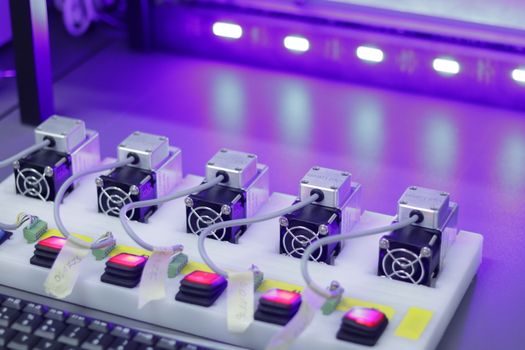
Port size on air solenoid valves is most often expressed in inches (1/8", 1/4", 3/8", 1/2") for NPT/BSP threads, or in millimetres (4 mm, 6 mm, 8 mm, 10 mm) for push-in fittings on miniature bodies — the 2V025-08 uses a 4 mm push-in barb on a 1/4" threaded base, which is the typical pattern for low-flow panel-mount pneumatic work [S1]. The same valve may also be rated by Cv (US gallons per minute at 1 psi drop) or its metric equivalent Kv (m³/h at 1 bar drop); a 1/4" port typically lands near Cv 0.5–1.0, a 1/2" port around Cv 3–5.
For a 50 mm bore, 100 mm stroke double-acting cylinder cycling once per second at 0.6 MPa, the rough required flow lands around 20–30 SLPM, comfortably inside a 1/4" port solenoid. See the air solenoid valve reference for the full Cv-to-port-size lookup and duty-cycle caveats.
Pressure, Temperature and Media Compatibility
Working pressure bands split cleanly: miniature plastic-body 2/2 and 3/2 valves commonly rate 0–0.8 MPa, brass-body 2-way direct-acting valves on 1/4"-1/2" threads commonly rate 0–1.0 MPa, and pilot-piston or dedicated high-pressure bodies push into 1.5–3.0 MPa and beyond for hydraulic-adjacent service [S2]. Vacuum service is the easy differentiator — only direct-acting or specially designed pilot valves will hold vacuum; standard pilot-diaphragm valves need a positive differential to stay open.
Media compatibility is mostly a seal problem, not a body problem. NBR (nitrile) covers general air, lubricated shop air, and light oil mist up to ~80°C; EPDM is required for brake-fluid-skimmed air, water-mix coolants, or any steam-adjacent service; FKM/Viton handles higher temperature air (to ~150°C in the right body) and aggressive lubricants; PTFE seats are the fallback for solvent vapour or pharmaceutical duty. Coil temperature class (B, F, H) sets the maximum continuous winding temperature — class F at 155°C and class H at 180°C are the common industrial picks. Watch the ambient too: a valve mounted next to a compressor in a 50°C enclosure has roughly 30°C less thermal headroom than the catalogue number suggests.
Coil Voltage, Duty Cycle and Heat
AC220V (or AC230V, AC240V depending on region) is the dominant mains coil in Asian-built pneumatic panels; DC24V is the dominant control-panel coil when the valve is driven by a PLC discrete output [S1][S2].
AC coils are noisier, generate inrush current 5–10× the holding value, and fail most often at the shading-ring joint — that is the moving part most likely to be heard ticking before it breaks. The solenoid coil page covers shading-ring failure modes, rectifier-snubber DC conversion, and IP65/IP67 connector options. For high-cycle pneumatic actuators, derate the cycle count by the duty cycle; a 10 Hz application is not the same thermal load as 1 Hz, even with the same valve.
Decision Matrix: Matching Architecture to Application
The matrix below lines up the four main architectures against the four most binding selection criteria — pressure range, minimum differential, vacuum capability, and typical port/flow — so a spec can be read off in one pass [S2].
Direct-acting: 0 to ~1.0 MPa working pressure, zero minimum differential (works on vacuum), 1/8" to 1/4" ports on common industrial bodies, ideal for single-acting cylinders, vacuum pick, instrument air shut-off, and low-flow on/off. Pilot diaphragm: 0.02–0.8 MPa with a positive differential, 1/4" to 1/2" ports, larger Cv for the same coil size, not for vacuum. Step-by-step pilot diaphragm: 0.02–1.0 MPa, 1/4" to 1/2" ports, the workhorse for general shop air at 0.5–0.7 MPa. Step-by-step pilot piston: 0.05–1.5+ MPa, 1/2" and up, the only sensible pick for high-pressure shop air and light hydraulic duty up to roughly 3 MPa on dedicated bodies [S2].
Standards, Sourcing and What to Watch

Industrial pneumatic solenoid valves typically reference ISO 5599 (valve-mounting interface), ISO 15407 / ISO 15218 (sub-base and miniature interfaces), and for hazardous-area body designs the IEC 60079 series plus ATEX 2014/34/EU for European installs. NACE MR0175 applies only when the wetted path contacts H₂S-rich well fluids, which is unusual for general pneumatic service but is sometimes invoked on oil-and-gas panels feeding pneumatic positioners. For valve bodies in drinking-water or food-adjacent air, check for NSF/ANSI 61 or WRAS approval on wetted elastomers. [S1]
On sourcing: Asian OEM lines offer 2/2 NC valves with 4 mm push-in fittings and AC220V coils in the consumer-and-light-industrial price band (the 2V025-08 pattern), with retail listings in single-unit pack quantities for prototyping [S1]. Volume industrial buyers typically go through a sourcing platform such as OKorder, where payment terms TT or LC, minimum order quantity 10 sets, and supply capability 100 sets/month are common contractual patterns for that product class [S3]. Two trackable signals over the next quarter: any move to IP67 moulded-coil connectors as the default on the AC220V retail-tier bodies, and any consolidation of the pilot-diaphragm catalogue around a single 1/4" Cv band as the volume-workhorse platform [S1][S2].