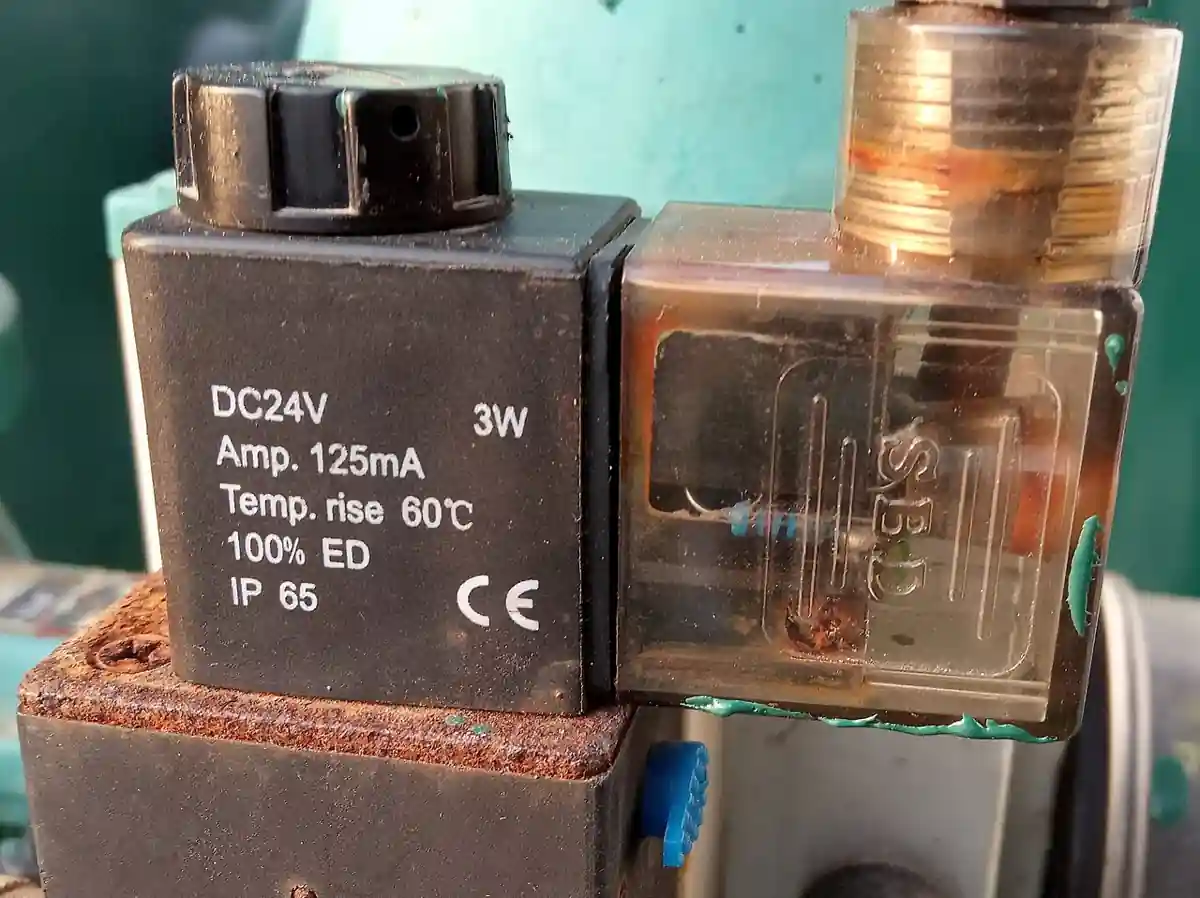
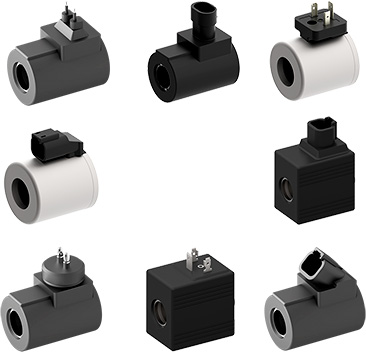
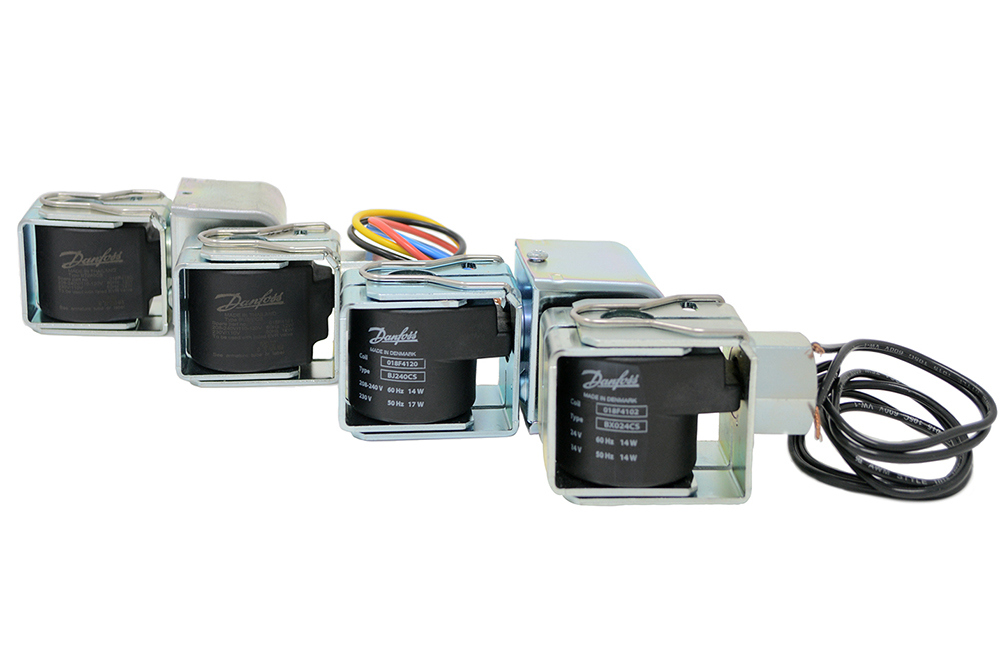
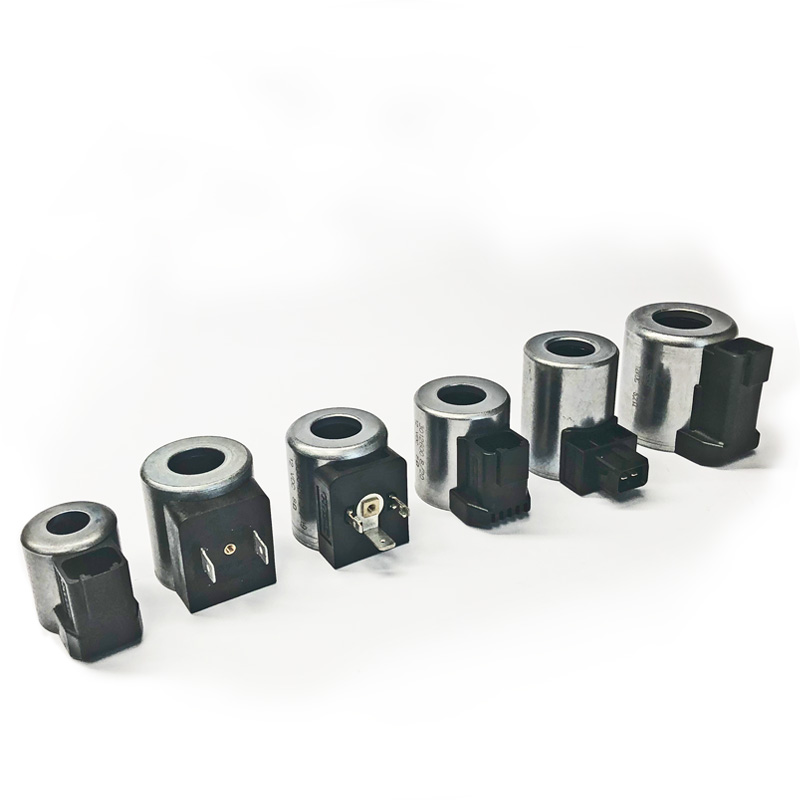
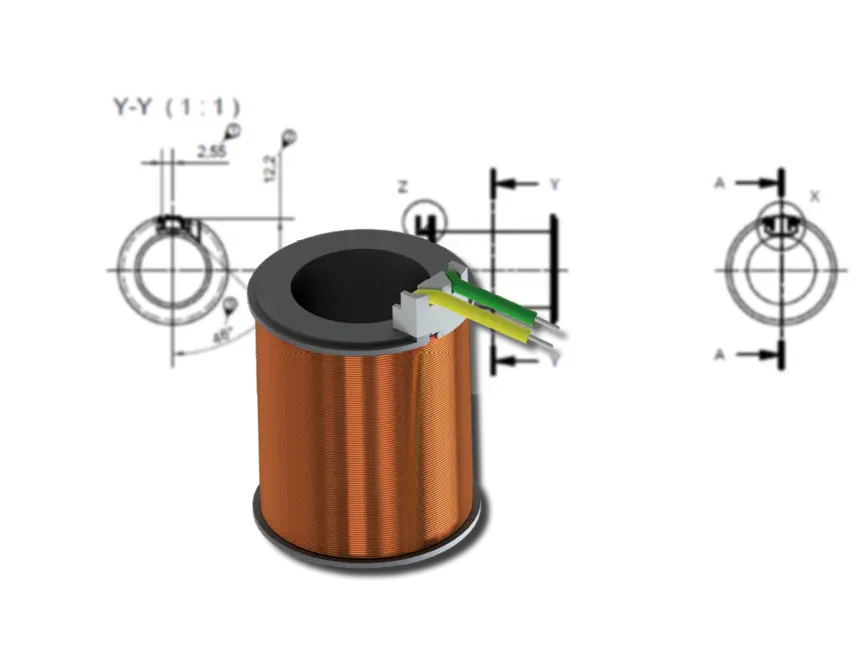
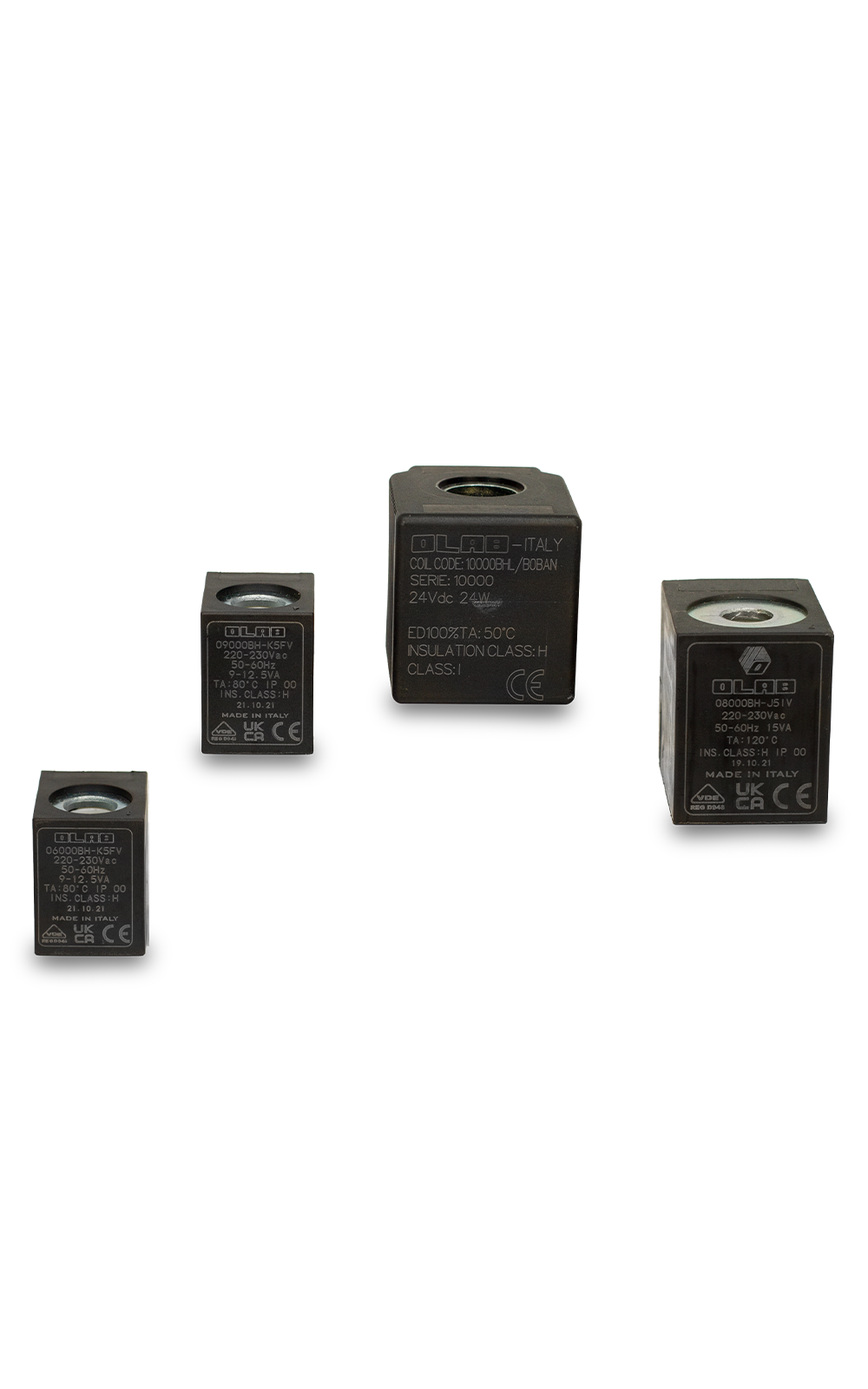
A solenoid coil is the electromagnetic actuator at the heart of a solenoid valve, relay, contactor, or linear pull solenoid. It is a multi-turn winding of insulated copper wire that converts electrical current into a magnetic field, pulling a ferromagnetic plunger or armature to open a valve, switch a contact, or move a load. The coil itself does no fluid sealing; it is the energy converter, and on most industrial valves it is a separate, field-replaceable part that slides over the armature tube.
Although procurement teams often order a complete "solenoid valve," the coil is the component that actually fails most often, almost always from overheating. Understanding voltage, frequency, insulation class, duty cycle, and connector form is therefore the practical core of solenoid selection and spare-part stocking.
This guide is written for industrial purchasing engineers and design engineers. It covers 6 chapters from working principle and history, AC versus DC types, insulation classes and thermal behavior, connectors and standards, spec-sheet decoding, to selection decisions, with 7 selection FAQs and manufacturer references. Thermal classes follow IEC 60085, connectors follow DIN 43650 / EN 175301-803 / ISO 4400, ingress protection follows IEC 60529, and hazardous-area duties reference the IEC 60079 series.
Chapter 1 / 06
What is a Solenoid Coil
A solenoid coil is a winding of insulated copper wire wound in many tightly packed turns around a hollow former, or bobbin, through which a ferromagnetic plunger can slide. When current flows through the winding it generates a magnetomotive force, measured in ampere-turns, that drives a magnetic flux down the bore of the coil. That flux magnetizes the plunger and pulls it toward the seated, minimum-reluctance position, against a return spring and against whatever mechanical or fluid load the actuator is working on. Cut the current and the spring returns the plunger. This direct conversion of electric current into linear mechanical force is the working principle shared by solenoid valves, relays, contactors, and the simple pull solenoids used in locks, dispensers, and clutches.
The governing relationship is compact: the magnetomotive force equals the number of turns multiplied by the current, often written as ampere-turns or NI. Magnetic flux through the coil cross-section rises with ampere-turns, and the pull force on the plunger rises with the square of that flux density at the working air gap. This is why the wattage or VA rating, the wire gauge, and the turns count all matter together. More turns or more current both raise ampere-turns and force, but more turns of a given wire raise resistance and heat, and a heavier wire gauge lowers resistance but takes more winding space. Coil design is a balancing act among force, power, size, and heat.
Structurally a solenoid coil has four parts: the bobbin or former that carries the winding; the copper winding itself, typically enameled magnet wire whose gauge sets resistance and current; the magnetic frame or yoke and pole piece that route flux to the plunger and back; and the insulation and encapsulation system that protects the winding from moisture, oil, vibration, and heat. On encapsulated coils the entire assembly is molded into a thermosetting epoxy or a thermoplastic such as nylon or polyurethane, which conducts heat outward, seals against ingress, and gives the coil its rugged industrial block shape. The wetted parts of the valve, the seat and the fluid path, are outside the coil entirely; the coil only sees the dry armature tube.
The history of the device runs through the nineteenth century. Andre-Marie Ampere coined the term solenoid in the 1820s for a current-carrying helix, and the electromagnet developed by William Sturgeon and Joseph Henry in the same decade established that current in a coil could lift iron. The industrial solenoid valve, combining a coil with a plunger and a valve seat, became a mass-produced component in the early and middle twentieth century, with companies such as ASCO, founded in 1888, commercializing the modern solenoid valve. The DIN 43650 connector standard, later harmonized as EN 175301-803, gave the industry the interchangeable rectangular plug that still dominates coil wiring today.
Four engineering properties determine coil quality and lifetime: the magnetomotive force it can deliver, which sets the maximum plunger force and therefore the valve pressure rating; the insulation class, which sets the maximum winding temperature; the duty cycle rating, which sets how long it may stay energized; and the enclosure and connector system, which set ingress protection and serviceability. Together these decide whether a coil survives years on a production line or burns out in a season. Because the coil is usually the cheapest and most replaceable part of the assembly yet the most failure-prone, stocking the correct spare coil is one of the highest-leverage maintenance decisions in fluid power and process plants.
Chapter 2 / 06
AC and DC Coil Types
The single most consequential classification of a solenoid coil is whether it is built for alternating or direct current. The two are not interchangeable, and choosing the wrong one is the most common and most expensive solenoid mistake, because it usually ends in a burned-out coil within seconds to minutes. The difference comes from a fundamental fact of physics: a DC coil's current is limited only by its ohmic resistance, while an AC coil's current is limited by inductive reactance that changes as the plunger moves. The table below summarizes the engineering consequences.
Property
DC coil
AC coil
Current limiter
Ohmic resistance
Inductive reactance
Inrush vs holding
Nearly equal
Inrush 5 to 10x holding
Inrush duration
n/a
~20 to 50 ms
Initial pull force
Moderate, steady
High at start
Stuck-plunger risk
Low
High burnout risk
Shading ring
Not required
Required to stop hum
Power rating unit
Watts (W)
Volt-amps (VA)
Typical voltages
12, 24, 48 V DC
24, 110, 230, 380 V AC
DC coils behave simply. The current is set by Ohm's law, current equals applied voltage divided by coil resistance, and it does not depend on plunger position. Inrush and holding current are therefore essentially identical, the force builds smoothly as the plunger seats, and the coil tolerates a stuck or slow plunger without a dangerous current rise. DC coils are quiet, with no line-frequency hum, and are the natural choice for battery, PLC, and 24 V control systems. Their limitation is that the steady current produces no inductive current-limiting, so the coil must be wound with enough resistance to keep that constant current within thermal limits, which can make DC pull force build more gently than the sharp AC kick.
AC coils are governed by reactance. When the plunger is in its open, de-energized position the air gap is large, the coil inductance is low, and the inrush current can rise to roughly 5 to 10 times the seated holding value. As the plunger seats, the air gap closes, inductance climbs, and the current falls to the much smaller holding level within about 20 to 50 milliseconds. This inrush gives AC coils a high starting force, useful for slamming open large or high-pressure valves, but it is also their fatal weakness: if the plunger jams in the open position the coil stays locked at full inrush current and overheats almost immediately. Most AC solenoid burnouts trace to a plunger that never seated.
A second feature unique to AC coils is the shading ring, a closed copper loop set into the pole face. An AC magnetic field passes through zero twice every cycle, which would let the spring momentarily push the plunger back and produce a loud 100 or 120 Hz buzz and chatter. The shading ring carries an induced current that lags the main field by about 90 degrees, sustaining a residual flux through those zero crossings so the plunger stays seated and quiet. DC coils have a steady field and never need a shading ring. Because of these differences a coil must be ordered for the exact supply: an AC coil run on equivalent DC sees no reactance and burns out, and a DC coil run on AC under-pulls and hums. Some DIN 43650 plugs include a rectifier insert that lets an AC supply drive a DC coil, which is the correct engineered bridge between the two worlds.
Chapter 3 / 06
Insulation Classes and Thermal Behavior
Almost every solenoid coil that fails fails because its winding got too hot. The enamel insulation on the magnet wire has a maximum temperature beyond which it softens, chars, and lets adjacent turns short together, which raises current and heat further until the winding opens. The maximum permissible winding temperature is the insulation class, standardized by IEC 60085 (harmonized as EN 60085). Each class is a letter tied to a maximum hot-spot temperature in degrees Celsius, and the numeric class equals that temperature. The table below lists the classes a coil buyer encounters.
Class (letter)
Max hot-spot temp
Typical use in coils
A
105 °C
Legacy, low-cost coils
E
120 °C
Light-duty appliance coils
B
130 °C
General industrial coils
F
155 °C
Common industrial standard
H
180 °C
Continuous-duty, high-ambient
N
200 °C
High-temperature special
R
220 °C
Severe high-temperature service
The hot-spot temperature is a budget shared by three contributions. First, the ambient temperature around the coil. Second, the coil's own temperature rise from copper losses in the winding resistance and iron losses in the magnetic frame, which on a continuously energized coil can add many tens of kelvin. Third, heat conducted from the process media up the armature tube, which on a steam or hot-oil valve can be substantial. A Class F coil rated 155 degrees C sitting in a 55 degrees C ambient leaves only about 100 K for self-heating plus media transfer; the same coil in a 40 degrees C ambient has more headroom. This is why a coil rated continuous at one ambient may need derating, or a higher insulation class, at a hotter location.
Class H, 180 degrees C, is the most common choice for continuous-duty industrial coils precisely because it gives the largest thermal margin and the longest insulation life. Class F at 155 degrees C remains a widespread general standard, and Class B at 130 degrees C and Class A at 105 degrees C survive in legacy and light-duty products. The relationship between temperature and life is steep: as a rule of thumb each roughly 8 to 10 K of sustained over-temperature halves the expected insulation life. A coil run 20 K over its class does not fail immediately, but its expected service drops by a large factor, which is why thermal margin, not just survival, is the design target.
Two design choices manage this heat. The first is encapsulation: molding the winding into a thermosetting epoxy or a thermoplastic such as nylon or polyurethane that conducts heat outward to the coil surface, seals out moisture and oil, and resists vibration and shock. Encapsulated coils dominate modern industrial use because they run cooler and seal better than older open, varnish-dipped windings. The second is duty cycle management, covered in Chapter 5: a coil energized only part of each cycle self-heats less than one held on continuously, so a 100 percent rated coil and a 25 percent rated coil of the same physical size will have different winding designs and different thermal margins.
For the buyer, the practical takeaways are direct. Match the insulation class to the worst-case sum of ambient plus self-heating plus media heat, not to the average condition. Prefer Class H for any continuous or high-ambient service, since the price premium over Class F is small relative to the cost of a burned coil and an unplanned shutdown. Confirm that the rated ambient on the datasheet matches the real installation; a coil rated continuous at 25 degrees C ambient is not the same as one rated continuous at 55 degrees C. And remember that voltage discipline is a thermal matter too: because power rises with the square of voltage, even a coil with a good insulation class will overheat if run persistently above its voltage tolerance.
Chapter 4 / 06
Connectors, Enclosure, and Standards
How a coil connects to the control wiring and how its enclosure resists the environment are as important to a long service life as the winding itself. The dominant industrial connector is the rectangular DIN 43650 plug, now harmonized internationally as EN 175301-803 and also referred to as ISO 4400. It comes in three sizes, distinguished by pin spacing, and the form must be matched to the coil at the time of order because the sizes are not mechanically interchangeable. The table below compares the three forms.
Form
Pin spacing
Typical coil size
Notes
Form A
18 mm
Full-size industrial
Most common on large coils
Form B
10 or 11 mm
Compact / manifold
11 mm uses three flat blades
Form C
8 or 9.4 mm
Miniature / micro
9.4 mm is the industry default
Most DIN plugs provide two power contacts plus an earth contact and accept a cable gland for field wiring. They are widely available with useful add-ins: an integrated LED to show the coil is energized; a varistor or flyback diode to suppress the inductive voltage spike that appears when the coil de-energizes, protecting upstream contacts and PLC outputs; and on AC supplies a rectifier insert that converts the line to DC so an AC line can drive a quieter DC coil. Beyond the DIN family, coils also ship with flying leads, fixed cable tails, and small circular connectors such as M12 for sensor-bus installations, the latter common where the valve sits on an IO-Link or fieldbus island.
Enclosure protection is rated by the IEC 60529 ingress protection, or IP, code. A correctly assembled DIN 43650 plug with its gasket typically reaches IP65, dust-tight and protected against low-pressure water jets, which suits most indoor and sheltered outdoor factory installations. Encapsulated coils with molded leads or sealed connectors are commonly available at IP67, withstanding temporary immersion, and specialized coils reach IP68 for continuous immersion or IP69K for high-pressure, high-temperature washdown in food and pharmaceutical plants. Outdoor, washdown, and dusty environments should specify IP67 or higher and confirm that the connector, not just the coil body, meets the rating, since the connection point is the usual leak path.
Several standards converge on the solenoid coil. IEC 60085 governs the insulation thermal class. DIN 43650 / EN 175301-803 / ISO 4400 govern the rectangular connector geometry. IEC 60529 governs ingress protection. For hazardous areas with flammable gas or dust, the IEC 60079 series governs explosion protection, with intrinsically safe (Ex ia) and flameproof or encapsulated (Ex d, Ex m) coils certified under ATEX 2014/34/EU in the European Economic Area, under the international IECEx scheme, and under NEPSI in China. Functional-safety duties may additionally call for an IEC 61508 SIL rating on the valve and coil assembly. The table below maps the main standards to what they constrain.
Standard
What it governs
Coil relevance
IEC 60085
Thermal insulation class
Max winding temperature (A to R)
EN 175301-803 / DIN 43650 / ISO 4400
Rectangular connector
Form A / B / C plug geometry
IEC 60529
Ingress protection (IP)
IP65 / IP67 / IP68 / IP69K
IEC 60079 series
Explosion protection
Ex ia, Ex d, Ex m hazardous areas
IEC 61508
Functional safety
SIL rating of valve assembly
Chapter 5 / 06
Key Specification Parameters
Reading a coil datasheet is a fundamental skill for purchasing and maintenance engineers. Coils list many figures, but only a handful actually drive selection and stocking decisions: rated voltage and frequency, power rating, inrush and holding current, coil resistance and turns, magnetomotive force, duty cycle, insulation class, and connector and IP rating. The insulation class and connector were covered in Chapters 3 and 4; the remaining parameters are decoded below.
Rated voltage and frequency are the first thing to match and the easiest to get wrong. The coil must match both the magnitude and the type of supply: 24 V DC, 24 V AC, 110 V AC at 50 or 60 Hz, 230 V AC, and so on are all distinct coils. Frequency matters for AC coils because reactance depends on it; a 50 Hz coil run at 60 Hz, or the reverse, shifts the holding current and temperature rise. Most coils tolerate a supply within about plus or minus 10 percent of nominal. Because heating power scales with the square of voltage, persistent over-voltage is a direct route to over-temperature, while under-voltage on an AC coil can leave the plunger unseated at high reactive current, which is equally damaging.
Power rating is quoted in watts for DC coils and in volt-amps (VA) for AC coils, because an AC coil draws reactive as well as real power. The rating sets two things at once: the magnetomotive force, hence the pull force available to move the plunger against pressure and spring, and the heat the coil must shed. AC datasheets separate inrush VA from holding VA; only the holding figure feeds steady self-heating, while the inrush figure governs how heavily the upstream contact, transformer, and protection must be rated. A higher-wattage coil gives more force, useful for high-pressure or large-orifice valves, but it runs hotter and demands a higher insulation class or a cooler ambient.
Inrush and holding current describe the time profile of the draw. On a DC coil the two are nearly equal, set by resistance. On an AC coil the open-armature inrush can reach 5 to 10 times the seated holding value for about 20 to 50 milliseconds. This profile drives three downstream decisions: the switching contact or PLC output must carry the inrush peak without welding; fuses and breakers must be slow enough to ride through the legitimate transient; and a coil left at full inrush by a stuck plunger is the classic burnout case. Coil resistance and turns count sit behind these numbers, since resistance sets DC current and, together with the turns, sets the ampere-turns and therefore the force.
Magnetomotive force, expressed in ampere-turns (NI), is the figure that ultimately decides whether a coil can lift a given plunger against a given spring and pressure differential. Two coils of the same voltage can produce very different forces if their turns and current differ, which is why a coil swap must match force, not merely voltage. Duty cycle, often written percent ED from the German Einschaltdauer, is the ratio of energized on-time to total cycle time within a reference period:
100 percent ED (continuous): may stay energized indefinitely without exceeding its insulation class. The default for valves held open for long periods.
50 percent ED: energized about half of each cycle; sized for lower average self-heating; not for permanent energization.
25 percent ED: energized about a quarter of each cycle; the smallest, lightest winding for a given force, but the least thermal margin.
Reference period matters: a short fast cycle and a long slow cycle at the same percentage are not thermally equal, because thermal mass averages short pulses but not long ones.
The decisive rule is that the worst-case single on-time, not the average duty, governs peak winding temperature. A process that occasionally holds a valve open for hours needs a 100 percent ED coil regardless of its low average duty. Finally, connector and IP rating close out the spec: confirm the DIN form (A, B, or C) or alternative connector, and confirm the ingress protection matches the environment, recalling that the connection point, not the coil body, is usually the weak link.
Chapter 6 / 06
Selection Decision Factors
To turn the preceding chapters into a specific coil part number, follow the decision sequence below. Most selection mistakes are not a single wrong figure but a premature decision taken before an earlier constraint was fixed, most often committing to a voltage before confirming AC versus DC. These eight steps make a reusable RFQ and spare-stocking template.
Confirm the valve series and the required force: identify the exact valve or actuator model first, because the coil must deliver the magnetomotive force, in ampere-turns, that the valve needs to lift its plunger against its spring and maximum pressure differential. Match force, not just voltage.
AC or DC, and the exact voltage and frequency: decide the supply type before anything else, since AC and DC coils are not interchangeable. Then fix the voltage (12, 24, 48 V DC or 24, 110, 230, 380 V AC) and, for AC, the frequency (50 or 60 Hz). Keep the supply within the rated tolerance, commonly plus or minus 10 percent.
Power rating and current profile: select the watt rating for DC or the VA rating for AC that meets the valve's minimum operating force. For AC, check both inrush VA and holding VA so the upstream contact, transformer, and protection are sized for the inrush peak.
Duty cycle: choose 100 percent ED for any continuous or long-hold service, and a lower percent ED only when the process genuinely cycles. Size to the worst-case single on-time, not the average duty.
Insulation class and ambient: sum the worst-case ambient, the coil self-heating, and any media heat, and pick a class with margin. Prefer Class H (180 degrees C) for continuous or high-ambient duty; confirm the datasheet ambient matches the real installation.
Connector and ingress protection: specify the DIN 43650 form (A, B, or C) or the alternative connector (flying leads, cable, M12), and add the LED, surge-suppression, or rectifier insert if needed. Set the IP rating to the environment, IP67 or higher for outdoor or washdown, and confirm the connector meets it, not just the coil body.
Certifications and environment: for hazardous areas add the IEC 60079 explosion-protection rating (Ex ia, Ex d, Ex m) under ATEX, IECEx, or NEPSI; for safety loops add the IEC 61508 SIL requirement; and confirm vibration and temperature ratings for the installation.
Total cost of ownership and spares: a coil is the cheapest and most replaceable part of the assembly yet the most failure-prone, so factor in spare-coil stocking, the cost of unplanned downtime, and whether a small premium for Class H insulation or higher IP pays for itself in avoided burnouts.
One last dimension is often overlooked: serviceability. Because the coil fails far more often than the valve body, the real question is how quickly a replacement coil can be on the shelf and on the valve. Confirm that the coil is a separate, field-replaceable part rather than potted into the body; verify a clear part-number cross-reference against the valve series chart; and prefer suppliers with local stock and standard connector forms. Established makers including ASCO (Emerson), Bürkert, Parker, Kendrion, and Magnet-Schultz publish coil-to-valve compatibility charts and offer the full range of voltages, insulation classes, and connector forms, which makes them dependable choices where long-term spare availability matters as much as the initial price.
FAQ
What is the difference between an AC and a DC solenoid coil?
A DC coil draws a constant current set by Ohm's law (current equals voltage divided by coil resistance), so its inrush and holding currents are essentially the same and the burnout risk on a stuck plunger is low. An AC coil is current-limited by inductive reactance: when the plunger is open the air gap is large, inductance is low, and inrush current can spike to roughly 5 to 10 times the seated holding value, then falls as the armature seats and inductance rises. AC coils therefore deliver higher initial pull force but overheat within seconds if the plunger jams open. AC coils also carry a copper shading ring around the pole face to keep the magnetic field from dropping to zero twice per cycle, which suppresses the 100 or 120 Hz hum and chatter. A DC coil never has a shading ring. The two are not interchangeable: an AC coil run on equivalent DC sees no reactance and burns out, and a DC coil on AC under-pulls and buzzes.
What do solenoid coil insulation classes mean?
The insulation class is the maximum permissible hot-spot temperature of the winding, defined by IEC 60085. The common classes are A (105 degrees C), E (120), B (130), F (155), H (180), N (200), and R (220), where the letter equals a numeric class equal to that temperature in degrees Celsius. The hot-spot budget is shared between ambient temperature, the coil's self-heating temperature rise from copper and iron losses, and any heat conducted from the process media. A Class F coil rated 155 degrees C running at a 55 degrees C ambient still leaves only about 100 K for self-heating plus media transfer. Class H (180 degrees C) is the most common choice for continuous-duty industrial coils because it gives the largest thermal margin and the longest insulation life. Operating an insulation system about 8 to 10 K above its class roughly halves its expected life.
What does duty cycle or percent ED mean for a solenoid coil?
Duty cycle, often written percent ED (from the German Einschaltdauer), is the ratio of energized on-time to total cycle time within a reference period. A 100 percent ED or continuously rated coil may stay energized indefinitely without exceeding its insulation class. A 25 percent ED coil energized one quarter of each cycle is sized for less continuous self-heating and will overheat if held on permanently. The reference period matters: a short fast cycle and a long slow cycle at the same percentage are not thermally equivalent because thermal mass averages short pulses but not long ones. Always confirm both the percent ED and the maximum continuous on-time. If a process holds the valve open for hours, specify a 100 percent ED coil regardless of the average percentage, because it is the worst-case single on-time, not the average, that drives peak winding temperature.
How do inrush and holding current differ, and why does it matter for wiring?
On a DC coil the two are nearly identical because current is fixed by resistance. On an AC coil the open-armature inrush can be 5 to 10 times the seated holding current, lasting only about 20 to 50 milliseconds until the plunger seats and inductance climbs. Sizing matters for three reasons: the upstream contact, relay, or PLC output must carry the inrush peak without welding; fuses and breakers must be slow enough not to trip on the legitimate transient; and a plunger that fails to seat leaves the coil stuck at full inrush, which is the classic AC coil burnout path. For VA budgeting, AC coil datasheets list both inrush VA and holding VA separately, and the inrush figure governs transformer and contact rating while the holding figure governs steady power draw and temperature rise.
What is the difference between DIN 43650 Form A, Form B, and Form C connectors?
DIN 43650, now harmonized as EN 175301-803 and also called ISO 4400, defines the rectangular industrial connector used on most solenoid valve coils. Form A is the largest, with 18 mm pin spacing, and is standard on full-size industrial coils. Form B has 10 or 11 mm pin spacing for compact and manifold valves; the 11 mm industry-standard version uses three flat blades. Form C is the most compact, with 8 or 9.4 mm pin spacing, used on miniature and micro solenoid valves. Most plugs offer two power pins plus an earth, and many are available with an integrated LED, a varistor or diode for spike suppression, and a rectifier insert that lets an AC supply drive a DC coil. Ingress protection is typically IP65 when correctly assembled with the supplied gasket. Form A and Form B plugs are not mechanically interchangeable, so the connector form must be matched to the coil at the time of order.
Why do solenoid coils burn out, and how do I prevent it?
The root cause is always the same: winding temperature exceeds the insulation class long enough to degrade the enamel, short adjacent turns, and cascade to an open circuit. The common triggers are a plunger stuck open on an AC coil, which holds the coil at full inrush; over-voltage beyond the rated tolerance, since power rises with the square of voltage; under-voltage on AC, which leaves the plunger unseated at high reactive current; ambient temperature above the rating; missing or wrong fill fluid that fails to conduct heat away; and exceeding the duty cycle. Prevention: confirm the coil voltage and frequency match the supply, keep voltage within the stated tolerance (commonly plus or minus 10 percent), select a 100 percent ED coil for continuous service, choose Class H insulation for thermal margin, ensure the plunger and tube are clean so the armature seats fully, and verify ambient temperature plus self-heating stays inside the class budget.
Can I swap a coil voltage without changing the valve body?
Usually yes, because on most industrial solenoid valves the coil is a separate field-replaceable component that slides over the armature tube and is held by a nut or clip. The valve body, plunger, and spring stay the same; only the coil changes. You can convert a 24 V DC valve to 230 V AC or to 24 V AC by ordering the matching coil for the same valve series, provided the new coil delivers enough magnetomotive force, in ampere-turns, to lift the same plunger against the same spring and differential pressure. The watt or VA rating and the magnetic force, not just the voltage, must match the valve's minimum operating requirement. Always confirm the coil part number against the valve series chart, verify AC versus DC, and check that the connector form and insulation class are compatible. Never assume that any coil of the right voltage will produce the right force.
Solenoid Coil Manufacturers
Source-backed product routes. Open a company dossier for procurement scope and cited evidence.
Bucher Hydraulics documents serviceable GPP PowerPacks, Smart PowerPacks and compact mobile or industrial hydraulic power-pack routes.
Published product fact
GPP PowerPacks, Smart PowerPacks, Electro-Pumps ET, Series UP, M-Series mobile DC/AC packs, MT & T industrial/commercial AC packs and YBZ application-specific units.
Published product fact
QXEHX internal-gear hydraulic pumps for open circuits, fixed- or variable-speed drives and reverse operation, with published working pressure up to 280 bar and speeds up to 6,050 rpm.
HYDAC's official website presents the company across hydraulics, electronics and filtration, while its retained catalogs document category-specific product families.
Published product fact
Hydraulic and lube-oil filter elements, including Stat-X element technology and high-efficiency depth media
Published product fact
Hydraulic and lube-oil filter elements with Stat-X technology and high-efficiency depth (absolute) filter media