
Molten aluminum attack on alumina is not a bulk chemical reaction but a localized interfacial process: pure α-Al₂O₃ is thermodynamically stable against liquid Al, yet molten metal still infiltrates grain boundaries, wedges cracks open on thermal cycling, and reduces the ceramic where Mg or flux residues are present [S5].
Failure of an alumina ceramic component in a foundry launder, thermocouple sheath, degassing rotor, or filter plate is therefore progressive, not catastrophic, and the dominant variables are purity, density, alloy chemistry of the melt, and the imposed thermal cycle [S5].
Why Pure Al₂O₃ Stays Up, Mechanistically
Thermodynamically, pure α-Al₂O₃ shares its oxide identity with the Al₂O₃ skin on the melt, so the driving force for reduction is near zero; the practical attack modes are physical infiltration and localized alloy-element chemistry, not bulk dissolution [S5]. The protective role of high purity (≥99.7% Al₂O₃) is to minimize the silica-based glassy phase at grain boundaries, which is the preferred pathway for both metal penetration and chloride-fluoride flux attack [S5]. For comparison, sintered Al₂O₃ without any CaO·5SiO₂ additive retained about 53% of initial strength after molten Fe exposure at 1600°C, versus about 47% for the additive-bearing grade whose anorthite grain-boundary phase reacted to form silicides and a hibonite layer [S2].
Density above 3.90 g/cm³ is the second line of defense: closed porosity eliminates the connected path that molten metal needs to wet a grain boundary and start the wedge-cracking cycle [S5]. Corrosion rates of solid-state sintered aluminas in aggressive media are several times lower than liquid-phase-sintered grades because the matrix dissolves more slowly than the grain-boundary glassy phase [S2].
Four Failure Modes Engineers See in Service
Molten-metal penetration plus wedge cracking is the dominant failure mode: liquid Al infiltrates open microcracks or grain boundaries, solidifies on cooling, and exerts tensile stress on reheat because the CTE mismatch is roughly 24×10⁻⁶/°C for Al against about 8×10⁻⁶/°C for alumina, so the metal wedge propagates the crack and spalls ceramic fragments into the melt [S5]. The process is autocatalytic; deeper penetration creates new cracks, which admit more metal.
Magnesium, a common Al alloying element, has a higher oxygen affinity than Al and reduces alumina at the interface to form MgO and then MgAl₂O₄ spinel, an unstable, porous, spall-prone reaction layer that exposes fresh ceramic [S5]. Salt fluxes (chloride-fluoride mixes used for degassing and cleaning) dissolve the silica-rich grain-boundary phase in lower-purity aluminas and trigger rapid intergranular disintegration [S5]. Finally, thermal shock from cold-tool immersion (RT to 660°C for Al) exceeds alumina's moderate thermal-shock tolerance, and high-velocity flow at degassing rotors adds liquid-erosion wear on top of the chemical attack [S5].
Material Comparison Against Molten Al Service
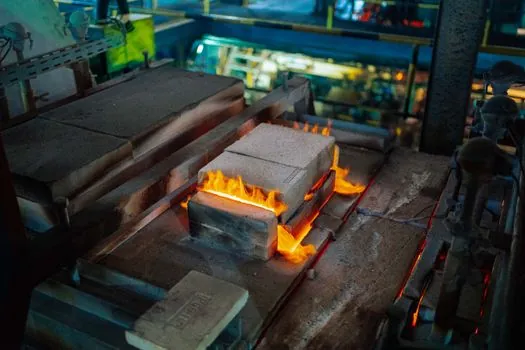
The real selection problem is alumina versus the alternatives that foundries actually quote: sialon, SiC, ZrB₂ cermets, and ZTA. The decision is driven by temperature, alloy chemistry, and whether the part sees flux or just metal contact. [S1]
On raw corrosion rate, SPS-densified ZrB₂-AlFeNiCoCr cermet at 1500°C sintering temperature measured an average corrosion rate of 1.225×10⁻³ mm/h in 700°C liquid aluminum, with 0.104 mm³ wear in the friction test, and the dense ZrB₂-B-B and Zr-B bonding gives it a high melting point, but the cost is the >2300°C densification requirement that needs a high-entropy-alloy binder to bring it down [S1]. Sialon (Si-Al-O-N) components retain strength up to 1450°C, show very low wettability to molten Al, and have outstanding thermal-shock resistance, with International Syalons' thermocouple sheaths, riser/heater tubes, and level sensors rated to 1200°C, 1400°C, and 800°C respectively [S3].
The side-by-side: high-purity alumina (≥99.7%, >3.90 g/cm³) is the cost-effective default for low-Mg melts below 1000°C with mild thermal cycling; sialon is the upgrade when thermal-shock resistance or sustained 1200-1400°C service is required, with documented zero-porosity cross-sections after aluminum service [S3]; ZrB₂ cermets are the specialty pick for hot-dip aluminum plating hardware (sink rollers, guide plates) where metal-melt wear compounds with oxidation [S1].
Selection Criteria for Foundry Specifiers
For launder liners, thermocouple sheaths, and degassing shafts in a primary or secondary aluminum smelter, the material decision follows three rules: specify ≥99.7% Al₂O₃ with density >3.90 g/cm³ to close off grain-boundary penetration; require documented CTE and thermal-shock data because the 24 vs 8×10⁻⁶/°C mismatch is what spalls parts, not the corrosion rate per se; and step up to sialon or ZrB₂ cermet when service temperature exceeds ~1000°C, when the alloy contains Mg, or when chloride-fluoride flux contact is unavoidable [S5][S3].
For hot-dip aluminum plating lines, where sink rollers, pull rollers, and guide plates sit in continuous contact with high-temperature liquid Al, the published ZrB₂-AlFeNiCoCr data point to a 1500°C SPS-bonded cermet as a candidate, but only if the buyer can absorb the higher cost and the binder's oxidation behavior above 1600°C has been characterized for the specific line [S1]. For the industrial ceramic buyer who just needs a generic "corrosion-resistant" tube or liner, high-purity alumina is still the default; for higher-temperature service, sialon and ZrB₂ are the documented upgrades [S3][S1].
Limits of Alumina and Where It Is the Wrong Pick
Alumina is the wrong material for molten Al service when any of three conditions are met: the alloy is high in Mg (spinel-forming reduction attack dominates), the part sees chloride-fluoride fluxes (silica-phase dissolution dominates), or the cyclic thermal gradient exceeds alumina's thermal-shock limit (wedge cracking dominates) [S5]. In these cases, switching to sialon or to a ZrB₂ cermet changes the failure mode, not just the rate.
A second, less obvious limit is purity. This is also why dielectric and wear grades that are perfectly adequate for non-molten-metal service fail prematurely in foundry launders.
Standards, Spec Sheets, and What to Ask the Vendor
For the sialon upgrade path, International Syalons publishes per-component temperature ratings (thermocouple sheaths to 1200°C and 1400°C, level sensors to 800°C) and cross-sectional evidence of zero porosity or Al ingress after service [S3]. For the ZrB₂ cermet path, the Yi et al. 2024 dataset gives 1.225×10⁻³ mm/h average corrosion rate at 700°C liquid Al for the 1500°C-SPS condition, with a clear warning that 1600°C sintering degrades the part because the AlFeNiCoCr binder phase overflows [S1]. Higher alumina purity raises hardness and wear resistance for the same reason it raises molten-Al resistance: less grain-boundary glass phase means fewer paths for the attacking medium.
Track the next node by monitoring two signals: any 2026-2027 update to ISO 5014 or EN 993-1 that adds a molten-non-ferrous-metal corrosion test method, and field reports on ZrB₂ cermet binder-phase oxidation above 1600°C, which is the current known limit of the published hot-dip Al data set [S1].