
Atmospheric plasma spraying of alumina (Al2O3) yields ceramic coatings with measured hardness near 8.5 GPa and a melting point of 2000-2200 °C, positioning the material as a workhorse for wear protection on automotive, aviation, and energy components [S1].
Plasma-sprayed alumina-titania (13 wt% TiO2, balance Al2O3) is the most common ceramic coating family used in wear-resistant thermal spray, applied across processing rolls, godet rolls, shafts, and generator-shaft insulation, with a lapped surface finish as smooth as 2-4 microinches aa [S2][S3][S5].
Alumina vs Alumina-Titania vs Chrome Oxide vs Zirconia: Decision Criteria
Alumina, alumina-titania, chrome oxide, and zirconia each occupy a different corner of the wear-resistance trade space, so material choice starts with the dominant failure mode rather than hardness alone [S3][S5].
On the four most common decision criteria, plasma-sprayed ceramics rank as follows. Hardness: alumina (~8.5 GPa, Rc63 for AT) and chrome oxide are comparable, zirconia is lower; alumina-titania macrohardness sits at Rc63 with 850-1000 DPH300 cross-sectional hardness [S1][S2]. Wear and abrasion resistance: alumina, alumina-titania, and chrome oxide are all rated highly; pure zirconia is intentionally porous for thermal-barrier use and trades away wear resistance [S3]. Electrical insulation: pure alumina and alumina-titania (300 V/mil dielectric strength) are strong; chrome oxide is not selected primarily for insulation [S2][S3]. Thermal expansion mismatch / thermal shock: alumina-titania has low thermal expansion and survives cryogenic-to-hot swings, making it a default choice when thermal cycling is part of the duty cycle [S2].
How Plasma Spraying Builds an Alumina Wear Layer
Plasma thermal spray builds a thin, densely packed layer of ceramic particles that lock together under the high temperature and pressure of the plasma arc, producing a coating resistant to abrasion, corrosion, and oxidation even at elevated temperature [S3].
The substrate supplies the structural strength while the ceramic layer provides the working surface; thicknesses on industrial components typically reach up to 60 μm in laboratory plasma-spray studies on titanium-steel substrates, and substantially more in production wear coatings [S4][S5]. A standard A&A powder cut for alumina-titania is -270 mesh +15 μm (or -53 +15 μm), with a feedstock melting point near 1840 °C and a finished coating density of 3.5 g/cc, weighing 0.018 lb/ft² per 0.001 inch of thickness [S2].
Performance Numbers Behind the Wear Rating
Alumina-titania macrohardness of Rc63 and 850-1000 DPH300 cross-sectional hardness put the coating in the mid-range among plasma-sprayed ceramics, softer than chromium oxide but harder than titanium dioxide alone [S2][S3].
In tribology data from plasma-sprayed Al2O3 systems, 1.5 wt% carbon nanotube addition raised densification by about 96%, increased hardness by 15%, raised fracture toughness by 24% (from 3.22 to 4.60 MPa·m^0.5), and improved wear resistance by 27%, at the cost of a roughly 6% higher coefficient of friction [S1]. Pure plasma-sprayed alumina itself shows fracture toughness near 1.5 MPa·m^0.5, which is the underlying brittleness that additive and composite work is trying to address [S1].
Porosity, Sealing, and Chemical Service
Alumina-titania plasma-spray porosity is described as negligible, which is unusual for plasma-sprayed ceramics, though a sealer is still recommended for corrosive chemical service as standard practice [S2].
In one documented exposure test, unsealed alumina-titania coatings were held in a 2% salt solution for five weeks with no penetration to the base material, indicating the raw coating is dense enough for many wet applications without a top seal [S2]. By contrast, plasma-sprayed zirconia is deliberately deposited with an open, porous structure to extend the heat-transfer path for thermal-barrier duty, so porosity is a feature in that family rather than a defect [S3].
Use Cases: Where Alumina Wear Coatings Are Specified
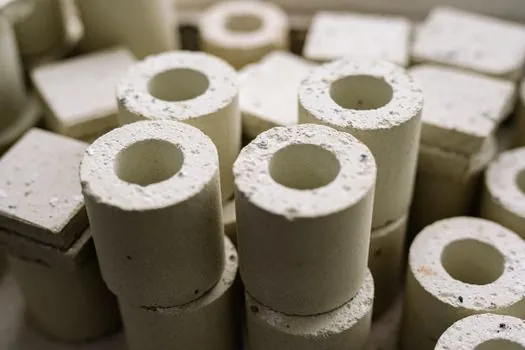
Alumina and alumina-titania plasma-spray coatings are specified for corona-roller insulation with uniform dielectric behavior, for processing and godet rolls in chemical and specialty-fiber lines, for generator-shaft insulation, and for valve balls and seats where low-galling, precision-lapped mating surfaces are required [S3][S5].
Alumina also serves as an electrical-insulation layer with high abrasion resistance, frequently chosen where the coated surface remains visible because the nearly pure white finish reads as clean [S3]. The underlying mechanism for low-adhesive wear on TiO2-coated valve components is that no metallic material is in contact, so there is no opportunity for adhesive wear or galling on lapped ball-and-seat pairs [S3].
Limits, Failure Modes, and Composite Workarounds
Plasma-sprayed alumina's inherent porosity, fracture toughness near 1.5 MPa·m^0.5, and high room-temperature coefficient of friction accelerate wear under extreme conditions and damage the counterbody, limiting service life in plain sliding [S1].
Carbon nanotube additives oxidize at 400 °C, and at 1800-2000 °C the Al2O3-CNT system can form aluminum carbide (Al4C3) via 2Al2O3 + 9C = Al4C3 + 6CO, which degrades the coating, so hexagonal boron nitride (h-BN), stable to 800-950 °C with tensile strength 25-33 GPa and elastic modulus 900-1300 GPa, is being explored as a more temperature-tolerant reinforcement [S1]. Alumina is also a frequent solution for alumina ceramic wear faces where both hardness and electrical insulation are required, while industrial coating selection rules for chemical plants still flag impact, thermal cycling, substrate deflection, and geometry as variables that can override any base-material advantage [S5].
Substrate Prep, Finishing, and Specification Hygiene
Plasma-sprayed ceramic coating performance depends on substrate preparation, coating thickness, in-process parameters, and final surface condition, not just the ceramic chemistry, so HFW and other applicators review the full application, including process chemistry, concentration, temperature, contact type, and prior service life, before recommending a material and process [S5].
As-sprayed alumina-titania texture runs 250-350 microinches aa, ground finishes drop to 10-20 microinches aa, and lapping takes the surface to 2-4 microinches aa, which is the finish window used for seal faces and precision sliding components [S2]. Purity-driven hardness gains, documented in adjacent work, reinforce the rule that higher-purity alumina feedstocks push wear performance higher; see Why Higher Alumina Purity Raises Hardness and Wear Resistance for the trade-off behind the spec.