
Single-piece EV battery trays weighing 25–40 kg with 2.5–4.0 mm wall stock require 2,500–5,000 ton cold-chamber high-pressure die casting (HPDC) machines; sub-2,000 t presses cannot maintain dimensional stability across projected areas above 1.0 m² [S1][S2][S4].
Vacuum-assisted HPDC below 50 mbar is now the default specification for porosity-sensitive sealing surfaces, with reported porosity rates under 0.1% and machined interface flatness of ±0.05 mm on AlSi10Mg trays [S1].
Why Tonnage, Clamping Force, and Shot Weight Set the Floor
Projected area drives clamp tonnage: a 1.0 m × 1.0 m tray demands 2,500–3,500 t, while a 1.2 m × 1.4 m structural pack floor pushes the spec to 4,500–5,000 t at 60–80 MPa injection pressure [S2][S4]. Cold-chamber machines dominate because molten aluminum at 680–720 °C erodes shot sleeves in hot-chamber designs, limiting hot-chamber use to zinc and magnesium [S3].
Shot weight must clear 25 kg to fill a 1 m² cavity with integrated cooling channels and ribbed floors; presses below 20 kg shot capacity cannot complete a single fill before the alloy drops below the 580 °C flow threshold, leaving cold shuts along the perimeter rails [S2]. One supplier benchmark on a 1.0 m × 1.0 m drop-in tray showed cell mid-plane temperatures 12 °C cooler than a welded-steel baseline at WLTP fast-charge, a gain attributed to the one-piece cast shell rather than alloy chemistry alone [S4].
Alloy Selection: AlSi10Mg vs A380 vs ADC12
AlSi10Mg (EN AC-43500) is the European reference for vacuum HPDC battery enclosures, with thermal conductivity in the 96–160 W/m·K range after T6 heat treatment, while A380 and ADC12 remain the North American and Asian volume defaults with 96–130 W/m·K as-cast conductivity [S1][S2][S3]. A380 reaches tensile strength up to 330 MPa in die-cast condition, which suits motor housings more than sealed enclosures, where ductility and weld-line integrity matter more [S3].
For enclosures destined for IP67 or IP69K sealing plus EMI shielding above 60 dB, AlSi10Mg in T6 condition is the cleaner specification, with magnesium content of 0.2–0.45% giving the age-hardening response that ADC12 cannot match [S1][S4].
Process Variant: Vacuum HPDC vs Standard HPDC vs Gravity
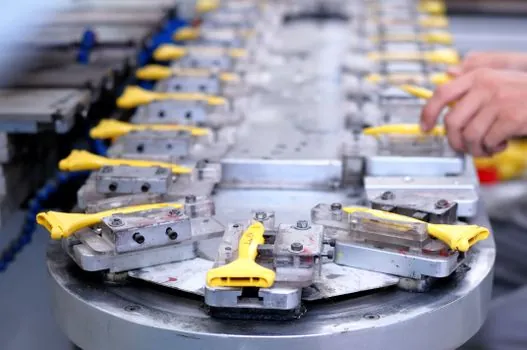
Vacuum-assisted cold-chamber HPDC evacuates the cavity to under 50 mbar before injection, which is the spec that consistently delivers porosity under 0.1% on machined sealing flanges and is now standard for battery trays and inverter housings [S1][S3]. Standard (non-vacuum) HPDC still works for non-sealing structural brackets where porosity in the 0.5–2.0% range is tolerable, but cannot be specified where leak-testing at 30 kPa pressure differential is required [S1][S4].
Gravity die casting is a fallback for low-volume prototype trays and for components that need higher mechanical properties than HPDC delivers, but cycle times of 8–15 minutes versus HPDC's 60–120 seconds rule it out for any program above 20,000 units/year [S3]. For a structural chassis component program running at 50,000+ units, vacuum HPDC remains the only path; for a similar 1–2 m battery tray shell, the same logic applies, and the machine spec overlaps heavily with aluminum die casting machine selection for thin-wall electronics enclosures on shot dynamics.
Critical Machine Specs Beyond Tonnage
Real-time injection control with closed-loop profiling to within ±5 bar of setpoint is required to keep fill velocity at 2.5–4.0 m/s and intensification pressure above 60 MPa, the window that prevents both air entrapment and cold shuts [S1]. Platen size must accept 1,400 mm × 1,800 mm or larger moulds, with tie-bar spacing above 1,600 mm to clear perimeter rails and slider cores for mounting bosses [S2].
Thermal management of the die itself matters: oil-temperature-controlled cooling circuits on the fixed and moving halves, plus hot-spot zone control on the perimeter rails where 4 cross beams concentrate heat, are non-negotiable on a 5,000 t machine cycling at 90-second intervals [S1][S2]. For program planning, mould lead time is 16–18 weeks for die-cast aluminum tooling versus 10–12 weeks for stamped steel, a gap that has to be built into the sourcing schedule from the design-freeze milestone [S4].
Supplier and Quality Gate Checklist
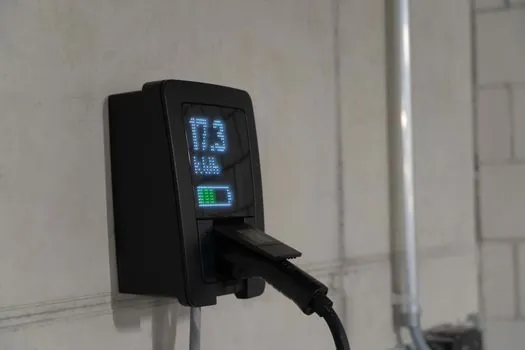
Before issuing a PO, verify that the supplier's press list includes machines above 3,000 t with shot weight above 40 kg, and that they can run CT (computed tomography) scanning for every PPAP lot rather than only sampled X-ray inspection [S2][S4]. ISO 9001 plus IATF 16949 certification with pack-scope coverage (not just general automotive scope) is the minimum; suppliers running only 80–800 t presses cannot be qualified for a 1.0 m² single-piece tray no matter how good their CNC post-processing is [S2][S4].
In-house leak testing at 30 kPa differential, dimensional CMM on machined sealing flanges, and X-ray or CT porosity reporting per lot are the three quality gates that have to be visible in the supplier's PPAP package [S2][S4]. The same machine class shows up on programs as varied as a large gearbox casing and a structural chassis component, where 2,500–4,500 t cold-chamber HPDC and AlSi-family alloys recur as the common spec; the motor-housing variant of the same selection problem is laid out in aluminum die casting machine selection for motor housing castings.
When an Aluminum Die Casting Machine Is the Wrong Choice
Die-cast aluminum is the wrong specification for prototype runs below 5,000 units where mould amortization cannot be recovered, for enclosures that need optical-grade surface finish without secondary painting, and for any cell-to-pack design where the housing doubles as a structural load path requiring forged-aluminum ductility above 12% elongation [S1][S3][S5].
CNC-machined billet enclosures win on lead time for sub-2,000 unit programs and on weld-free hermeticity for aerospace or military battery packs, but lose decisively on part count, weight, and thermal conductivity for any volume passenger-EV program [S3]. Hybrid designs (extruded rails welded to a die-cast central plate) sit between the two, useful where the central plate carries the cooling circuit and the rails take the crash energy, but they reintroduce 3–5 weld seams that the single-piece HPDC approach exists to eliminate [S4].
The next signal to watch is the supply-side expansion of 6,000–9,000 t mega-presses, which would let programs specify a full pack floor in one shot rather than the current 1.2 m × 1.4 m max envelope, plus the revision of IATF 16949 audit criteria covering CT-based porosity reporting on safety-critical castings.
Component reference pages worth checking: aluminum die casting machine, die casting machine, and gravity die casting machine.