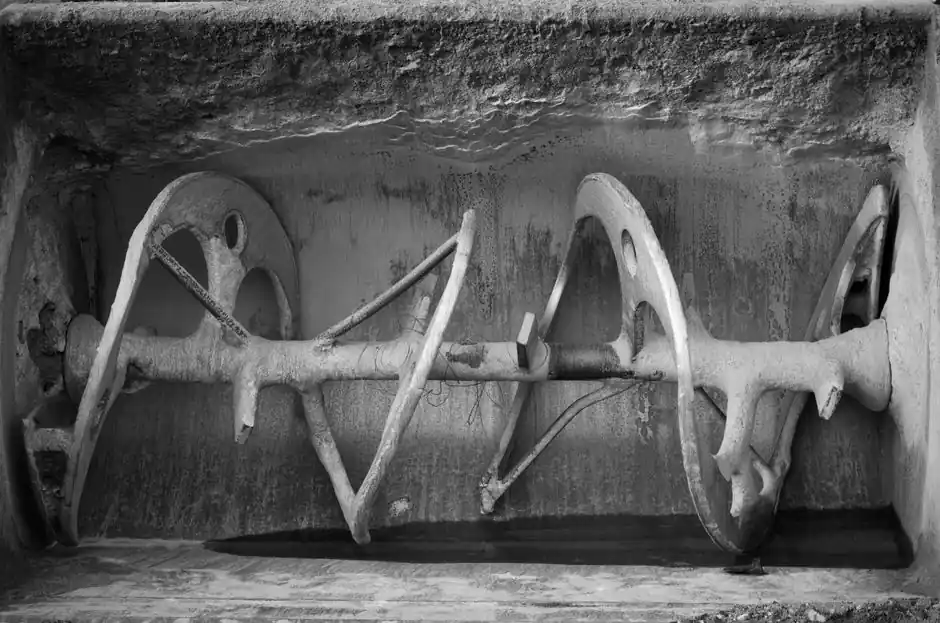
An aluminum gearbox casing is sized first by the part, not the press: pick the smallest cold-chamber HPDC that simultaneously passes projected-area clamp demand, total shot weight, die envelope, and injection profile, with the typical envelope for large housings landing in the 800 to 1600 t clamp-force band [S5][S6].
The casing has to hold bearing bores to tight positional tolerances, seal oil under thermal cycling, and survive NVH loads, so the casting process has to deliver as-cast dimensional repeatability of about plus or minus 0.1 to 0.3 mm with subsequent CNC machining finishing bearing seats to H7 [S7]. Aluminum remains the default because it combines low density, thermal conductivity around 96 W/m.K for A380-family alloys, and enough castability for ribbed, ported, multi-bore housings [S2][S3].
What the Casing Has to Deliver, and Why That Drives Machine Choice
A gearbox housing has to provide structural stability for gear and bearing loads, dimensional accuracy for shaft center distances, sealing reliability against lubricant leakage, and thermal performance to dissipate heat; failing any of these introduces NVH, leakage, or shortened service life [S3]. Those four duties translate directly into machine-level requirements: clamp tonnage for projected area, shot weight for the full casting plus biscuit and runners, injection velocity and pressure for rib filling at the local wall thickness, and die-stability for joint flatness [S5].
For a large casing the projected area commonly drives the machine above the 800 t mark, while a typical 4 mm average wall with local sections above 9 mm creates hot spots that demand intensified die cooling, and a benchmark acceptable cross-section porosity not higher than 5% with pore size not above 3 mm [S1]. The interaction of thick-to-thin transitions, oil-passage coring, and leak-test acceptance is the reason process simulation (Magmasoft or equivalent) and high-pressure point cooling are now standard on these housings, not optional [S1].
Alloy and Process Routes Compared for Large Housings
For high-volume structural housings, A380 is the workhorse for general-purpose castability, A383/ADC12 is preferred for thin-wall or geometrically complex automotive transmission parts, A360 adds corrosion resistance and ductility for harsher environments, and AlSi10Mg delivers higher mechanical performance when tighter process control is available [S3]. European passenger-car gearbox programs lean on AlSi9Cu3 with a target shrinkage of 6 per mil, while A356 in T5 or T6 is the typical gravity or sand-casting option when heat-treated mechanical properties outweigh cycle time [S1][S2].
The four casting routes line up against the program needs as follows: HPDC for medium-to-high volume near-net-shape housings with thin walls and short cycles, gravity or permanent-mold for heat-treated structural parts in A356, sand casting for prototypes and low-volume large housings where permanent tooling is not economical, and low-pressure casting as a hybrid option for thicker-walled premium housings [S2]. A buyer comparing the options should score tooling cost, annual volume, achievable mechanical properties, machining stock, and total finished-part cost, rather than choosing on casting price alone [S2].
Sizing the Press: Clamp, Shot, Die Envelope, and Injection
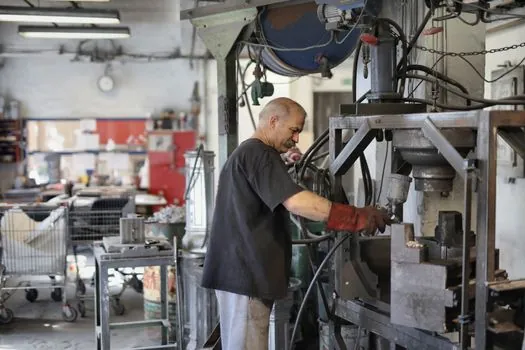
Clamp tonnage is set by projected area times a pressure basis, typically in the 40 to 80 MPa range depending on part geometry, gating, and alloy; a large housing with a 1500 to 2500 cm squared projected footprint therefore lands in the 800 to 1600 t band [S5][S6]. Total shot weight has to cover the casting, biscuit, runner, and overflows with a fill ratio commonly held under 80% to avoid air entrainment, which for a 6 to 12 kg casting pushes the cold-chamber shot capacity into the 10 to 16 kg range [S5].
Die envelope is the second silent constraint: tie-bar clearance, die height stroke, and ejection stroke have to clear the housing's bearing-bore machining datums and the side core-pulling mechanism that a ribbed, ported gearbox shell always needs [S1]. The injection stage matters as much as tonnage: intensification pressure above 80 MPa and plunger velocities around 3 to 5 m/s are typical for filling 4 mm walls in AlSi9Cu3 without cold shuts, and the response time of the accumulator system sets the practical ceiling on shot weight and intensification pressure together [S1][S5]. A 4-axis real-time shot control system with closed-loop velocity and pressure profiling is now baseline for these housings because of how directly it affects porosity [S6]. For a deeper dive into the metal-side controls that interact with the machine, see the notes on A356 melt and die temperature control.
Cell-Level Specs Buyers Should Write Into the RFQ
A press-only RFQ leaves too much risk on the table for a large housing; the cell spec has to call out the shot-end configuration, vacuum or evacuation option for the die cavity, leak-test station with pressure and decay thresholds, automated trimming, and the CNC machining cell that holds bearing-bore position and cylindricity inside the H7 envelope [S5][S7]. Vacuum-assist HPDC is now the norm for housings with porosity targets under 5% because it removes entrained air that would otherwise show up as leak paths in the oil galleries [S1][S5].
For background on how aluminum and zinc machine pricing diverge once the tonnage and shot package are fixed, the aluminum vs zinc die casting machine price and cost drivers breakdown covers the BOM logic. Buyers specifying the cell should also confirm: real clamping force with a pressure-trace record, platen parallelism under full tonnage, dry-cycle time, and a documented OEE acceptance run on a representative die before sign-off [S5].
Common Failure Modes and How to Pre-empt Them
Porosity and leakage are the recurring defects on large gearbox housings, and both trace back to the same root: inadequate intensification pressure combined with local thick-to-thin transitions that starve the die of cooling [S1]. The fix is rarely a larger machine; it is targeted high-pressure point cooling at the leak-prone location, validated by industrial CT, and gated behind a Magmasoft-style fill-and-solidification simulation run during die tryout [S1]. Cold shuts typically point to low melt temperature, slow shot velocity, or premature slowdown; the countermeasure is a verified injection profile, not a tonnage upgrade [S1][S3].
Distortion after trim and during machining is the third failure class and it is driven by uneven residual stress from non-uniform wall sections; the preventative is to hold average wall near 4 mm, route thick bosses through ribs rather than mass, and anneal or stress-relieve the casting where the drawing allows [S1][S3]. Buyers should also write the leak-test medium, pressure, and dwell time into the drawing rather than leaving it to the foundry's default, since the same housing will pass an air-under-water 0.5 bar test and still leak under gearbox oil at 80 degrees C [S3].
Selection Criteria Side-by-Side
Three press classes are typically considered for a large aluminum gearbox casing; the comparison below lines up the decision criteria that matter in practice. The 500 to 800 t band suits smaller e-axle covers and reducer housings under roughly 4 kg shot weight, the 800 to 1250 t band is the workhorse for a 6 to 9 kg housing with a 1500 to 2000 cm squared projected area, and the 1250 to 1600 t band is reserved for the largest single-piece housings above 9 kg shot weight or where vacuum-assist and intensified cooling drive the cycle above the mid-tier press's stable window [S5][S6]. Across all three, the dominant cost driver is shot weight, then clamp tonnage, then platen size and tie-bar clearance; specifying a press that is one size larger than the calculation gives a comfort margin, but specifying two sizes larger wastes 15 to 25% of capex without quality gain [S6].
The RFQ that consistently returns comparable bids lists: alloy and temper, projected area and shot weight with fill ratio, wall-thickness map, accepted porosity and leak-test thresholds, die envelope including side cores, vacuum or evacuation requirement, injection profile targets, and the CNC acceptance class for bearing bores and joint faces [S2][S3][S5]. A drawing that arrives without those eight items forces the foundry to assume, and the assumptions always favor cycle time over the buyer's leak rate.
Standards, Sourcing Discipline, and What to Verify Next
Gearbox housings do not sit under a single product standard the way a pressure vessel does; they inherit specifications from the OEM's drawing, the gearbox company's internal acceptance, and the relevant casting standard for the alloy (ASTM, EN AC, or JIS designations depending on the supply region) [S2]. International alloy designations such as LM4/A319, LM21/A308, and ADC12 are not automatically interchangeable across regions; chemistry, mechanical properties, heat treatment, and applicable specifications have to be confirmed before approving a substitute grade [S2]. For defect limits, the practical ceiling cited in published gearbox-housing work is cross-section porosity not higher than 5% and pore size not higher than 3 mm, verified by industrial CT on first-articles and sampled on serial production [S1].
To move from selection to PO, track three signals over the next procurement cycle: whether the supplier's first-article CT scan shows porosity inside the 5% limit, whether leak-test reject rate stays under 0.5% over the first 5,000 parts, and whether the as-cast dimensional Cpk on bearing-bore stock holds above 1.33 with the chosen press and die package. For an overview of how the machine type itself compares against other foundry routes for these housings, the die casting machine reference page covers the cold-chamber versus hot-chamber split, and the aluminum die casting machine page covers the alloy-specific envelope, while the broader vacuum die casting machine entry documents the evacuation option that large gearbox housings now typically require.