For a heat-sink casting, the machine decision is not about tonnage alone: it hinges on clamp force, plunger speed profile, die-temperature control, and the ability to fill sub-1 mm fins. Cold-chamber aluminum die casting machines running alloys A380, A356, ADC12, and A383 are the baseline, and published research confirms that 0.5 mm thin fins with 50 mm fin height are reproducible on a properly tuned cold-chamber cell [S3].
Heat-sink geometry is geometrically aggressive (high aspect-ratio fins, integral mounting features) and thermally demanding, so the machine envelope must support multi-cavity dies, fast shot, and high die-temperature stability. For reference on how these machines are classed, the die casting machine overview covers tonnage, shot size, and cold- versus hot-chamber architecture.
Alloy Selection Sets the Machine Envelope
A380, A356.0, ADC12, and A383 are the workhorse alloys for die-cast heat sinks, while pure aluminum (1xxx series) is now experimentally castable into thin fins when plunger speed and die temperature are matched to flow-length data [S1][S3][S5]. Of these, A380 is the most widely cited general-purpose alloy; A356.0 is preferred when corrosion resistance and weldability matter; ADC12 (the Japanese JIS equivalent) is common in Asia-Pacific LED supply chains; A383 is used as a fluid-flow alternative when filling thin walls [S3][S5].
Thermal conductivity drives the alloy choice. Wrought 6061/6063 extrusions sit near 200 W/mK, while typical die-cast aluminum alloys land lower, with pure aluminum providing the highest bulk conductivity among die-castable options [S1][S3]. Magnesium heat sinks are roughly 35% lighter than aluminum and can match aluminum dissipation efficiency at optimized fin geometry; zinc gives the highest conductivity per volume but is generally excluded from weight-sensitive electronics due to density [S2]. Where field corrosion is a concern, die cast Al 360 is specified as a corrosion-resistant alternative with above-average conductivity [S2]. For purely LED-form-factor sinks cast on standard cold-chamber cells, the aluminum die casting machine class is the default match.
Machine Class: Cold-Chamber Versus Hot-Chamber
Aluminum die-cast heat sinks are produced on cold-chamber die casting machines because molten aluminum attacks iron-based components at the injection sleeve; hot-chamber machines are reserved for zinc, magnesium, and lead alloys [S2][S4]. A typical cold-chamber heat-sink cell holds the metal in a separate ladle, then injects it into a closed die under high hydraulic pressure, with the two die halves locked together by the clamping unit [S6].
Within aluminum, three sub-categories of machines matter for heat-sink buyers: standard cold-chamber (the LED and automotive-electronics default), vacuum die casting machine cells (used to reduce porosity in dense integral-fin sinks), and high-pressure variants with real-time shot profiling. Where weight is critical and the volume is high, magnesium die casting machine cells are also evaluated, since a 35% mass reduction versus aluminum is achievable at comparable thermal-diffusion performance when fin geometry is optimized [S2].
Shot-End and Clamp Sizing for Heat-Sink Geometry
Heat-sink dies are fin-dense and thin-walled. Published experimental work cast pure aluminum fins with a top thickness of 0.5 mm, fin height of 50 mm, and a 0.5° draft angle, with thin-and-tall fins fully filled when plunger speed and die temperature were set to values that differ from conventional die-casting intuition [S3]. That single data point reframes machine selection: a sink buyer must ask the foundry for documented plunger-speed and die-temperature envelopes, not just clamp tonnage.
Clamp force is driven by projected area and injection pressure. For thin-fin heat-sink dies with a 0.5 mm fin gap, slow first-phase shot followed by an intensifier-driven second phase is the typical profile; this is mechanically delivered by aluminum die casting machine hydraulic sizing for fast shot speed, which is the practical limit on how thin a fin can be filled before the melt freezes. Foundries running porous-sensitive parts (such as heat-sink bases for high-brightness LED modules) often move to vacuum-assisted cold-chamber cells to drop entrapped-gas porosity below the level that hurts thermal interface conductance.
Material Behaviour: Porosity, Conductivity, and Surface
Die cast aluminum heat sinks deliver a one-piece, integral-fin body, so the thermal path from the heat source to the fin tip avoids the bonded-interface resistance that limits stacked or skived-fin constructions [S4]. The trade-off is bulk conductivity: a typical die-cast aluminum alloy lands below the 200 W/mK that 6063 extrusion reaches, so the part compensates with surface area, fin count, and forced airflow [S1].
For LED street-light and high-bay applications, die cast aluminum is the standard because the geometry (mounting boss, fin field, driver cavity) can be net-shape cast in a single shot, eliminating downstream machining [S4][S5]. Practical porosity control on these cells is treated separately under Die Casting Porosity Reduction: Process Data Analytics and Control Thresholds, which is a useful companion reference for buyers writing porosity acceptance criteria into a heat-sink PO. For tool life, the die is typically H-series hot-work steel, and H-13 Hardness Targets and Thermal Fatigue in Aluminum Die Casting Dies walks through the H-13 working hardness range and the thermal-fatigue modes seen in high-volume heat-sink dies.
Comparison: Die Cast Versus Extruded Versus Cold Forged Heat Sinks
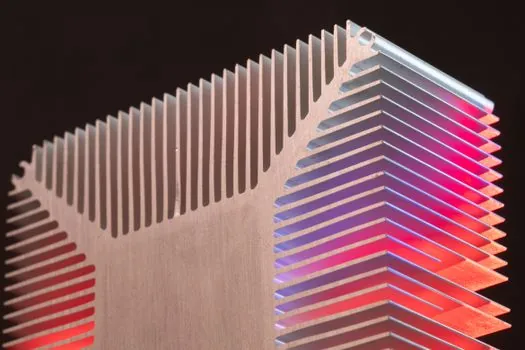
Selection is a four-criteria decision: thermal conductivity, geometric complexity, unit cost at volume, and weight. Extruded 6061/6063 aluminum gives the highest bulk conductivity (about 200 W/mK) but is limited to linear fin profiles, since the part is pushed through a fixed die [S1]. Die cast aluminum (A380, A356, ADC12) accepts complex 3D geometry and integral mounting features, ships near-net-shape, and wins on cost per part at high volume, with lower bulk conductivity as the trade [S1][S5]. Cold-forged aluminum is denser and stronger but constrained to axisymmetric or near-axisymmetric forms [S6].
On a like-for-like heat-sink program, the rule of thumb is: extruded for high-conductivity straight-fin designs in computer, audio, and telecom cooling; die cast for complex, high-volume parts in LED street lights, automotive electronics, stadium lighting, and power supplies; cold forged for compact sports-lighting and portable devices where mechanical robustness is critical [S1][S4][S6]. Magnesium die cast lands in the same die-cast complexity tier as aluminum but with a documented 35% mass reduction, and is selected when weight is the primary design driver [S2]. For lower-volume programs with simple 2D fin profiles, extrusion remains the cost winner because the die cost is amortized across shorter runs and the higher thermal conductivity can reduce fin count [S1].
Use Cases and Sourcing Signals
LED canopy retrofits and stadium-lighting retrofits are documented high-volume die-cast aluminum heat-sink applications: the University of Phoenix Stadium LED retrofit cut lighting energy from about 1,240 kW to roughly 310 kW, about a 75% reduction, and the cast heat sink was the thermal-management enabler [S4]. Solar-energy heat-sink programs similarly lean on aluminum die casting for thin-wall finned enclosures, with thin-wall filling being the consistent production bottleneck [S1].
For buyers evaluating suppliers, three trackable signals matter: (1) whether the cell is certified to a quality program such as ISO 9001 and what the documented defect rate is on thin-fin SKUs [S5]; (2) whether the foundry can quote porosity and conductivity test data on production heat-sink coupons, not just prototype samples; (3) whether the die-casting machine is dedicated to a heat-sink part family or shared across product mixes, since high-mix cells tend to drift away from the narrow plunger-speed / die-temperature window needed for sub-1 mm fins [S3]. Where a new heat-sink program demands magnesium, sourcing a gravity die casting machine cell as a pilot before committing to high-pressure die casting is a common path, and zinc programs should be evaluated on a zinc die casting machine class cell rather than retrofitted onto an aluminum line.
For procurement and process engineering, the next node to track is the foundry's published flow-length data for the specific fin thickness in the RFQ; if that data is missing or the foundry cannot share it, the cell is the wrong cell for a sub-1 mm fin heat sink. A second trackable signal is NADCA Product Specification Standards alignment on the heat-sink part drawing, since that standard governs dimensional and alloy callouts and reduces ambiguity at incoming inspection [S2].