
Aluminum extrusion profiles are categorized first by alloy family and temper, then by section geometry and surface treatment, with 6063-T5 holding the largest share of architectural and decorative orders and 6061-T6 commanding industrial structural work where tensile strength climbs to roughly 310 MPa versus 6063-T5 at about 185 MPa [S2].
The 6000-series (Al-Mg-Si) is the universal extrusion family, followed by 2000 (Al-Cu) and 7000 (Al-Zn-Mg-Cu) for higher-strength niches; standard widths sit below 300 mm with minimum wall above 0.8 mm to keep the die flow and surface finish within spec [S2][S7].
Alloy and Temper Decision Matrix
6063-T5 profiles extruded under GB 5237.1-2008 deliver yield strength near 145 MPa, elongation 8 percent, and surface quality suitable for anodizing, which is why they dominate window, door, curtain wall, and T-slot framing [S2][S10]. For heat sinks, the higher copper-bearing 6061 alloy, often machined from extruded stock, raises thermal conductivity while keeping weight below one-third that of a steel equivalent [S7][S10].
Specialized 2000 and 7000 grades — 2024 and 7075 — are routed to CNC-machined mechanical parts where strength-to-weight rules out 6063, and a Chinese supplier (Langle) explicitly markets 6061/7075/2024 turning stock alongside its 60-series T-slot line [S7]. Temper selection follows end use: T4 for forming-and-bending fabrications, T5 for air-cooled artificial aging on architectural profiles, T6 for solution-treat-and-age on structural components, with a "T5/T6 or other special status" callout confirming the temper menu on industrial catalogs [S2].
Section Geometry Categories
Standard sections separate into four geometry buckets: solid bar and rod, semi-hollow (one closed void), hollow (multi-void), and large custom cross-sections, the last category being where press capacity dictates feasibility — for example, 6063-T5 large cross-section mill-finish profiles used in machine and building frames are quoted by tonnage rather than length [S5].
Modular T-slot framing — the 20/30/40/45/60-series family — runs on standardized slot pitch (typically 6, 8, 10 mm) and a connector ecosystem of more than 3,000 components per Ruituo's catalog, so the same profile line covers workbenches, machine guards, conveyor rails, and anti-static workstations [S4][S7]. Specialized sections include heatsink extrusions with parallel fin arrays for LED and power-electronics cooling, and synchronizing-wheel hubs cut from round bar stock for automation [S7][S10].
Surface Treatment Options
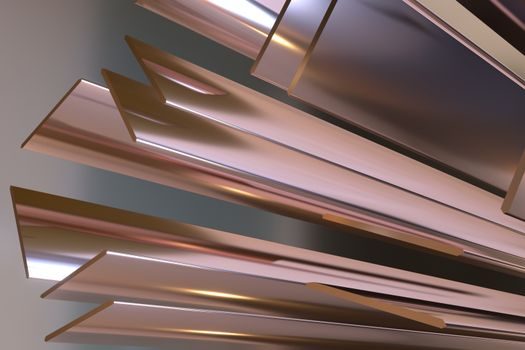
Mill finish, anodizing, powder coating, wood-grain transfer, electrophoresis, PVDF fluorocarbon, and heat-insulation pouring (pouring rubber strips into the chamber to break the thermal bridge) are the seven standard finishes listed on Chinese extrusion catalogs, and each is gated by a downstream process step after extrusion [S2]. Powder coating thickness on curtain-wall profiles is typically 60–120 µm verified by coating-thickness gauges, while anodized film for architectural use is set at AA10 or AA15 per the supplier Q&A [S2].
Heat-insulation (thermal-break) profiles pour a polyamide or polyurethane strip into the profile chamber to interrupt the conductive path, producing a "compact structure, artful appearance, lighting area, high strength, high heat insulation, high material ratio" effect per the Okorder technical Q&A, and these are now standard on 60-series insulating window systems (section size roughly 60 × 53.5 mm, window 67.8 × 68.6 mm) [S2].
Construction, Industrial, and Decorative Applications
Architectural deployment covers windows, sliding doors, hinged doors, curtain walls, kitchen cabinet framing, wardrobes, and interior decoration; the same Jiahua Aluminum line (Foshan) lists eight product families including window-and-door, curtain wall, kitchen cabinet, wardrobe, standard profiles, CNC profiles, heatsink, and T-slot under one roof [S10]. For a deeper primer on how alloy choice shifts in building skins, see the aluminum veneer panel reference and the broader aluminum window and door entry.
Industrial deployment is the second volume center: heatsinks for inverters and LEDs, modular framing for production lines, security fencing for factory perimeters, and aluminum ladders — Jinmeicheng lists finned tubes, charging rooms, and ladders as co-products with extruded profiles, all in 6000-series stock [S3]. Mechanical-engineering uses (machine frames, conveyor structures, workbenches) draw on 6063-T5 large cross-section with 2000+ plant-area extrusion capacity at suppliers like Renqiu Zhongsheng, whose MOQ is 1 ton and quoted price US$3,100–3,300 per ton [S3]. On the aluminum ladder category page the alloy logic for telescoping and platform ladders is laid out in more detail.
Production Flow and Quality Checks
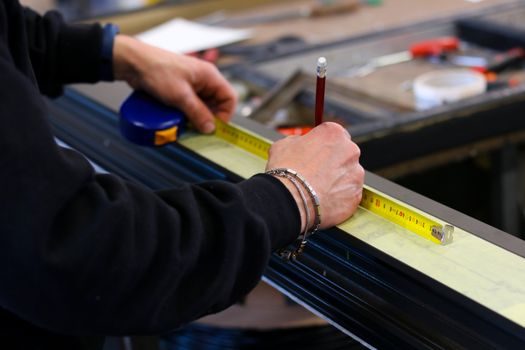
The canonical extrusion flow runs ingot → melting and casting → extrusion → powder coating → pouring rubber for heat insulation → check-out → packing → PVDF or anodizing or electrophoresis → warehouse, matching what Ruhlamat (German-owned, Suzhou) and CNBM (via Okorder) describe on their production pages [S2][S9]. Tensile properties, hardness, and coating thickness are the three mandatory test items for curtain-wall profile acceptance per the same Okorder technical Q&A [S2].
Supplier audits in 2026 listings consistently show ISO 9001:2015 plus ISO 14001 and ISO 45001:2018, with Shandong Nuolin Hengxin and Renqiu Zhongsheng both holding the trio of management certifications on a 2000+ m² plant footprint [S3]. Third-party automation is also visible: Ruhlamat's Suzhou subsidiary supplies extrusion handling and CNC automation to the same downstream mills it sells profiles alongside, indicating the upstream equipment and downstream product sit on a single engineering chain [S9]. For a process-level view of the casting side, the gas aluminum melting furnace entry maps furnace design parameters, while die-casting machine selection is the natural cross-reference when a part geometry exceeds what extrusion can release from the die.
Selection Criteria, Limits, and Sourcing Bands
Pick 6063-T5 when the priority is surface quality and anodizing response; switch to 6061-T6 when ultimate tensile nears 310 MPa or machining stock is needed; jump to 7075-T6 only when the section will see aerospace-grade fatigue loading, because the higher Zn content compromises corrosion resistance and extrudability [S2][S7]. A useful comparison — 6063-T5 vs 6061-T6 vs 7075-T6 — on four decision criteria:
(1) Tensile strength: roughly 185 MPa / 310 MPa / 572 MPa respectively; (2) Anodizing response: 6063 best, 6061 acceptable, 7075 poor; (3) Extrusion complexity: 6063 highest, 6061 moderate, 7075 lowest (often replaced by drawn bar); (4) Cost per ton on current Made-in-China listings: 6063 around US$3,100–3,300/ton, 6061 around US$3.38/kg, 7075 specialty items quoted by piece [S3].
Spec boundaries to enforce on drawings: minimum wall 0.8 mm, maximum width 300 mm, temper code T4/T5/T6 explicitly stated, surface finish per GB 5237.1-2008 for Chinese architectural supply, and inspection per ISO 9001:2015 supplier audits [S2][S3]. For platform framing inside factories — mezzanine floors, machine bases, conveyor supports — the mezzanine platform type map lays out load classes, and many of those structures sit on an aluminum-extrusion sub-frame rather than welded steel.
Trackable signals to watch over the next two quarters: GB 5237 revision activity, additional Chinese extruders adding 7000-series capacity, and any 60-series T-slot vendors publishing load-class data in kN per meter, since today's catalogs quote component counts (3,000+ accessories) rather than structural ratings [S4][S2].