
Medium-frequency induction melting furnaces in the 250-2000 kg per-batch class dominate the spec sheets of Chinese OEM Hengyang for aluminum, copper, and cast iron production relevant to telecom enclosure casting [S2].
Telecom enclosure buyers (cabinets, heat sinks, EMI/RFI shields, pole-mount housings) sit at the intersection of die-cast aluminum, extruded aluminum, and occasional cast iron or copper busbar work, so furnace selection is a multi-alloy decision rather than a one-furnace-fits-all call.
Why a Melting Furnace, Not Just a Casting Cell
A telecom enclosure shop that runs its own melt shop needs a furnace matched to alloy family, melt rate, and the cleanliness of the cast surface that feeds into CNC machining or powder-coating [S2].
In-house melting gives the foundry control over alloy chemistry (A380, A383, 6061 modification for extrusions) and over inclusion levels that affect IP-rated gasketing surfaces, which is why Hengyang and similar Guangdong suppliers list multiple furnace classes on a single product page [S2].
Alloy Map: Aluminum, Copper, Cast Iron, Stainless
For telecom enclosure work, the dominant alloy is die-cast aluminum (A380 family) for housings and copper for busbar and ground bars, with stainless or cast iron appearing only in structural base frames or pole-mount brackets [S2].
Each alloy dictates furnace lining (silicon carbide for aluminum, magnesia for copper, silica/alumina for iron) and coil frequency: medium-frequency (200-3000 Hz) for aluminum and copper, mains-frequency coreless (50/60 Hz) for larger iron and steel melts [S1][S2].
Capacity Classes and Throughput Math
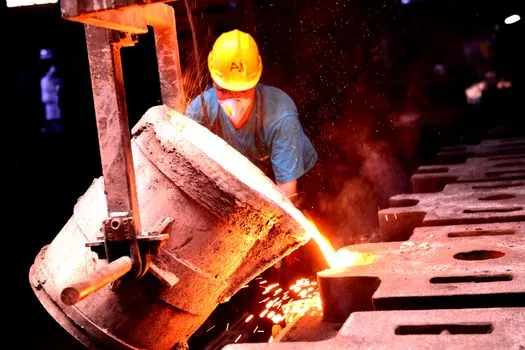
Hengyang lists 250 kg, 500 kg, 1000 kg, 1500 kg, and 2000 kg as standard induction melting furnace sizes for copper, aluminum, steel, and iron production, with MOQ of 1 piece on made-in-china [S2].
For a telecom enclosure cell running two 8-hour shifts, a 500-1000 kg furnace typically yields 4-6 melts per shift at roughly 1-hour cycle time, which is the throughput band most enclosure fabs size their casting cells around [S2][S4].
Power Topology: SCR Parallel vs Series Inverter
SCR-parallel intermediate-frequency (IF) furnaces and series-inverter IF furnaces are the two main topologies on the market, with one-to-two configuration (one power supply feeding two furnaces) a common energy-saving arrangement listed by Chinese suppliers [S4].
For telecom enclosure production, SCR-parallel IF is the workhorse because it tolerates variable load and partial melts between batches, while series-inverter is more efficient at steady-state full-bath operation [S4]. A new energy-saving series-inverter family from Chinese OEMs explicitly markets the one-to-two power-sharing configuration for smaller foundry cells [S4].
Vacuum Induction: When It Earns Its Cost
Vacuum induction melting furnaces (VIM) are used when the alloy is reactive or the application demands low gas content; the technology is a well-defined sub-family in both Chinese and English reference material [S1].
For telecom enclosures, VIM is normally over-spec: a sealed nitrogen or argon cover on a standard IF furnace is usually enough to keep hydrogen pickup down for A380 die castings, and VIM is reserved for the specialty alloys that the enclosure supply chain rarely touches [S1].
Pairing Furnace with Casting Unit
Semi-continuous casting units (screw-type for rod, vertical for billet and strip) are commonly paired with medium-frequency melting furnaces in Chinese foundry offerings, with copper strip semi-continuous casting lines in the 1200 x 650 mm size class listed as standard products [S5].
For telecom enclosure fabs, the relevant pairing is usually a 500-1000 kg IF furnace feeding a vertical billet caster (for extrusion billets going into 6061 heatsink profiles) or directly into a die-casting machine (for A380 housing shells) [S2][S5].
Supplier and Sourcing Map
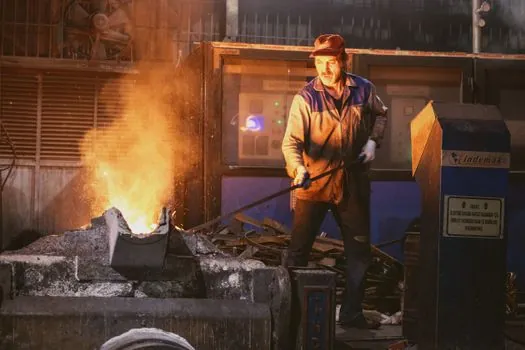
Guangdong Hengyang Furnace Manufacturing (Jiangmen, Zhishan Town) is a Diamond Member since 2012 on made-in-china, with 6 foreign-trading staff and 40 supply-chain partners, exporting mainly to domestic China and West Asia [S2].
For North American telecom enclosure buyers, AMELT (Toronto) lists custom induction melting furnaces including aluminum, copper, and iron casting units as a regional alternative, though the public page was returning HTTP 403 at crawl time, so direct quotation is required [S3].
Limitations and Failure Modes
Common failure modes in IF furnaces for aluminum and copper melts include coil water-leak from dissolved hydrogen in the cooling loop, refractory wear at the slag line after 200-400 heats, and thyristor stack failure in SCR-parallel units under repeated partial-load cycling [S2][S4].
Buyers specifying furnace IP rating (e.g. IP54 control cabinet for dusty foundry floors) and refractory supplier pre-qualification typically avoid the most common warranty disputes, and they should require a documented cold-start to full-melt cycle time in the FAT (Factory Acceptance Test) [S2][S4].
Decision Criteria Comparison
For telecom enclosure production, the four main furnace options line up as follows on selection gates: medium-frequency IF (best fit for aluminum and copper, 250-2000 kg, 1-2 hour cycle) [S2]; mains-frequency coreless IF (larger iron and steel melts, lower Hz, larger bath) [S1]; vacuum induction melting VIM (low gas content, specialty alloys, high capex) [S1]; and resistance or gas-fired crucible furnaces (small batch, low capex, slower cycle, higher emissions) per the broader crucible furnace class.
For typical telecom enclosure volumes (50-500 kg of aluminum per hour at steady state), medium-frequency IF is the lowest total-cost-of-ownership option and lines up with the induction furnace category that dominates Chinese OEM catalogs [S2][S4].
Related Reading and Trackable Signals
Furnace selection for telecom enclosure production overlaps directly with the broader melting furnace selection for hardware manufacturing spec map, and buyers running mixed aluminum-and-steel cells should also read the melting furnace selection for automotive parts reference for alloy-and-throughput benchmarking. [S2]
Trackable next signals: (1) revisions to GB/T 25139 foundry furnace energy-efficiency standards, which Chinese suppliers cite in their product datasheets; (2) IEC 60079-series updates that may push enclosure shops toward lower-emission electric melting, replacing gas-fired crucible units; (3) SCR-parallel IF retrofit pricing trends at the 500-1000 kg class through 2026-Q4 as one-to-two inverter configurations become more common [S2][S4].
Spec-level background on the components involved: melting furnace.