
Industrial aluminum extrusion profiles from audited Chinese mills in Shandong cluster at US$3,100–3,500 per tonne at 1-tonne MOQ on the Made-in-China B2B portal, captured 2026-06-04 [S1]. The same portal indexes 1,500–3,000 USD/set container-house packages built around industrial aluminum tube frames, sourced from Guangdong audited suppliers and snapshotted 2026-05-11 [S2]. Together these two data points frame the 2026 spot-market shape for Asian-origin commodity aluminum: extrusion billet still priced per tonne, structural tube increasingly bundled into prefabricated building kits rather than sold as loose meterage.
Downstream, the capital-equipment side of the chain is dominated by reheating, melting and refining furnace rebuilds, with OEMs such as Andritz explicitly offering preheat pushers, pit furnaces, car-bottom, auto-batch, fuel-fired and electric units for solid-aluminum processors [S4]. On the marketing side, ALUMINIUM Düsseldorf continues to act as the global hub, with the organizer running both ALUMINIUM China in Shanghai and ALUMINIUM USA in Nashville on a two-year cycle [S3]. Buyers planning 2026 sourcing should triangulate spot extrusion tonne-pricing [S1], structural-tube supply chains inside the container-house segment [S2], and the furnace-retrofit engineering channel [S4].
Extrusion profile spot pricing: US$3,100–3,500/tonne band, 1-tonne MOQ
Deteng Aluminum (Qingdao) Co., Ltd., a Diamond Member audited supplier in Shandong, lists "Factory Price Custom Aluminum Extrusion Profile for Construction and Industry" at US$3,100.00–3,500.00 per tonne at 1-tonne MOQ as of 2026-06-04 [S1]. A separate Shandong vendor — Rational Construction Material — posts "Hot Sale China Industry Cost Price Aluminum Industrial Aluminum Profiles" inside the same US$3,100.00 band, also at 1-tonne MOQ on the same portal [S1]. The 400 USD/tonne spread between the two quotes is unusually wide for an industrial profile and typically signals differences in alloy family, billet source, surface treatment and dimensional tolerance rather than a true market dislocation.
For B2B buyers, the practical read is that 2026 spot extrusion from Eastern Chinese mills is still quoted on a per-tonne basis with low MOQs, not on per-piece or per-meter pricing typical of finished architectural systems — a fact that matters when comparing aluminum alloy billet offers against finished aluminum window and door assemblies, where the same kilogram of metal carries very different labour and finishing content.
Industrial aluminum tube: drifting from loose meterage into prefab container-house kits
The Made-in-China product search for "industry aluminum tube" inside the Container House category returns modular building packages — including "Ready Made Camping Movable Shelter Modern Luxury Container House" and "Easy Install Prefab Folding Foldable Container House" — at US$1,500.00–3,000.00 per 1-set MOQ from Guangdong audited suppliers such as Hamon Industry CO., LTD. [S2]. The price is per assembled set, not per tube, reflecting how the Chinese supply chain has migrated upstream: tube is no longer sold as a generic SKU but is absorbed into prefabricated, foldable and transportable building units aimed at campsites, construction-site dormitories and emergency shelter markets.
This shift has direct consequences for buyers specifying aluminum veneer panel skins or aluminum ladder sub-assemblies: the same audited mill that used to quote tube by the metre is now bundling it into a finished modular box, and any retrofit or replacement tube has to be cut and matched to that proprietary frame geometry rather than ordered off-the-shelf. The MOQ unit is the kit, not the extrusion, and lead time becomes the kit lead time — typically several weeks, not the few days of a stock-length tube order.
Furnace side: reheating, melting and refining rebuilds dominate the 2026 capex line
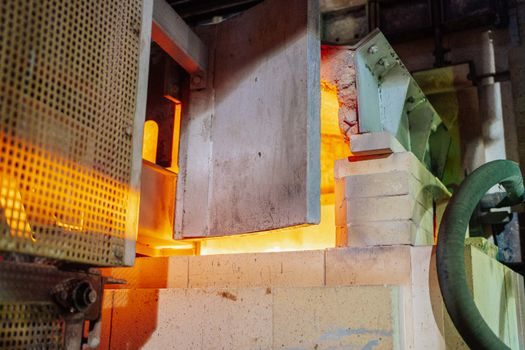
Andritz's metals-division product page for the aluminum industry explicitly lists preheat and reheat pushers, pit furnaces, car-bottom furnaces, auto-batch units and both fuel-fired and electric configurations as in-scope equipment, with a project-management and engineering team dedicated to retrofitting and rebuilding existing installations [S4]. The positioning is engineering-led: the OEM is selling furnace know-how and rebuild scope, not just refractory-lined shells, which is consistent with the 2026 capex pattern across primary and secondary smelters, where most capital is going into debottlenecking existing capacity rather than greenfield potlines.
For a foundry or extrusion house weighing furnace choices, the same engineering gate covers gas aluminum melting furnace conversions from fuel-fired to electric or hybrid firing, and a side-by-side economic cut against induction melting belongs in any 2026 sourcing memo — see the spec-driven comparison in Gas-Fired Aluminum Melting Furnace vs Induction: 2026 Spec Cut for Foundry Buyers for the per-tonne energy and refractory numbers. Buyers building a sizing case from scratch can start from the throughput and tonnage assumptions in Gas-Fired Aluminum Melting Furnace 2026 Buying Guide: Specs, Sourcing and Sizing.
Trade-fair calendar: ALUMINIUM Düsseldorf sets the biennial cadence
ALUMINIUM is the global flagship trade fair for the sector, held on a two-year cycle at a scale under 10,000 exhibitors, with the organizer explicitly running the international portfolio that includes ALUMINIUM China in Shanghai and ALUMINIUM USA in Nashville alongside the Düsseldorf parent event [S3]. The fairs are framed as full-stack showcases covering automotive, mechanical engineering, building and construction, aerospace, electronics, packaging and transport — the seven end-markets that drive the majority of 2026 aluminum demand [S3].
For a B2B buyer, the practical implication is that the Düsseldorf cycle is the only place where extrusion mills, container-house fabricators, furnace OEMs and downstream aluminum die casting machine builders are physically in the same hall. Buyers who cannot attend the parent show in Germany should still track the Shanghai and Nashville editions, because alloy and equipment launches tend to roll out across all three in the same 24-month window.
Comparison: 2026 aluminum supply channels on four decision criteria

Lining the three main procurement channels against four engineering criteria gives a structured decision frame: (1) Shandong audited extrusion mills at US$3,100–3,500/tonne, 1-tonne MOQ, with alloy and tolerance flexibility but no finished assembly [S1]; (2) Guangdong audited container-house fabricators at US$1,500–3,000/set, 1-set MOQ, bundling tube, skin and hardware into a modular building with proprietary geometry [S2]; (3) furnace-engineering rebuilds from Andritz covering preheat, pit, car-bottom, auto-batch, fuel-fired and electric units, scoped per project rather than per piece [S4]. On price-per-kilogram of metal, the extrusion mill is cheapest; on time-to-site for a usable structure, the container-house kit wins; on capex longevity and energy efficiency of an existing melt shop, the furnace rebuild route is the only option that touches thermal efficiency at all.
The risk profile also differs: extrusion mill orders carry alloy-cert and dimensional-tolerance risk, container-house kits carry frame-geometry and shipping-damage risk, and furnace rebuilds carry refractory-life and ramp-up risk. Buyers should map their requirement to one of these three risk envelopes rather than treating "aluminum supply" as a single category.
Limitations and failure modes B2B buyers should price in
The 2026-06-04 spot data is per-tonne MOQ, not per-piece, and the 400 USD/tonne spread between two Shandong audited suppliers [S1] is a real signal that alloy family, surface treatment and tolerance class are not normalized across listings. A buyer who treats the lower end of the range as a like-for-like benchmark against the upper end will mis-spec the order. Similarly, the container-house US$1,500–3,000/set range [S2] spans basic campshell and "modern luxury" units — a 2× spread inside one category that reflects finishing and MEP scope, not tube price.
On the furnace side, retrofit scope from [S4] is explicitly project-based, which means refractory life, burner type and electrical balance-of-plant are not standardized; a "fuel-fired" rebuild and an "electric" rebuild cannot be compared on sticker price alone. Comparable industry-wide capex signals — the 2026 steel casting demand split and the related alloy-buyer supply map in Steel Market 2026: Casting Demand, Sub-Segment Divergence and Sourcing Levers — are useful cross-checks for any buyer who is balancing aluminum tonnage against ferrous tonnage in the same spend envelope.
Trackable next nodes for 2026 H2: the next ALUMINIUM cycle window per the organizer's two-year cadence [S3]; the next Shandong extrusion-mill price refresh on Made-in-China (the 2026-06-04 snapshot [S1] is the baseline); and any post-Düsseldorf release of new aluminum alloy billet or aluminum die casting machine cell data from furnace-engineering rebuilds under the Andritz-style retrofit scope [S4].