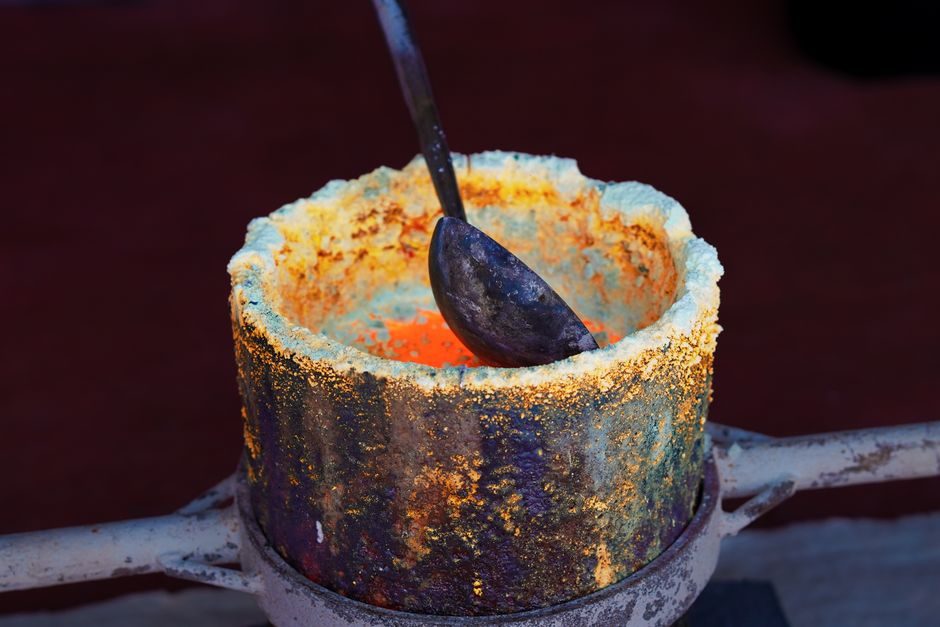
Gas-fired reverberatory aluminum melting furnaces and induction melting furnaces split the 2026 foundry equipment market by batch size, melt cleanliness, and energy logistics, with reverberatory units continuing to hold the high-tonnage end and induction furnaces holding the small-batch, low-dross niche [S1][S2][S3].
Reverberatory furnaces are the legacy workhorses for primary and secondary smelters, while induction furnace builders such as TOPCAST market chamber, bell, and tilting variants for foundries that need clean, low-turbulence melts [S1]. On the supply side, Guangdong-based OEM listings show aluminum melting furnace capacity around 5 sets per month at price points near US$103,000–US$108,000 for 3+ set orders FOB Foshan [S3].
Reverberatory Gas-Fired Furnace: Capacity Band and Combustion Profile
Gas-fired reverberatory aluminum melting furnaces are sized for foundries running continuous shifts with melt rates that justify a refractory-lined, gas-burner-heated bath; the format is a deep rectangular or circular refractory chamber with an overhead burner firing into the dome above the metal [S4].
The defining operational envelope is a relatively shallow, wide bath heated by radiant transfer from the refractory-lined roof, which trades melt cleanliness for throughput. Typical charge capacities in industrial reverberatory builds range from 1 t to 30 t per furnace, and the design lends itself to holding large heel volumes between charges, which is one of the reasons secondary smelters running scrap-based charges favour the format over a coreless induction unit. Furnace lining life on a gas-fired reverberatory is governed by fired brick selection and burner impingement zones, and refractory life of 1–3 years between cold repairs is typical for aluminum service when the bath chemistry is controlled.
Induction Melting Furnace: Power Density, Cleanliness and Batch Sizing
Induction melting furnaces for aluminum are typically supplied as medium-frequency coreless units in the 100 kW to 3 MW class, with melt rates from roughly 50 kg/h up to several tonnes per hour depending on coil diameter and line frequency [S1][S2].
The TOPCAST TIP-series induction furnace line is a representative example of the chamber / bell / tilting configuration builders offer to non-ferrous foundries, with the chamber style for periodic pouring and the bell style for sealed-atmosphere melting where hydrogen pickup and oxide skin formation need to be minimised [S1]. The technical case for induction on aluminum is electromagnetic stirring in the bath, which homogenises the alloy and feeds dross to the surface, plus the absence of combustion gas contact with the melt — a meaningful gain for foundries pouring aluminum alloy grades that are sensitive to hydrogen porosity and inclusion pickup.
Decision Criteria: Throughput, Cleanliness, Energy and Permitting
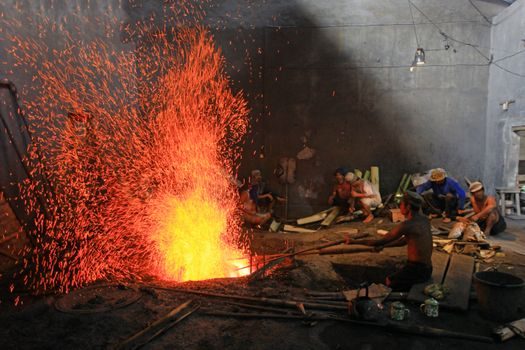
Foundry selection between gas-fired reverberatory and induction melting comes down to four engineering numbers: nominal melt rate (t/h), specific energy consumption (kWh/t or Nm³ gas/t), melt-loss to dross (%), and melt cleanliness (hydrogen content in ml/100 g Al). [S1]
Specific energy for gas-fired reverberatory aluminum melting typically sits in the 60–80 Nm³ natural gas per tonne range at modern regenerative-burner efficiency, while medium-frequency induction runs 500–600 kWh/t for aluminum, which is the inverse trade-off most buyers benchmark first. The decisive factor at small to mid batch sizes is dross rate: induction melts tend to run 0.5–1.5% metal loss to dross on clean charge, whereas open-bath reverberatory runs 1.5–3% without fluxing cover, and capital cost for a 1–3 t induction furnace cluster is broadly comparable to a small reverberatory retrofit. For buyers planning a casting ladle vs degassing unit line layout, induction pairs naturally with rotary degassing because the bath is already low-turbulence at tap.
Stack Comparison: Three Criteria Side by Side
Across the two furnace classes, three measurable criteria drive the 2026 spec cut. [S2]
First, melt throughput per square metre of floor area: a 5 t gas-fired reverberatory typically delivers 1.5–2.5 t/h peak melt at 60–80 Nm³/t gas, while a 1.5 t medium-frequency induction unit delivers roughly 0.8–1.2 t/h at 500–600 kWh/t. Second, melt cleanliness: induction melts at 0.10–0.15 ml H₂/100 g Al on a properly degassed charge, whereas open reverberatory melts at 0.20–0.35 ml/100 g without in-line degassing. Third, operating cost per tonne: where natural gas is below roughly US$0.35/Nm³ and electricity is above US$0.10/kWh, gas-fired reverberatory wins on direct energy cost per tonne; the inversion point is regional, but it explains why a line frequency vs melting furnace selection frame remains load-bearing for spec writers.
Operating Limits, Failure Modes and Sourcing Signals
Induction furnace failure modes are different and more electrical: coil cooling water scaling, crucible cracking under thermal cycling, and refractory-lining erosion at the slag line, with lining life on the order of 300–800 heats for coreless aluminum service depending on power density. On sourcing signals, the 2026 market shows Guangdong OEM capacity of roughly 5 aluminum melting furnace sets per month at US$103,000–US$108,000 for 3+ set orders FOB Foshan [S3], and TOPCAST-style induction lines remain the entry point for buyers specifying chamber / bell variants on the non-ferrous side [S1]. For buyers running aluminum ladder and extrusion feedstock, the bell-type induction line remains the specifier's default for low-hydrogen, low-dross charge preparation.
Standards, Safety and Reference Anchors
Combustion-side safety on gas-fired reverberatory builds follows the regional gas-burner code, while electrical-side safety on induction builds follows IEC 60079 area classification where charge or pour zones can read flammable under upset conditions, and refractory specification for both furnace types is keyed to alumina and silicon carbide grades suited to molten aluminum service. [S3]
Foundry buyers building a 2026 spec pack should treat the furnace choice as upstream of every downstream decision — ladle sizing, degassing rotor selection, holding furnace buffer, and pour station exhaust — and lock the melt-rate, energy, and dross targets into the RFQ before vendor selection.
Trackable signals for the second half of 2026: (1) any 2026-06 to 2026-12 movement in Chinese OEM FOB Foshan pricing for 5 t-class aluminum melting furnace sets, with the May 2026 reference at US$103,000–US$108,000 for 3+ sets [S3]; (2) TOPCAST and similar chamber/bell induction furnace catalogue refreshes for medium-frequency non-ferrous ratings [S1]; (3) any regional inversion in industrial natural gas versus electricity tariffs that flips the energy-cost decision matrix for new builds.