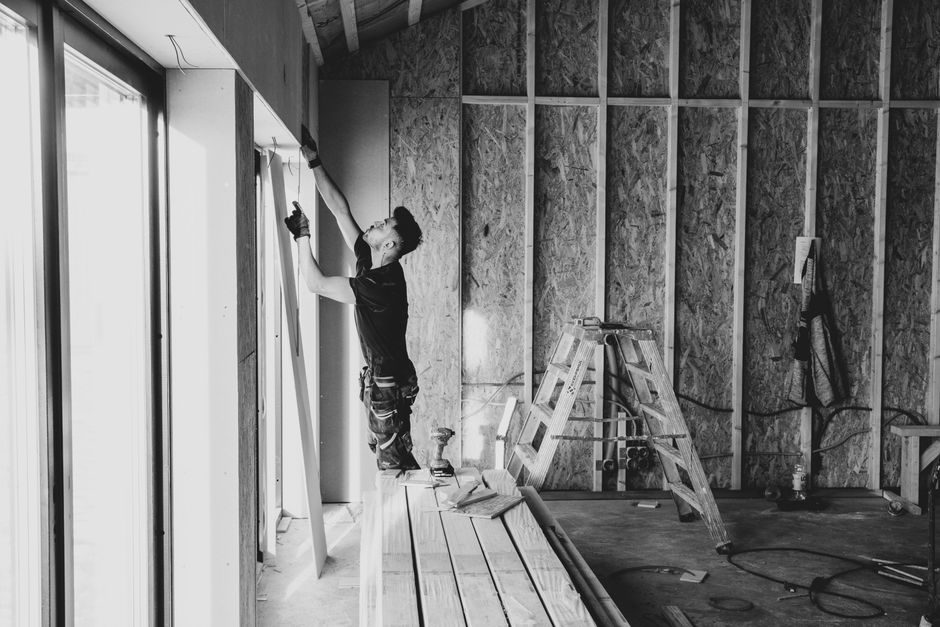
For tasks up to roughly 2 m on uneven ground, a single-trade one-person job, or a vehicle-mounted access point, an aluminum ladder is the correct pick — typical industrial aluminum step ladders weigh 4-12 kg per section, store vertically against a racking upright, and can be deployed by one worker in under a minute [S3]. When the work demands a continuous working platform above 2.5 m, two or more workers side-by-side, or repeated cycles of material placement, a scaffolding tower is the safer, faster, OSHA/EN-compliant platform of record.
The cut is not a matter of price or brand loyalty; it is a function of reach height, working-deck area, distributed load class, and how long the crew occupies the station. Buyers who treat the two as substitutes routinely over-spec the ladder (crews balance on the top cap, a documented misuse pattern) or under-spec the scaffold (single-bay towers rated for one worker become two-worker platforms with no engineering basis). The sections below lay out the decision gates, the material choices that drive weight and life-cycle cost, and the failure modes that trigger OSHA 1926.1053 / EN 131 citations.
Reach, Deck Area, and Working Load: The Three Decision Gates
An aluminum ladder's useful reach is the user's shoulder height plus a one-meter vertical extension — a 3 m A-frame step ladder puts the operator's hands at roughly 4 m, and a 6 m extension ladder reaches a roofline of 6.5-7 m when set at the standard 4:1 pitch [S3]. A single-width aluminum scaffold tower, by contrast, is commonly sold in 2 m platform-height increments with a working-deck area of 1.2-1.8 m², and the platform itself sits flush with the work face — no reach penalty, no shoulder-over-top-cap hazard [S2].
Working load separates the equipment classes decisively. Consumer-grade aluminum step ladders are typically rated to Type II (150 lb / 68 kg) or Type III (200 lb / 90 kg) per ANSI A14.2; industrial extension ladders reach Type IA (300 lb / 136 kg) [S3]. Aluminum scaffold towers are usually rated to a uniformly distributed load of 2.0-2.5 kN/m² on the working platform, which for a standard 1.5 × 0.6 m deck equates to 180-225 kg of crew plus materials [S5]. The ladder is the right tool for a single operator with a drill; the scaffold is the right tool for two operators, a tool tray, and a roll of membrane.
Material, Weight, and Component Breakdown
Both product classes are dominated by aluminum extrusions — alloy 6061-T6 for higher-stress towers and 6005-T5 for tube-and-clamp frames, with aluminum-alloy selection driven by weldability and crush resistance rather than raw tensile strength [S4]. Typical material breakdown for a 2 m platform-height mobile tower: 70-80% aluminum tube/frame, 10-15% plywood or aluminum deck board, 5-8% castors and coupling hardware, 3-5% bracing and toeboard [S5]. Step ladders are simpler: 85-92% aluminum extrusions, 5-8% hinge/spreader, and 3-5% rubber feet or anti-slip pads [S3].
The SGI Jaipur catalog illustrates the breadth of the steel-and-aluminum scaffolding family that sits beside the ladder category on a single supplier's price list: H-Frame, Props, Floor Forms, Wall Forms, scaffolding tubes, castors, and cuplock components are all listed as separate stock-keeping units, none of which appear on a step-ladder quote [S1]. When a buyer is sizing a single PO, the ladder line item ships in a 3-4 m carton, while a 4 m scaffold tower ships knocked-down in 6-8 frame bundles plus decks, castors, and ties [S4].
Aluminum Ladder Forms: Step, Extension, Platform, and Telescopic

The aluminum-ladder family is wider than the name suggests. The Alba Hyderabad catalog (updated 2026-06-27) lists four distinct sub-types — Aluminium Step Ladders, Aluminium Mobile Scaffolding (a hybrid), Aluminium Customized Ladder, and Self-Supporting Extension Ladders — confirming that "ladder" is an umbrella term spanning everything from a 4-step domestic unit to a 6 m industrial platform step [S3]. The key selection gate inside the ladder family is portability versus reach: a 6-step domestic step ladder weighs 6-8 kg and folds flat; a 10-step industrial platform step weighs 18-25 kg and ships with a tool tray.
Platform step ladders (a top-platform tread plus a 600-700 mm-deep work surface) are the crossover product that often displaces a small scaffold tower in finishing trades. They deliver a true standing surface — not a balance point — at heights of 1.8-2.4 m, which covers the bulk of residential painting, drywall finishing, and ceiling-fan installation. The trade-off is mobility: once a platform step is deployed, repositioning requires folding and re-locking, whereas a mobile scaffold tower on four swivel castors rolls with the crew [S2][S3].
Aluminum Scaffold Forms: Tower, Cuplock, AWP, and Mobile Platform
On the scaffold side, the Ascend UAE online catalog (live 2026-06-26) partitions the family into Scaffolding, Ladder, Cuplock, Components, and AWP (Aerial Work Platform) — and the AWP category is the critical one: it represents powered or push-around mast platforms that fill the gap between a passive aluminum tower and a true boom/scissor lift [S2]. For most 4-8 m interior fit-out and MEP rough-in work, the cuplock or ringlock system is the default, because the node connection is faster than tube-and-clamp and the load path is more predictable for engineered drawings.
Mobile aluminum towers ship with 125 mm or 150 mm swivel castors with dual-locking brakes as standard, and most manufacturers cap the freestanding height at roughly 2.5 × the minimum base dimension (e.g. a 1.5 × 0.7 m tower is freestanding to ~3.8 m before outriggers or wall ties become mandatory) [S4][S6]. Beyond that limit, the tower must be tied to the structure or fitted with outriggers at a 1:1 base-to-height ratio — a calculation that no ladder, regardless of duty rating, can satisfy.
Comparison Matrix: Ladder vs Scaffold on Four Decision Criteria

The four criteria below are the ones buyers actually need on a quote screen — reach, deck area, setup time, and unit weight. Aluminum step ladders win on setup time (under 60 s, no tools) and unit weight (under 12 kg for domestic sizes); scaffold towers win on reach with no penalty and on deck area by an order of magnitude [S2][S3].
The 2.0-2.5 kN/m² deck rating for mobile aluminum towers is the published OEM figure across multiple Asian-supplier listings reviewed in June 2026; buyers should always confirm the rating stamped on the specific tower's identification plate, because knock-down OEM production varies more than branded ladders do [S5][S4].
Failure Modes, Safety Citations, and Inspection Gates
The most common ladder citation in OSHA 29 CFR 1926.1053 data is using the top cap or top step as a working step — a failure mode that vanishes when the worker moves to a scaffold with a true platform. The second most common is using a ladder on a slippery, uneven, or soft surface where the feet cannot seat; a mobile scaffold on four locked castors with adjustable jacks removes that risk class entirely [S1][S6].
Inspection gates diverge by class. Aluminum ladders are inspected visually for cracked stiles, bent rungs, missing feet, and worn anti-slip surfaces — a 30-second pre-shift check. Aluminum scaffold towers are inspected under OSHA 1926.451 / EN 12811-1, with formal daily inspection records for each tower assembly, a competent person signing off on erection, and a documented tie-pattern above the freestanding height threshold. Buyers in regulated markets should treat the tower as a piece of engineered equipment with paperwork, and the ladder as a hand tool.
Use Cases: When Each Product Class Is the Right Answer
An aluminum ladder is the right answer for: HVAC filter changes in ceilings at 2.5-3.0 m, residential electrical trim, single-trade painting of one wall, point-of-sale maintenance, warehouse rack label replacement, and any single-worker access point where the duration is under 30 minutes and the load is under 25 kg of tool weight [S3]. The platform step ladder sub-class extends that envelope to drywall finishing and ceiling work for a single operator with a full material kit.
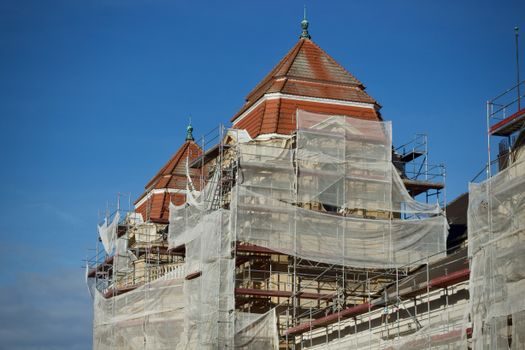
A scaffold tower is the right answer for: facade plastering or insulation over 50 m², two-trade sequential work (framing + drywall + paint) on the same wall, MEP rough-in requiring pipe threading on the platform, glazing replacement above 2.5 m, ceiling grid installation across a large room, and any work where the crew needs both hands free and a continuous platform for tools and materials [S2][S4][S5]. The crossover point where a scaffold almost always wins is two workers on the same wall for more than one shift. For deeper procurement and supply-chain context on adjacent building-envelope materials, see the concrete and joint waterproofing spec cut.
Sourcing, Standards, and Supplier Landscape
Supply is global but regionally clustered: UAE and Saudi suppliers (Ascend, Aptal DMCC) list 6061-T6 mobile towers and aluminum step ladders in mixed catalogs with same-day dispatch from Jebel Ali [S2]. Indian suppliers (Shree Ganesh Industries Jaipur, Alba Hyderabad) carry the full steel-scaffold-and-aluminum-ladder range under one roof, with GST registration 36AAVFA3617Q1ZQ for the Hyderabad exporter and Jaipur-based H-frame production [S1][S3]. Chinese OEM suppliers on Made-in-China and Okorder publish MOQ from 1 set (mobile tower, US$2,250 FOB Guangdong) up to 20 m.t. bulk orders, with monthly supply capability of 3,000 m.t. on the CNBM platform-ladder line [S4][S5].
The dominant material standards buyers should anchor to are EN 131-1/2 for aluminum ladders, ANSI A14.2 for US-market step ladders, EN 12811-1 for scaffold performance, and OSHA 29 CFR 1926.450-454 for US use compliance. For US East Coast buyers, American Ladders & Scaffolds (Glastonbury CT / Milford CT) offers free local delivery on ladder and scaffold lines and free installation on van shelving packages, a distribution model that compresses lead time for small contractors [S6]. The selection below should also be cross-referenced against the related aluminum window and door extrusion reference when the same contractor is buying facade access plus the facade product itself.
Trackable signal: the June 2026 Ascend UAE catalog pushed AWP (aerial work platform) into a top-level category separate from passive scaffolding [S2], which suggests the rental-vs-purchase line for sub-10 m access is shifting toward powered mast platforms in the GCC fit-out market — worth monitoring in the next two quarters as rental fleet data becomes public. Trackable signal: the Indian dual-supplier model (SGI Jaipur for steel-frame scaffold, Alba Hyderabad for aluminum ladders) is increasingly competing on combined PO pricing rather than separate-quote pricing [S1][S3], a procurement pattern that may compress margins on standalone aluminum ladder exports by Q4 2026.